Posted on

Wilderness Therapy Programs

Wilderness therapy programs like the Mindfulness-Based Ecotherapy 12-week Program combine therapeutic elements with outdoor activities in a natural setting to help treat individuals with a range of needs including behavioral, emotional, psychological, and substance use issues.

In 2021, the Washington State Legislature directed The Washington State Institute for Public Policy (WSIPP) to conduct a research review of wilderness therapy programs related to behavioral health.

This report, the first in a two-part series, summarizes findings from their systematic literature review.

In the youth literature reviewed, wilderness therapy programs typically served adolescents aged 13 to 18 with behavioral, mental health, and/or substance use issues. Participants were usually enrolled in programs from one week to three months.

While enrolled, participants backpacked and organized camps, and learned outdoor skills like fire-making, meal prep, and navigation. Therapy sessions facilitated by mental health professionals or therapeutic elements like reflection and goal-setting were embedded into daily outdoor activities.

In the adult literature, wilderness therapy programs were typically provided to individuals ages 18 to 26 with behavioral, psychological, and/or substance use disorders. Adults tended to enroll in programs for shorter periods than adolescents (about 21 days on average). Adults participated in similar outdoor activities as youth.

The majority of studies examining wilderness therapy for youth and adult populations found that outcome measures improved post-treatment, compared to pretreatment. Typically, improvements were observed for outcomes like self-concept, behavior, and clinical measures of depression, anxiety, and PTSD. Other outcomes like resilience, substance use, and social development were also common in both bodies of literature.


https://www.wsipp.wa.gov/ReportFile/1748/Wsipp_Wilderness-Therapy-Programs-A-Systematic-Review-of-Research_Report.pdf

Posted on

Wise Mind

embodied mindfulness

Wise Mind is a concept often used in mindfulness-based ecotherapy. One of the skills we develop in the practice of mindfulness is the skill of acceptance. Acceptance allows us to experience emotions without feeling obligated to react to them. This is done by noting the emotion, and then letting go of the negative thought processes that the emotion generates.

We can benefit from mindfulness by learning to accept the flood of emotions that blocks rational thought. The goal of acceptance isn’t to become a totally rational person, devoid of emotion. Instead, the goal is to practice Wise Mind.

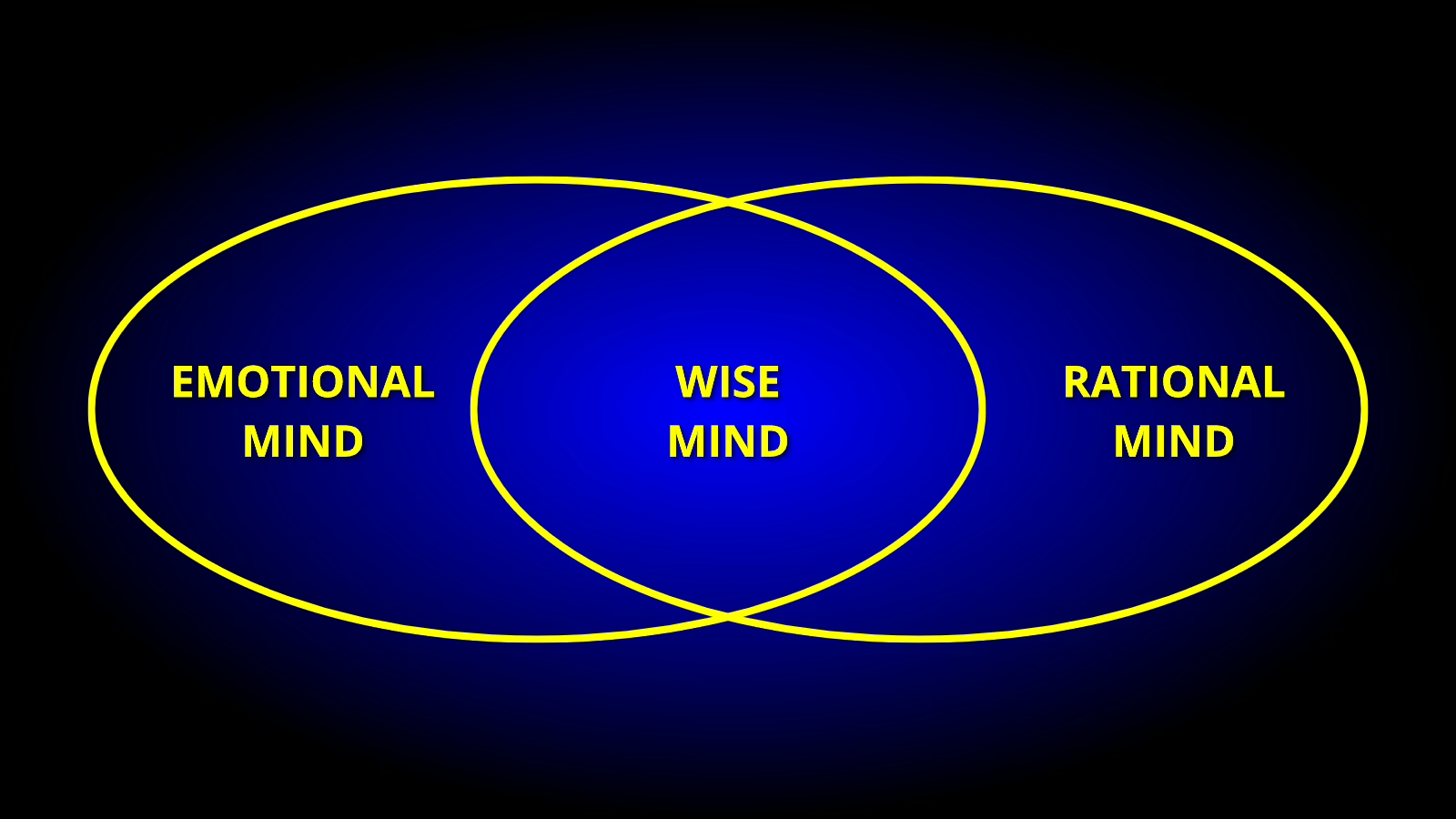
Wise Mind is the balance of emotional mind and rational mind, in perfect harmony.

To illustrate this concept, let’s suppose that a destitute woman has been arrested for stealing a loaf of bread with which to feed her hungry children. If we approach this situation from Rational Mind, we are only using logic and reason. There is no emotional content to our approach to the situation in Rational Mind. In this situation, Rational Mind would say that she broke the law, and there are penalties for breaking the law, therefore she should be punished.

Wise Mind, on the other hand, would allow logic and reason to be tempered with emotion. In this case, Wise Mind would allow some sense of compassion for the mother and her plight. While the woman in this scenario may have broken the law, she did so because she had love for her children and did not wish to see them go hungry. Wise Mind would recognize this and allow for some leniency.

On the other hand, what does Emotional Mind look like?

I’m sure we all know of someone who is subject to wild mood swings. Such a person is ruled by emotions that often run out of control. Imagine that this person is cut off in traffic. They may become very angry and chase down the offender, horn blaring and lights flashing. Perhaps this person even tries to run the offender off of the road.

In such a case, this person is being ruled by Emotional Mind. If this person could learn to live in Wise Mind, then he would realize that while the person who had cut him off in traffic had done something dangerous, it may not have been intentional. It could be that this person was distracted. Even if the person had done it intentionally, there is no need to increase the danger to himself by provoking further confrontation in an episode of road rage.

In this case, Wise Mind would accept the fact that such events are inevitable on a busy highway. Emotional Mind would then be tempered with Rational Mind, achieving the balance that is the goal of Wise Mind.

According to Follette, et al (2006), “”Wise mind is understood as a balance (or dialectic) between emotion mind and reasonable mind, where both emotion and reason are considered before taking action in life.”
This concept is often illustrated as below, where Wise Mind is the overlapping area between Rational Mind and Emotional Mind:

Wise Mind is where Rational Mind and Emotional Mind meet

In the clinical practice of Mindfulness, clients are taught the concepts of Rational Mind, Emotional Mind, and Wise Mind, and how to differentiate among these states.

Each state has its own usefulness; for example, Rational Mind might be good for solving math problems like balancing a checkbook, while Emotional Mind might be good for a romantic interlude. But there are also situations, such as those outlined above in which one mode of mind might not be as productive as another. In those cases, Rational Mind can be tempered with compassion from Emotional Mind, or Emotional Mind can be balanced with reason.

When using Mindfulness in clinical practice, it is helpful to teach clients the concepts of Rational Mind, Emotional Mind, and Wise Mind, then have them list examples of each in order to gain practice in differentiating among these states.


Follette, Victoria & Palm Reed, Kathleen & Pearson, Adria. (2006). Mindfulness and Trauma: Implications for Treatment. Journal of Rational-Emotive and Cognitive-Behavior Therapy. 24. 45-61. 10.1007/s10942-006-0025-2.

Posted on

Automatic Thinking

Learning to drive an automobile can be an overwhelming task. You have to focus on keeping the vehicle between the lines on the highway while watching for other cars, traffic signals and road signs. In addition to all of this, you must constantly glance at the speedometer to make sure that you are driving at a safe speed. You cannot look at the speedometer for too long because you must also concentrate on what may be happening on the highway. When learning to drive, you probably recited the ‘rules of the road’ to yourself over and over while driving (“Hands at two and ten,” “Watch out for animals and children running into the road,” etc.).

But as you gained knowledge and experience of driving, it became more and more of an automatic process. It may have become so automatic that now from time to time you make a routine drive without remembering anything about it. If you have ever let your mind wander and have missed an exit or a turn, then you are fully familiar with the process of automatization.

The process of automatization occurs in many areas of our lives. Just as the process of driving eventually becomes automatic, and can occur without our conscious awareness, so can thought and feeling processes become automatized.

If you have ever had a strong emotional reaction to a situation without knowing why, it is possible that one of your automatized emotional processes was activated (Moulds & Bryant, 2004).

Mindfulness is just the opposite of this automatic pilot experience. It is a way of paying close attention to your immediate experiences without getting lost in thought or shifting into automatic patterns of thinking or behaving. It is a shift from Doing Mode into Being Mode.

Doing Mode

Think about your morning routine. When you were in the shower this morning, were you actually ‘in’ the shower, or was your mind racing down the highway to your day-to-day errands? When you were there in the shower, were you feeling the warmth of the water on your skin, smelling the fragrance of the soap, and hearing the sound of the water, or was your mind elsewhere?

When we are preoccupied with thoughts of the past or the future, or with thoughts of getting things done, we are in Doing Mode. Doing Mode can also be expressed as Thinking Mode, because to get things done, we generally have to think about those things first. We make ‘to do’ lists in our minds and then do them in Doing Mode.

Thinking Mode takes us away from experiencing the world directly with our senses. When we leave Thinking Mode, and focus our awareness directly on the information provided by our senses, we have entered Sensing Mode.

Mindful Awareness teaches us to focus on the world experienced directly by our senses: touch, taste, smell, hearing, and sight. Experiencing life in sensing mode introduces us to a richer world. It’s impossible to be bored or apathetic if you treat each experience as if it is happening to you for the first time. Approaching each new situation without any assumptions or expectations is referred to as Beginner’s Mind, or sometimes as Child’s Mind.

Being Mode

Williams (2008) presents research that indicates the benefits of mindful states of being. Mindfulness is associated with decreases in levels of rumination (a process of becoming ‘trapped’ in negative thought cycles), avoidance (refusing to accept the reality of a given situation), perfectionism (attempts to control a situation), and maladaptive self-guides (attempting solutions that maintain the problem). Taken together, this reduction in negative thought and behavior patterns form what is known as Being Mode.

By focusing on the present moment, we leave Thinking Mode and enter into Sensing Mode.

In Sensing Mode, we simply allow ourselves to become fully aware of what is going on around us and within us, without attempting to control or manipulate these events and sensations. Being Mode reduces ruminations by allowing us to become aware of our thoughts and feelings as internal processes that we can choose to participate in, or choose to simply observe. In Being Mode we learn that we are not our thoughts.

In Western modes of thought, we are taught that our thoughts and feelings are our identities. Descartes said, “I think, therefore I am,” but does that mean that if you stop thinking, you cease to exist?

Being Mode allows us to detach from our cognitive and emotional processes and observe them, or stop them, if we so choose.

Being Mode reduces avoidance by allowing us to be in the present moment. If you are trying to avoid an unpleasant emotional state, you set up a cycle of denial. This denial creates anxiety and stress, which leads to more unpleasant emotional states to be avoided, which starts the avoidance cycle all over again. Being Mode allows us to participate in the unpleasant situation without internalizing it; i.e., without allowing the unpleasantness to become a part of our identity.

Perfectionism can be seen as a control mechanism. It is a displacement technique. If we feel out of control of certain areas of our lives, and we feel powerless to change those areas, we may displace our attention on the areas that we can control. By engaging in compulsive, perfectionist behaviors we assert our control over tangible areas as a substitute for areas over which we may feel we have no control. The idea of “perfection” becomes an obsessive means of anxiety management.

Being Mode allows us to realize that perfection is a subjective ideal. For example, if I asked you to describe your “perfect” day, you are likely to give me a totally different answer to that question than I would give if I were asked the same question.

Since our answers to the question, “What is your idea of the perfect day?” would not be identical, there is no objective definition to the word “perfect.” Being Mode helps one to realize that perfection is a self-defined concept.

In Being Mode we learn that every moment is perfect in and of itself, if we allow it to be.

Finally, Being Mode allows us to disengage from our own cognitive and emotional processes for a time. By doing so, we can become objective observers of our own inner states, without feeling that we must participate in them. Being Mode is a type of metacognition, or “thinking about thinking.” By observing the thoughts and feelings that have led to maladaptive consequences, we gain the ability to change those thought and feeling processes to lead to more productive conclusions.


Moulds, M. L. & Bryant, R. A. (2004). Automatic Versus Effortful Influences in the Processing of Traumatic Material in Acute Stress Disorder. Journal of Cognitive Therapy and Research, Vol. 28, No. 6, December 2004, pp. 805–817.

Williams, G. (2008). Mindfulness, Depression and Modes of Mind. Journal of Cognitive Therapy and Research, Vol. 32, No. 6, December, 2008. Pages 721-733.

Posted on

Mindful Moments – 7Cs of Family Resilience

All families encounter problems from time to time. When families go through a crisis, some fall apart, while others manage to “ride the storm out” and come through the other side relatively intact. Research has shown that families who manage to handle a crisis effectively all have certain characteristics in common. These characteristics are called resiliency factors. In this episode of Mindful Moments, we’ll discuss these resilience factors and the 7Cs of Family Resilience.

Posted on

Mindful Acceptance

One of the skills we develop in the practice of mindfulness is the skill of ‘acceptance.’ Acceptance allows us to experience emotions without feeling obligated to react to them. This is done by noting the emotion, and then letting go of the negative thought processes that the emotion generates.

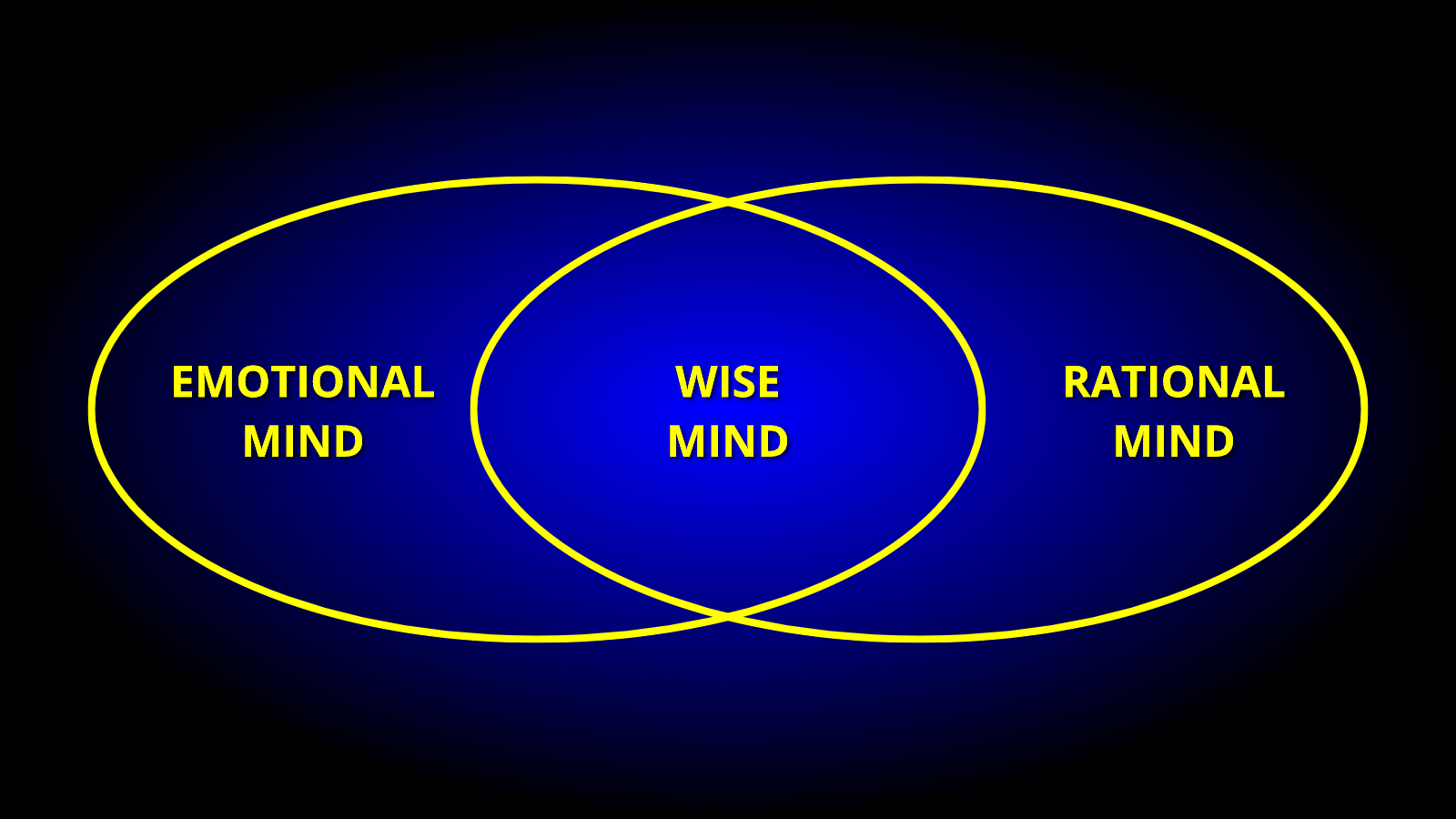
We can benefit from Mindfulness by learning to accept the flood of emotions that blocks rational thought. The goal of acceptance isn’t to become a totally rational person, devoid of emotion. Instead, the goal is to practice ‘Wise Mind.’ Wise Mind is the balance of emotional mind and rational mind, in perfect harmony.
To illustrate this concept, let’s suppose that a woman has been arrested for stealing a loaf of bread with which to feed her children. If we approach this situation from Rational Mind, we are only using logic and reason. There is no emotional content to our approach to the situation in Rational Mind. In this situation, Rational Mind would say that she broke the law, and there are penalties for breaking the law, therefore she should be punished.

Wise Mind, on the other hand, would allow logic and reason to be tempered with emotion. In this case, Wise Mind would allow some sense of compassion for the mother and her plight. While the woman in this scenario may have broken the law, she did so because she had love for her children and did not wish to see them go hungry. Wise Mind would recognize this and allow for some leniency.

I’m sure we all know of someone who is subject to wild mood swings. Such a person is ruled by emotions that often run out of control. Imagine that such a person is cut off in traffic. This person becomes very angry and chases down the offender, horn blaring and lights flashing. Perhaps this person even tries to run the offender off of the road. In such a case, this person is being ruled by Emotional Mind. If this person could learn to live in Wise Mind, then he would realize that while the person who had cut him off in traffic had done something dangerous, it may not have been intentional. It could be that this person was distracted. Even if the person had done it intentionally, there is no need to increase the danger to himself by provoking further confrontation in an episode of road rage. In this case, Wise Mind would accept the fact that such events are inevitable on a busy highway. Emotional Mind would then be tempered with Rational Mind, achieving the balance that is the goal of Wise Mind.

According to Follette, et al (2006), “Wise mind is understood as a balance (or dialectic) between emotion mind and reasonable mind, where both emotion and reason are considered before taking action in life.”
This concept is often illustrated as below, where Wise Mind is the overlapping area between Rational Mind and Emotional Mind:

Wise Mind is a balance between Emotional Mind and Rational Mind

In the clinical practice of Mindfulness, clients are taught the concepts of Rational Mind, Emotional Mind, and Wise Mind, and how to differentiate among these states. Each state has its own usefulness; for example, Rational Mind might be good for solving math problems like balancing a checkbook, while Emotional Mind might be good for a romantic interlude. But there are also situations, such as those outlined above in which one mode of mind might not be as productive as another. When using Mindfulness in clinical practice, it is helpful to teach clients the concepts of Rational Mind, Emotional Mind, and Wise Mind, then have them list examples of each in order to gain practice in differentiating among these states.


Follette, V., Palm, K. M. & Pearson, A. N. (2006). Mindfulness and Trauma: Implications for Treatment. Journal of Rational-Emotive & Cognitive-Behavior Therapy, Vol. 24, No. 1, Spring 2006.

Linehan, M.M. (1993). Cognitive Behavioral Treatment for Borderline Personality Disorder. New York : Guilford Press