
COURSES CURRENTLY OFFERED BY THE MINDFUL ECOTHERAPY CENTER
Table of Contents
The Mindful Ecotherapy Center, PLLC, and Dr. Charlton Hall offer a range of workbooks and textbooks that focus on integrating mindfulness and ecotherapy into clinical practice. These resources emphasize evidence-based approaches to combining mindfulness with nature-based therapies. Topics include mindfulness exercises, ecotherapeutic interventions, eco-art therapy, meditation, and techniques for enhancing mental health through a connection with nature.
Nature-Based Recovery with Mindfulness-Based Ecotherapy
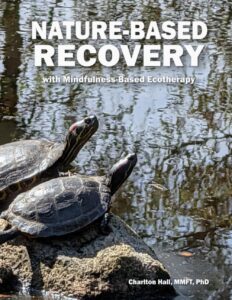
The problem with some recovery plans is that they focus on abstinence by telling you not to think about substance use. The problem with telling yourself not to think about it is that telling yourself not to think about it is thinking about it.
What if, instead of focusing on telling yourself not to use, recovery were something you did with the living world around you?
In Nature-Based Recovery with Mindfulness-Based Ecotherapy, Charlton Hall, MMFT, PhD, offers you a structured yet deeply experiential path for healing substance use and behavioral addictions through the restorative intelligence of nature. Drawing from mindfulness-based ecotherapy, trauma-informed practice, and systems thinking, this workbook invites you to step out of cycles of compulsion and into a lived experience of connection, awareness, and grounded change.
You are guided to notice how addiction is not an isolated behavior, but a pattern shaped by disconnection from your body, from others, from meaning, and from the natural world itself. Through carefully designed exercises, reflective prompts, and nature-based practices, you learn to rebuild those connections in ways that are tangible, embodied, and sustainable.
Rather than relying solely on willpower or abstinence-based thinking, you are invited to cultivate mindfulness as it shows up in real environments: walking outside, observing seasonal change, tracking internal states alongside ecological ones, and recognizing the reciprocal relationship between personal healing and environmental awareness.
Each chapter helps you develop practical skills for relapse prevention, emotional regulation, and values-based living while also restoring a sense of belonging within the wider ecological web.
This workbook is for you if you are seeking more than symptom management. If you are ready to understand recovery as reconnection with clarity, compassion, and grounded exercises, Charlton Hall offers a pathway where healing is not separate from nature but supported by it at every step.
ABOUT THE AUTHOR
Charlton Hall, MMFT, PhD, is a clinician, educator, and author with more than twenty years of experience specializing in the treatment of substance use disorders and co-occurring mental health conditions. His work integrates clinical rigor with experiential, nature-based approaches to healing, with a particular focus on mindfulness-based ecotherapy as a pathway for recovery and reconnection.
Dr. Hall is the founder and director of the Mindful Ecotherapy Center, an organization dedicated to advancing the integration of mindfulness practices and ecological awareness within mental health treatment. Through this work, he has developed innovative therapeutic models that emphasize the interconnection between personal healing, community wellbeing, and the natural world.
Over the course of his career, he has worked with diverse populations in both clinical and educational settings, helping people move beyond cycles of addiction, trauma, and disconnection toward sustained recovery and meaningful engagement with life. His approach is grounded in the belief that healing is not only an internal psychological process, but also a relational one extending to the environment and the broader web of life.
In addition to his clinical work, Dr. Hall is an author and trainer, developing resources and curricula that support therapists, counselors, and recovery professionals in applying mindfulness-based ecotherapy principles in their own practice. His writing and teaching emphasize practical tools, experiential learning, and accessible frameworks for integrating nature into recovery work.
He continues to live and work in the Pacific Northwest, where he draws ongoing inspiration from the natural landscapes that inform his clinical philosophy and professional practice.
Visit the Mindful Ecotherapy Center at www.mindfulecotherapy.org
Self-Care for Therapists: Addressing Burnout with Mindfulness-Based Ecotherapy

Self-Care for Therapists: Addressing Burnout with Mindfulness-Based Ecotherapy offers a compassionate, practical guide for mental health professionals who spend their lives caring for others and too often neglect their own well-being in the process. In this timely and deeply relevant book, Charlton Hall, MMFT, PhD, explores the realities of therapist burnout, compassion fatigue, emotional exhaustion, and reduced personal accomplishment, while offering a clear path toward restoration through the healing practices of mindfulness and ecotherapy.
Drawing on decades of clinical experience, teaching, and research, Hall introduces readers to Mindfulness-Based Ecotherapy, an integrative approach that combines evidence-informed mindfulness practices with the restorative power of the natural world. Through reflective exercises, clinical insights, and nature-based self-care practices, therapists will learn how to reconnect with themselves, regulate stress, strengthen boundaries, and cultivate resilience in both their personal and professional lives.
Rather than offering self-care as a vague ideal or afterthought, this book presents it as an ethical necessity for sustainable clinical practice. Hall shows how therapists can use mindful awareness, embodied presence, and intentional connection with nature to interrupt burnout cycles, restore emotional balance, and rediscover meaning in their work. Whether you are a seasoned clinician, a new therapist, or a graduate student preparing for the demands of the profession, Self-Care for Therapists provides a grounded and inspiring roadmap for caring for the caregiver.
Written by Charlton Hall, MMFT, PhD, Executive Director of the Mindful Ecotherapy Center, this book invites therapists to move beyond survival and into a more sustainable, connected, and life-giving way of practicing.
Mindfulness-Based Ecotherapy in Clinical Practice
This is the textbook for the Mindfulness-Based Ecotherapy in Clinical Practice online home study course.
NOTE: If you enroll in the course, there is no need to purchase this textbook, as a PDF copy is included with the course materials. If you are enrolled in the course, only purchase if you would like a hard copy of the textbook.
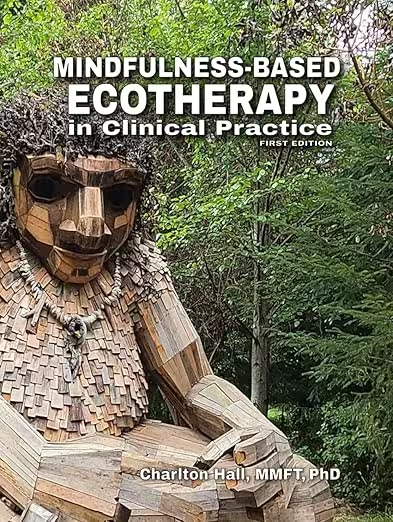
This textbook provides a comprehensive guide to Mindfulness-Based Ecotherapy that integrates mindfulness practices with nature-based therapy techniques, offering insights and practical tools for mental health professionals looking to enrich their therapeutic approaches with mindfulness and ecotherapy. Here is the step-by-step guide on how to effectively use this resource in your clinical practice.
Mindfulness-Based Ecotherapy (MBE) is a therapeutic approach that combines traditional mindfulness practices with ecotherapy, which involves interacting with nature to promote mental well-being. MBE is rooted in the principles of mindfulness, which is the practice of being fully present and aware of the moment without judgment, and ecotherapy, which is the therapeutic use of nature and outdoor settings as a context for healing and personal growth.
Each chapter contains information on the foundational concepts and theoretical underpinnings of MBE. Understanding the rationale behind combining mindfulness and ecotherapy will provide a solid base for integrating these practices into your own sessions.
Key topics covered in this text include the historical background of mindfulness and ecotherapy, and the historical background and theoretical framework for many of the techniques used in Mindfulness-Based Ecotherapy (MBE). We will also discuss the core principles of MBE and what the latest research says about the benefits of MBE.
Many of the chapters will look at the science behind nature’s impact on mental health, using evidence-based principles and citations to recent studies on the tools and techniques introduced in each chapter.
The textbook offers a variety of mindfulness and ecotherapy exercises that can be adapted for both individual and group therapy settings, and there is a chapter covering most of the major interventions and activities used in MBE.
The practice of MBE brings its own unique challenges and opportunities. There are detailed session plans and structures provided in the textbook to organize your therapy sessions. The book outlines various stages of MBE, from introductory sessions to advanced practices, ensuring a comprehensive approach. We will also review how to address some of the challenges unique to the practice of MBE.
MBE also has distinct ethical and practical considerations. This textbook will review and help you to understand the ethical and practical considerations involved in incorporating MBE into clinical practice. This includes maintaining professional boundaries, ensuring client safety during outdoor activities, and respecting the natural environment. We will also review some of the challenges to be overcome to maintain confidentiality even in outdoor settings, being mindful of potential interruptions or onlookers.
This text will also teach you how to conduct thorough risk assessments for outdoor activities and have contingency plans for adverse weather or other issues.
You will also learn how to promote environmental stewardship and encourage clients to engage with nature in a respectful and sustainable manner.
The Ecospirituality Workbook: Reconnecting to Nature, to Others, and to Self
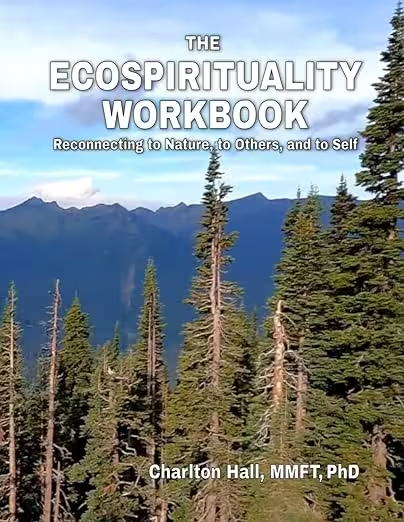
This is the official workbook for the Ecospirituality Program developed by Dr. Charlton Hall and the Mindful Ecotherapy Center. Ecospirituality focuses on achieving mindful states in nature. It is through these moments of connection that ecospirituality works its magic. There are twelve skills of ecospirituality. The first six skills are mindful. The remaining six skills are ecospirituality skills. The mindful skills are what you do to create space for change in your life, and the ecospirituality skills are how you create mindfulness in nature. Each session of the 12-week program covers one of these skills.
Session 1: Mindful Awareness
Mindful Awareness is a way of tuning in to what is happening right now, at this moment.
Session 2: Living in the Now
Living in the Now means allowing yourself to be in this moment, here and now.
Session 3: Letting Go
Ecospirituality teaches us how to let go of stress and anxiety through the power of mindful acceptance.
Session 4: Radical Acceptance
Acceptance teaches us that we are not our thoughts and that we are not our emotions. We are something different.
Session 5: Wise Mind and Wise Body
Wise Mind is the joining of Rational Mind and Emotional Mind in balance and harmony. When we can balance Rational Mind and Emotional Mind, we will achieve Wise Mind.
Session 6: Centering
Centering allows you to connect with your own True Self through ecospiritual exercises. The more centered you are, the more your perceived self and your True Self integrate and align.
Session 7: Connecting
Spirituality is all about connectedness. Ecospirituality can help you achieve personal spiritual growth through fostering a sense of connection to nature, to others, and to your own True Self.
Session 8: Nature as Metaphor
We all have personal stories called “my life.” The good news about the story of our lives is that we are the only authors. If we don’t like the way the story is going, we have the power to rewrite it at any time.
Session 9: Nature as Teacher
The lessons our ancestors learned about nature haven’t gone away. They’re still there, waiting in the forest like an open book. All we have to do is learn how to read it using Nature as Teacher.
Session 10: Nature as Nurture
When we allow nature to nurture us, we are healed. When we nurture the nature around us, we set up a reciprocal cycle of nurturing that allows us to become one with nature.
Session 11: Nature as Healer
Ecospirituality helps you to connect to the healing power of nature using evidence-based activities in natural environments. This skill allows you to accept the power of Nature as Healer.
Session 12: Living in True Self
The ultimate goal of the Ecospirituality program is to realize and acknowledge your True Self, and to live in it. Doing so allows you the opportunity to reconnect in positive ways with nature, with others, and with yourself. When you learn to do so, you will be living in your True Self as the person you were born to be.
The Mindfulness-Based Ecotherapy Workbook (2nd Edition)

This is the second edition of the Mindfulness-Based Ecotherapy Workbook. The original workbook was published in 2015, and the sciences of mindfulness and ecotherapy have advanced a great deal since that time. This second edition was updated to reflect this new research.
This edition, like its predecessor, was written to accompany the 12-week Mindfulness-Based Ecotherapy workshop series. Some of the exercises in this new edition have changed based on participant feedback regarding what is more helpful in facilitating nature experiences.
This new version of the handbook introduces the 12 skills of Mindfulness-Based Ecotherapy (MBE) and introduces one of these skills at each of the 12 sessions in the program.
Although this book is designed to accompany the 12-week Mindfulness-Based Ecotherapy workshop series, it may also be completed on your own at home. The experiential nature of the work allows anyone with access to outdoor spaces the opportunity to complete the series. If you are interested in participating in a workshop series near you, you can visit the directory of Mindfulness-Based Ecotherapy programs worldwide.
The Mindfulness-Based Ecotherapy Facilitator Manual (2nd Edition)

This Second Edition of the Facilitator Manual for the Mindfulness-Based Ecotherapy Program contains the complete text of the Mindfulness-Based Ecotherapy Workbook plus additional material on how to facilitate each session of the program. The Facilitator Manual also includes information on running a successful group, and the stages of group change and group dynamics. This manual is designed to help facilitators of the Mindfulness-Based Ecotherapy program successfully implement a workshop series.
The Mindfulness-Based Ecotherapy workshop series teaches you the 12 skills of Mindfulness-Based Ecotherapy (MBE) by introducing one of these skills at each of the 12 sessions in the program. The experiential nature of the work allows anyone with access to outdoor spaces the opportunity to complete the series on their own.
The Mindfulness-Based Ecotherapy Workbook allows you to embrace the healing power of nature in an experiential way.
Sandtray Eco-Art Therapy in Clinical Practice
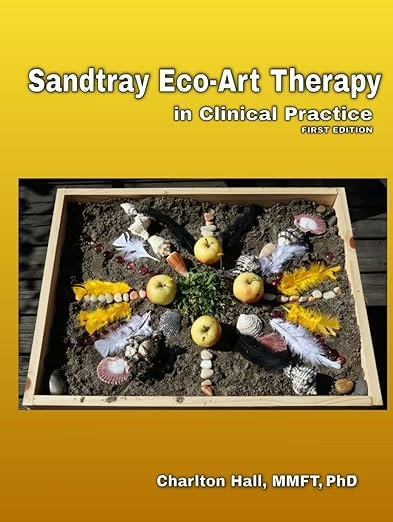
Sandtray Eco-Art Therapy in Clinical Practice offers a nature-based approach to therapy by combining the rich symbolism of sandtray therapy with the expressive, healing power of eco-art. This textbook introduces readers to a pioneering model that bridges two therapeutic methods, creating an innovative framework for clinicians working with individuals and groups facing various emotional, psychological, and behavioral challenges.
Rooted in mindfulness-based ecotherapy, this text emphasizes the role of nature in the healing process, helping clients reconnect with the environment and, in turn, with themselves. Sandtray Eco-Art Therapy (SEAT) blends the tactile, reflective process of sandtray therapy—where clients use miniatures to build symbolic worlds within a sandbox—with eco-art therapy, which invites clients to work with natural elements like leaves, stones, and wood in their artistic creations. This combination enhances therapeutic outcomes by fostering emotional expression, self-awareness, and grounding in the present moment.
The book offers clear, step-by-step instructions for integrating SEAT into your clinical practice, covering practical considerations for setting up a sandtray eco-art space, selecting materials, and structuring sessions to facilitate healing conversations. Through case studies, clinicians will gain insight into how SEAT can be applied to a variety of populations, including children, adolescents, and adults, helping clients navigate issues such as trauma, anxiety, grief, and relationship challenges.
Sandtray Eco-Art Therapy in Clinical Practice provides theoretical underpinnings that link SEAT to current trends in ecotherapy, expressive arts therapies, and mindfulness-based interventions. Readers will also find practical tips for tailoring SEAT to specific therapeutic goals, as well as methods for evaluating and documenting client progress.
Whether you are new to sandtray or eco-art therapy or are seeking to expand your existing toolkit with nature-based interventions, this textbook serves as a valuable resource. With a focus on creativity, environmental connection, and client-centered care, Sandtray Eco-Art Therapy in Clinical Practice offers a holistic path toward healing that integrates mind, body, and spirit. Perfect for therapists, counselors, social workers, and students, this text equips you with the knowledge and confidence to bring the benefits of nature and creativity into the clinical setting.
Ecoplay: Re-Introducing Your Children to Nature
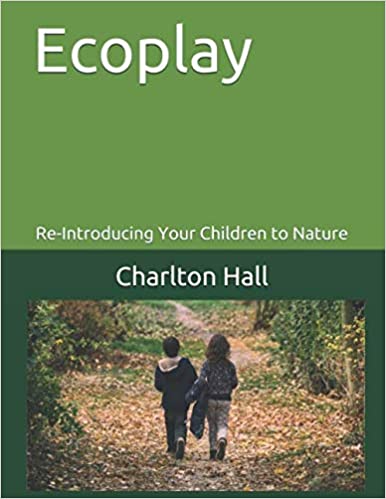
This workbook is the manual for the Ecoplay program.
Ecoplay is an evidence-based eight-session training program designed to give parents and their children the opportunity for experiential activities outdoors that combine mindfulness, ecopsychology, and the skills of positive parenting.
Ecoplay is an authoritative, rather than authoritarian, approach to discipline and parenting. It is a framework for guiding your child(ren) to reconnect to nature in healing ways.
Ecoplay trains parents to be nature-based play therapy facilitators for their own children. It is also a theoretical framework and approach to parenting that allows children to express themselves in play, their natural language.
Ecoplay allows this expressive play to happen in healthy natural outdoor environments.
Ecoplay Facilitator Manual
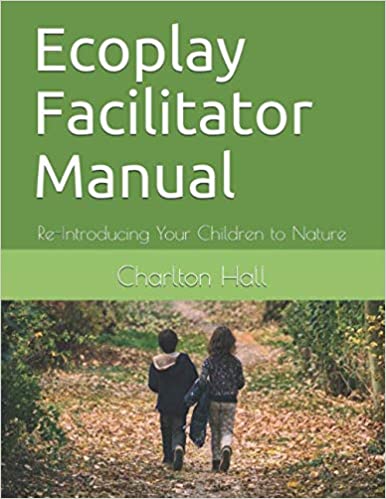
This is the Facilitator Manual for the Ecoplay: Re-Introducing Your Children to Nature workshop series. If you wish to conduct your own Ecoplay workshops, this manual contains the complete text of the Ecoplay: Re-Introducing Your Children to Nature workbook, plus helpful tips for facilitating each session of the program. It is a valuable tool for mental health professionals and play therapists interested in incorporating nature into their work.
Ecoplay is an evidence-based eight-session training program designed to give parents and their children the opportunity for experiential activities outdoors that combine mindfulness, ecopsychology, and the skills of positive parenting. Ecoplay is an authoritative, rather than authoritarian, approach to discipline and parenting.
It is a framework for guiding your child(ren) to reconnect to nature in healing ways.
Ecoplay trains parents to be nature-based play therapy facilitators for their own children. It is also a theoretical framework and approach to parenting that allows children to express themselves in play, their natural language.
Ecoplay allows this expressive play to happen in healthy, natural outdoor environments.
Spanking is Child Abuse

Are you ready to challenge the conventional wisdom surrounding physical violence in the name of “discipline?” In Spanking is Child Abuse, Dr. Charlton Hall dismantles the myths surrounding spanking and reveals the profound impact it has on child development. Grounded in extensive research and compelling evidence, this groundbreaking book explores how spanking is not just a discipline method but a harmful practice that can lead to a lifetime of psychological and behavioral issues.
Dr. Hall, a respected expert in child development, dives into the neurological consequences of spanking, exposing how it alters brain function and increases aggression in children. He discusses the intergenerational transmission of violence, illustrating how children who are spanked are more likely to become aggressive adults, perpetuating a cycle of abuse.
Through extensive research and thorough analysis, Dr. Hall emphasizes the importance of understanding the lasting effects of corporal punishment on emotional and social well-being. He advocates for effective, non-violent disciplinary strategies that foster healthy relationships between parents and children.
Join the conversation on child welfare and empower yourself with the knowledge needed to make informed parenting choices. Spanking is Child Abuse is a call to action for parents, educators, and policymakers to reconsider the role of physical punishment in child-rearing.
Get your copy today and take a stand against corporal punishment. Together, we can create a safer, healthier environment for our children to thrive!
Available now on Amazon and at major bookstores.
ABOUT THE AUTHOR
Charlton Hall, MMFT, PhD, is the author of multiple books on using mindfulness and ecotherapy to facilitate change within families and individuals, and he has presented research throughout the world at conferences and seminars on this and other topics. In 2020, Dr. Hall retired from his position as Chair of Behavioral Health at a major medical center to serve full-time as the Executive Director of the Mindful Ecotherapy Center, PLLC in Tacoma, Washington.
Meditative Music
Mindful Ecotherapy Center on YouTube
Subscribe to the Mindful Ecotherapy Center’s YouTube channel to bring peace, presence, and healing into your daily life. Our videos guide you through mindfulness-based ecotherapy practices, including forest bathing, tree planting rituals, nature meditations, and reflective exercises for grief, stress, and emotional well-being.
Whether you’re seeking to reconnect with the natural world, cultivate inner calm, or find restorative tools for personal growth, our content offers practical guidance, inspiration, and community support. Join us to explore the transformative power of nature and mindfulness, and start your journey toward balance, resilience, and deeper connection today!
Share Your Thoughts!
What do you think? Share your thoughts in the comments below! And don’t forget to subscribe to our newsletter!