
Posted on

Mindfulness – The River

thought streams the river

Our thoughts and feelings are a river.

What does this river look like?

As we’ve discussed often, mindfulness means paying attention to the present moment, with intention. There are six skills involved in mindfulness. These are:

  1. Observing
  2. Describing
  3. Participating
  4. Being non-judgmental
  5. Being one-mindful
  6. Being effective

Would these skills help you to recognize that your emotional states are simply processes of the mind? Would these skills help you to identify any addictive processes that lead to emotional aggression on your part?

It may help to realize that your thoughts and feelings are like a river. The goal of mindfulness is not to dam up the river and stop its flow. The river is always flowing. Sometimes negative thoughts and feelings float to the top of that river. Sometimes positive thoughts and feelings float to the top of that river. If you find yourself in a period where those negative thoughts and feelings are floating to the top, you have a choice. You don’t have to drown in the river. You can choose to get out of the river, sit on the riverbank, and watch if flow by. When you choose to get out of the river, you’re not stopping the flow of the river. You’re just choosing for a time not to ‘go with the flow’ if the flow is negative. The choice is always yours.

One goal of mindfulness is to realize that we are not our thoughts. We are not our feelings. We are something else. We can choose to identify with our thoughts and feelings, but we can also choose not to identify with negative thoughts and feelings. In doing so we come to realize that we are not bad people. We’re just people who sometimes may have less productive thoughts and feelings. We’re not angry people. We’re just people who sometimes may let our anger get the better of us. We’re not sad, anxious or depressed people. We’re just people who sometimes experience sadness, anxiety, or depression.

The River of Perfection

Sometimes emotional aggression is the result of feeling the need to be ‘perfect’ all of the time. People who have problems with emotional regulation are obviously passionate people. We feel strongly about things and people we believe in. Sometimes that passion can manifest in perfectionism. But what does ‘perfect’ really mean?

Try this sometime: Ask three of your closest friends what their idea of the ‘perfect’ day would be. I’m willing to bet that you’d get three different answers. Some people might think that a perfect day would be spent at the beach, while others might think that a perfect day would be spent hiking in the mountains. Still others might consider a day in a library or bookstore to be the perfect day.

The point here is that if different people have different definitions of what ‘perfect’ means, there can be no objective definition to the word ‘perfect.’ If there is no objective definition to the word, then each individual defines perfection for themselves. If you find yourself defining ‘perfect’ in such a way that perfection becomes impossible to achieve, then you have a choice. You may choose to redefine it in such a way that it becomes possible to achieve. You may also choose not to feel guilty or inadequate if you are unable to meet your own self-defined standards of perfection.

The tools and skills of mindfulness help us to understand that we don’t have to meet some arbitrary standard of perfection. Mindfulness teaches us self-awareness, and with self-awareness comes the realization that we are “perfect” just as we are. Until we come to that realization, change is not possible.

Mindfulness helps us to come to that awareness.

Posted on

Acceptance vs. Change


“God grant me the serenity to accept the things I cannot change; courage to change the things I can; and wisdom to know the difference.”

-The Serenity Prayer of Reinhold Niebuhr

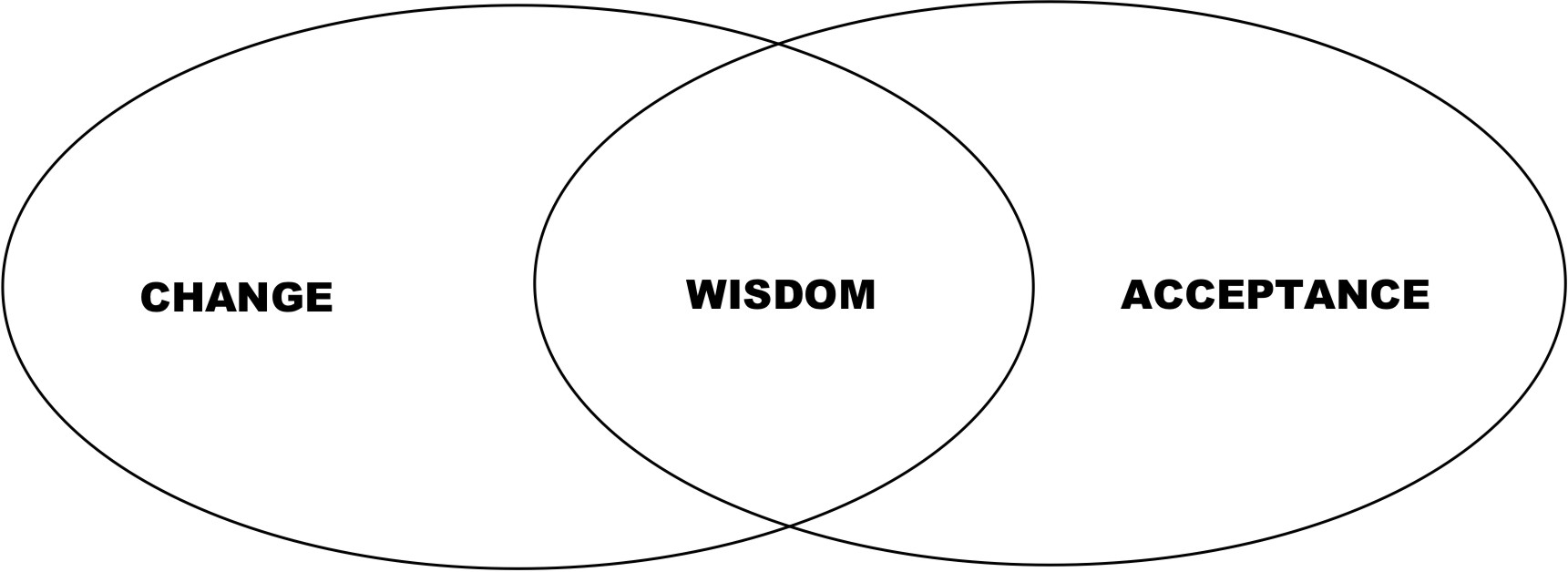
Many of us are familiar with the Serenity Prayer. It deals with the dialectic of Acceptance vs. Change. This dialectic may be illustrated as follows:


One of the skills we develop in the practice of mindfulness is the skill of acceptance. Acceptance allows us to experience emotions and thoughts without feeling obligated to react to them. This is done by noting the emotion or thought, and then letting go of the thought and feeling processes that the emotion generates. Acceptance teaches us that thoughts and feelings are not facts. They are simply processes of the mind.

Mindful awareness teaches us the art of acceptance. Emotional reactions to our circumstances are natural, but that doesn’t mean that we have to respond to these emotions. The mindful skill of acceptance teaches us that we can experience these emotions without engaging in cycles of behavior, thought or feeling that lead us to negative consequences. Acceptance teaches us that we are not our thoughts, and that we are not our emotions. At any time we can choose which thoughts and emotions we wish to respond to, and which to let go of.

“Never underestimate your power to change yourself; never overestimate your power to change others.”

-H. Jackson Brown, Jr.

Some things in life that cause us stress, anxiety and depression are things we can change. Others are things we cannot change, but must learn to accept. As Niebuhr reminds us, true wisdom lies in knowing the difference between the two. In Being Mode, we come to recognize the fact that true happiness can only come from within. There’s good news and bad news with this realization. The bad news is that nobody can change your life circumstances but you. The good news is that nobody can change your life circumstances but you.
Mindful Acceptance includes, among other things, the idea that you can only change yourself. If your problems involve other people, then you can only accept that they are who they are. You cannot change anyone but yourself.

The art of Mindful Acceptance can best be described as the Art of Letting Go. Once you have done everything in your power to solve a problem, you have done all you can, so at that point worry and stress is counterproductive.

Note that letting go of the stress and anxiety doesn’t necessarily mean letting go of the problem itself. For example, suppose you have a car payment coming up, and you don’t have the money to pay it. This would naturally cause you anxiety. If, after brainstorming for solutions, you find that you still don’t have the money to pay the car payment, then at that point you’ve done all you can do. So at that point, you let go of the anxiety associated with the problem.

That doesn’t mean that you let go of car payments altogether. You’ll make the payment when you can. In this instance, letting go just means that you won’t worry about not being able to make the payment. The energy you might have used worrying about the situation could be put to better use in trying to come up with solutions.

Let’s try another example, this one a bit tougher. Imagine you’re in a relationship. You feel that your partner doesn’t spend enough time with you. You offer suggestions on activities you can do together, only to be met with a blank stare or excuses about why your partner doesn’t have the time to participate in an activity with you.

Once you’ve done everything you can do to persuade your partner to spend more time with you, if you still aren’t getting the results you want, it’s time to practice letting go. This doesn’t necessarily mean that you let go of your partner. It just means that you let go of the anxiety associated with the problem. Once you let go of that anxiety, you may find that your partner will actually want to spend more time with you, because you are less stressed-out. But even if this is not the case, you’ve let go of the stress associated with an emotionally distant partner.

Mindful Acceptance is looking at the thoughts and feelings that cause you anxiety, worry, or stress. As you examine these thoughts, ask yourself which of these thoughts concern things you have the power to change. Make a conscious decision to focus your energy only on those things in your life that you have the power to change. If you focus on those things that you cannot change, you are not using your energy to change the things that you can.

Decide right now that you will not feed your negative thoughts by giving in to them. Realize that it is natural to have negative thoughts, but having those thoughts does not mean that they have to control your life. Learn trust your own inner wisdom. While negative thoughts may come, you do not have to let them rule your life.

Another key to Mindful Acceptance is to understand that anxiety has a useful purpose. It is nature’s way of letting us know that there is something wrong. Your anxiety protects you from harm, but sometimes it may do its job too well. Ask your anxiety if it is trying to protect you from something that you cannot change. Picture yourself thanking your anxiety for protecting you, and say to your anxiety, “I am now using my own inner wisdom to make positive choices in my life.”

Mindful Acceptance teaches us that each mistake is an opportunity for growth. Each mistake contains a lesson. If you never made a mistake, you would never have an opportunity to learn and grow. In Mindful Acceptance, you learn to accept your mistakes as signs that you are becoming a stronger and wiser individual.


Segal, Z. V., Williams, J. M. G., & Teasdale, J. D. (2002). Mindfulness-based cognitive therapy for depression: A new approach for preventing relapse. New York: Guilford Press.

Posted on

Being Effective

Mindfulness is the art of being effective. This simply means doing more of what works and less of what doesn’t work.

As you continue to hone your ability to focus only on one thing at a time, this skill can be extended to problem-solving. When you become mindfully aware of a problem with the idea of solving it, you have focused your intention on the solution rather than on the problem. You can talk about a problem all day, but in the end, talking about a problem does nothing to help solve it. Only by focusing your intention on solutions will the problem get solved.

In Mindfulness we speak of the power of intention. This means that we choose every act deliberately and purposefully, focusing our awareness on each task with intention. When using the power of intention, we never wander about aimlessly, driven by the winds of whim and fortune. Every act is deliberate. Every act is intentional. This is the power of intention.

Once there was a sculptor who was famous for his carvings of animals. Of all the animals he carved, his elephants were the most lifelike and inspiring. One day an art student came to him and asked him the secret to creating such beautiful elephants.

“The answer,” the artist replied, “Is simple. You just get a block of marble and chip away anything that doesn’t look like an elephant.”

When difficulties arise in life, it’s usually because we’ve set out to carve an elephant, but we suddenly find ourselves carving a bear or a donkey or some other animal instead. When this happens, we’ve gotten caught up in the details of living, and we have lost sight of our original goal, the elephant.

You may talk about the problem for as long you wish, but simply talking about the problem doesn’t do anything to actually solve the problem. If your intention is to have a happy, healthy life and happy, healthy relationships, then anything that doesn’t promote these ideals is irrelevant. It’s just marble to be carved away. If you find yourself constantly discussing problems, and never reaching resolution, ask yourself, “What is my intention?” or perhaps, “Is this the elephant I’m trying to carve, or is it just excess marble?”

Mindfulness-Based Cognitive Therapy (MBCT) was developed by Segal, Williams and Teasdale (2002) as a method of treating clinical depression and for preventing relapse. There are eight sessions in the usual MBCT intervention:

  1. Automatic pilot and mindfulness
  2. Dealing with barriers and pleasant events
  3. Mindfulness of the breath
  4. Staying present
  5. Allowing and letting be
  6. Thoughts are not facts
  7. How can I best take care of myself?
  8. Using what has been learned to deal with future moods

In the first session, students are taught how to switch from “automatic pilot mode” or habitual mode, to intentional mode. Intentional mode involves moving from a ruminative mode to a mindful mode. Rumination in this sense refers to the tendency to engage in automatic patterns of thought, feeling and experience that lead to a recurrence of depressive symptoms.

These automatic patterns are driven by memory; i.e., they are learned responses to certain stimuli. By harnessing the power of intention, the practitioner of MBCT moves from this automatic ruminative state to an intentional, purposeful mindful state. Intentionality involves metacognition (thinking about thinking). By becoming a conscious observer of these automatic states, the student learns that these automatic thought processes are simply thoughts. They are not destiny, nor or they identity. My acting intentionally to step outside of oneself and simply observe and describe these automatic thoughts and feelings, practitioners learn that they have control over these internal states.

By using the power of intention to move from Thinking Mode to Sensing Mode, the student learns to view unwanted or difficult thoughts and feelings as passing mental events, and not as permanent characteristics. If the student can intentionally “ride out the wave” of depression or anxiety, then he/she will learn that “this too shall pass.”


Williams JM, Russell I, Russell D. Mindfulness-based cognitive therapy: further issues in current evidence and future research. J Consult Clin Psychol. 2008 Jun;76(3):524-9. doi: 10.1037/0022-006X.76.3.524. PMID: 18540746; PMCID: PMC2834575.

Posted on

Fully Participating

Fully participating can be described as a state in which we are in the present moment, devoid of thoughts or anxiety about the past or the future. Fully participating is most closely associated with Baer’s “act with awareness” factor of the Five Factor Model of Mindfulness. To participate fully in any activity is to be aware in every moment, and to act out of that state of awareness, with purpose and intention.

Mindful awareness allows you to experience every aspect of an activity. We have a tendency, when in thinking mode, to see things and activities as either “all bad” or “all good.” This is not necessarily an accurate depiction of reality. In reality, there is a little good in most bad things, and a little bad in most good things.

In Mark Twain’s book, The Adventures of Tom Sawyer, Tom gets his friends to help him whitewash a fence by convincing them that fence painting is one of the most fun and enjoyable activities in the world. There is an element of truth in Tom’s deception. Most activities aren’t inherently good or bad. We’ve taught ourselves to think of them in such terms, but we can also teach ourselves a different way.

Think about an unpleasant activity that you have to engage in on a regular basis, such as washing the dishes or taking out the trash. Can you think of any pleasant aspects of these activities? For example, the last time I hand-washed dishes, I found myself fascinated by the bubbles in the sink. I watched the way the light played across them, generating myriads of rainbows that danced and moved across the surface of the bubbles. I was so entertained by this, that I was done with the dishes before I knew it.

There are enjoyable aspects to every experience, if we train ourselves to look for them. Even if we find ourselves caught in an activity in which we can find no pleasure at all, at least we have the pleasure of thinking about how good we’ll feel when the activity is over!

Mindful Awareness teaches us the art of acceptance. Emotional reactions to our circumstances are natural, but that doesn’t mean that we have to respond to these emotions. The mindful skill of acceptance teaches us that we can experience these emotions without engaging in cycles of behavior that lead us to negative consequences. Acceptance teaches us that we are not our thoughts, and that we are not our emotions. At any time we can choose which thoughts and emotions we wish to respond to.

If, at any time, we should engage in thoughts and behaviors that lead to negative consequences, this does not mean that we have become bad persons. This simply means that we are human beings, and as humans we are entitled to make mistakes. Each mistake is an opportunity for growth and learning. Forgiveness is a skill and an art. The place to start with learning the art of forgiveness is in learning first to forgive ourselves when we make mistakes.

Clients with chronic pain issues can benefit from the art of fully participating by realizing that the pain is not something alien, but a part of their daily experience. Instead of fighting the pain, they learn to accept it. A result of this acceptance is that their perception of the pain lessens because they are no longer fighting it. By fully participating in each moment, chronic pain sufferers get back a part of their lives that the pain had taken away (Isenberg, 2009).

Fully participating can also help clients with chronic anxiety problems, stress or depression. By learning to accept the depression or anxiety, clients lean not to fight the problem. By not fighting the anxiety or depression, we avoid setting up the self-perpetuating cycle of avoidance and anxiety enhancement. If the client learns not to try to avoid depression and anxiety, and instead accepts it openly, then there is nothing to fight against, and the downward spiral stops before it begins.

Fully participating can also be very useful to therapists. Grepmair, et al (2007) found that therapists who practiced Zen meditation themselves actually had better success rates with their clients than therapists who did not practice meditation.

One potential explanation for this is that those who practice mindful meditation have developed their capacity to fully participate. By being able to fully participate in what the client may be telling them in a given session, they are better able to offer solutions.

The more the therapist is able to participate in a given session, the more validated the client feels. If you’ve ever experienced a therapist who kept glancing at the clock during a session, you know what an invalidating experience that can be. By learning to fully participate in each session, a therapist or counselor strengthens the client/clinician bond and enhances the chance of success for an intervention.


Grepmair, Ludwig & Mitterlehner, Ferdinand & Loew, Thomas & Bachler, Egon & Rother, Wolfhardt & Nickel, Marius. (2007). Promoting Mindfulness in Psychotherapists in Training Influences the Treatment Results of Their Patients: A Randomized, Double-Blind, Controlled Study. Psychotherapy and psychosomatics. 76. 332-8. 10.1159/000107560.

Isenberg, Sarina & Maragh-Bass, Allysha & Ridgeway, Kathleen & MPH, Mary & Knowlton, Amy. (2017). A qualitative exploration of chronic pain and opioid treatment among HIV patients with drug use disorders. Journal of opioid management. 13. 5. 10.5055/jom.2017.0363.

Ortet G, Pinazo D, Walker D, Gallego S, Mezquita L, Ibáñez MI. Personality and nonjudging make you happier: Contribution of the Five-Factor Model, mindfulness facets and a mindfulness intervention to subjective well-being. PLoS One. 2020 Feb 4;15(2):e0228655. doi: 10.1371/journal.pone.0228655. PMID: 32017791; PMCID: PMC6999907.

Posted on

Mindful Describing

apples on a tree

“Whatever you are doing, ask yourself, ‘What’s the state of my mind?’”
– Dalai Lama, 1999

Mindful describing is a skill of mindfulness. Baer et al (2006) described five factors associated with mindfulness. These factors are: observe, describe, act with awareness, non-judge and non-react. These five factors can be measured by several instruments, and have been shown to be good predictors of psychological symptoms and/or psychological resilience. While these five factors are interrelated, they are also distinct and separate domains. For example, the skill of observing is separate from the skill of describing, but one cannot describe without first observing, therefore these skills overlap to some degree. Taken together, these five factors, or skills, constitute a state of mindful awareness.

Mindful describing may be defined as focusing on the details of an event or activity, sensing the components of that activity, and then defining the experience.

The skill of describing first involves observing the smallest details of an object, event or activity. When we are in a state of mindful awareness, we approach each daily activity as if we are experiencing it for the first time. To practice the art of describing, approach each new experience by examining as many dimensions of it as you can. You can probably readily identify with the fact that the color of an apple is red, or perhaps yellow or green, but have you ever thought about what an apple sounds like? Is there a distinct quality of an apple that would make it identifiable only by sound? What would a blind person’s experience of an apple be? When you think of apples, do you have any emotional reaction to them? Do you have any positive memories about apples? What about negative memories? By identifying and labeling these feelings and thoughts about apples, we become more aware of our internal experiences relating to apples.

When we gain experience with this technique, we can apply it to other areas of our lives as well. For example, by looking at your negative thought processes, and identifying and labeling them as such, you are better able to recognize them simply as processes, and not as part of who you are as a person.

A child’s experience of the world is vastly different from an adult’s experience of the same world. To a child, the world is new each day. Children approach the world each day with a sense of wonder. As we get older and learn about things, we learn what to expect by learning how things usually work. This is usually a good thing. For example, if you learn that dogs may bite, you will probably approach a new dog with caution, as a matter of safety. But what if it’s a friendly dog?

Our assumptions can work to protect us, but sometimes our assumptions can work against us as well. If you approach all dogs as dogs that might bite, you’re naturally going to avoid dogs more. You may even miss an opportunity to play and roll in the grass with a friendly dog because your assumption may be “all dogs bite.”

What about people and relationships? If you’ve been hurt in a relationship, your assumptions might include “all people bite.” Such an assumption will color the way you approach new people. If you assume that all people are unfriendly, how is a new person likely to react to you? By learning the art of describing, we can focus more on the whole person (or dog!) and see that each individual has both positive and negative qualities. We can choose which qualities to focus on based on the assumptions we make in our interactions with them.

While it is probably impossible to achieve a state where we are totally free of any assumptions, the more assumptions we make, the more we increase the risk of making an incorrect assumption. Therefore one of the goals of Mindfulness is to achieve what is known as childlike mind or beginner’s mind. In this state we start each day with a blank slate, and allow the day to write on it what it will.

From an attitude of beginner’s mind, we can then more fully use the skill of describing, by seeing things in a new way, as if for the first time. The more we use the skill of describing, the more open we become to seeing things in new ways. Once we learn to see things in a new way, new solutions to old problems may present themselves.


Baer, Ruth & Smith, Gregory & Hopkins, Jaclyn & Krietemeyer, Jennifer & Toney, Leslie. (2006). Using Self-Report Assessment Methods to Explore Facets of Mindfulness. Assessment. 13. 27-45. 10.1177/1073191105283504.

Posted on

Mindful Observing

mindful observing mindful describing

Mindful Observing begins by learning to pay attention to an object. Any object will do. In fact, the more mundane the object is, the better for practicing observing skills. The idea of observing is to be entirely present in the moment with the object being observed, using all of the senses. If you can engage senses ordinarily not associated with the predominant characteristics of the object, then so much the better. For example, most people know what an orange looks like, and tastes like, but have you ever considered what an orange sounds like? If you were blindfolded and someone held an orange up to your ear and squeezed it, would there be a distinct sound that would identify the orange to you? The purpose of observing in this way is to see things in a way we have never seen them before.

Mindfulness-Based Cognitive Therapy (MBCT) is a blending of Mindfulness and Cognitive Behavioral Therapy techniques. It was developed in 2002 by Segal, Williams and Teasdale for the treatment of depression. It was specifically developed to prevent recurrence of depressive symptoms after a successful therapeutic intervention. MBCT is composed of eight sessions, or lessons. During the first session, participants are taught to differentiate between Doing Mode and Being Mode. They are also taught the mindful skill of observing, as a way of moving from Doing Mode to Being Mode.

The first step in observing is to eliminate as many assumptions as possible about what we are observing. We all make assumptions every day about the world around us, and many of these assumptions help us to navigate and survive in the world around us. When a traffic light turns green, you automatically assume that the person coming the other way will stop. If that assumption is incorrect, we put ourselves in great danger. But if we did not make that assumption, we would never be able to go anywhere. So our assumptions are useful to a point. But what if our assumptions are incorrect or unhelpful?

Suppose you are at work one day and your coworker, Bob, frowns at you. You could assume that you have done something to upset Bob. If that is your assumption, you will probably interact differently with Bob than you would if you had assumed that perhaps Bob is just having a bad day and his facial expression has nothing to do with you. If you assume that Bob is upset with you, and you act accordingly, what is likely to happen if you discover your assumption was incorrect? Will you act differently with Bob based upon your assumptions about his intentions? Will Bob act differently with you based on his assumptions about your intentions?

When practicing the skill of observing, the observations should be made without drawing any conclusions regarding their content. Observing should be done without making any assumptions.

One way of engaging in observing is to picture yourself an artist, about to draw the object that you are observing. It may be an object you have looked at a thousand times, but if you look at it through the eyes of an artist, suddenly you will see it in a new way. You will begin to notice how light and shadow fall on the object, and how colors transition into each other. You will notice the depth of the object, and its perspective. Now explore the object with the rest of your senses. Pick it up. How heavy is it? How does it feel as your skin makes contact with it? Is it hot or cold, soft or hard? Smell it. Does it have a distinct aroma? What does it sound like? What does it taste like? Observe the object as if you have never seen it before, with Beginner’s Mind, free of assumptions about the object.

When you have gained some practice with observing objects, you may move on to observing your own internal states. What are you feeling at this very moment? What is your emotional state? Remember, the goal is to simply observe this internal state, without drawing any conclusions or making any assumptions about it. Practice the skill of observing with both your thoughts and your emotions. The more skill you gain with observing, the more you come to realize that emotions and thoughts are just mental processes. They are not who you are. They are not your identity.

Kingston et al (2007) looked at the effectiveness of using Mindfulness-Based Cognitive Therapy (MBCT) in the treatment of residual depression. They found that those who continued to practice MBCT had a continual decline in the recurrence of symptoms of depression. One significant departure from these results was in the area of rumination. While rumination scores decreased in the test population as well, there was a statistically significant correlation between higher rumination scores and rates of relapse. In other words, those who were more prone to ruminate were more prone to relapse.

Rumination could be defined as “coming to conclusions about observations of my own internal state,” as rumination is associated with worrying about a particular problem or observation. Since the goal of observing is to note your internal state without drawing conclusions about it, or without making assumptions about it, observing tends to reduce the tendency to ruminate.


Mathew, Kate & Whitford, Hayley & Kenny, Maura & Denson, Linley. (2010). The Long-Term Effects of Mindfulness-Based Cognitive Therapy as a Relapse Prevention Treatment for Major Depressive Disorder. Behavioural and cognitive psychotherapy. 38. 561-76. 10.1017/S135246581000010X.

Posted on

The “What” and “How” Skills

There are six skills of mindful awareness in Dialectical Behavior Therapy (DBT). They are divided up into “what” skills and “how” skills. The “what” skills are what you do to be mindful, and the “how” skills are how you do what you do to be mindful. This worksheet lists and briefly describes each of these skills.

The “What” Skills of Mindful Awareness

Observing
When we are preoccupied with thoughts of the past or the future, we are in thinking mode. Thinking mode takes us away from experiencing the world directly with our senses. In thinking mode, we are living in our heads instead of living in the moment.

Mindful Awareness teaches us to focus on the world experienced directly by our senses: touch, taste, smell, hearing, and sight. Experiencing life in sensing mode introduces us to a richer world. It’s impossible to be bored or apathetic if you treat each experience as if it is happening to you for the first time, through your senses.

The skill of observing involves shifting out of thinking mode and into sensing mode by observing what you are experiencing in the present moment through all of your senses.

Describing
This skill of Mindful Awareness involves observing the smallest details of an object, event or activity, then describing the experience in a non-judgmental fashion. Describing means approaching each daily activity as if you are experiencing it for the first time. Explore as many dimensions of it as you can. When we gain experience with this technique, we can apply it to other areas of our lives as well.

For example, by looking at your negative thought processes, and identifying and labeling them as such, you are better able to recognize them simply as processes, and not as part of who you are as a person. DBT teaches you to describe experiences without judging them or labeling them as “good” or “bad.” Instead, you can label them as merely thoughts or feelings, while remembering that thoughts and feelings are not facts.

Participating
Mindful Awareness allows you to experience every aspect of an activity. We have a tendency, when in thinking mode, to see things and activities as either “all bad” or “all good.” This is not necessarily an accurate depiction of reality. Most activities aren’t inherently good or bad. We’ve taught ourselves to think of them in such terms, but we can also teach ourselves to think in a different way.

Think about an unpleasant activity that you have to engage in on a regular basis, such as washing the dishes or taking out the trash. Can you think of any pleasant aspects of these activities? There are enjoyable aspects to every experience, if we train ourselves to look for them. Even if we find ourselves caught in an activity in which we can find no pleasure at all, at least we have the pleasure of thinking about how good we’ll feel when the activity is over!

Life occurs in the present moment. Mastering the art of participation allows us to get the most out of life in the present.


The “How” Skills of Mindful Awareness

Non-judgmental
Mindful Awareness teaches us the art of acceptance. Emotional reactions to our circumstances are natural, but that doesn’t mean that we have to respond to these emotions. There’s no such thing as a “wrong” feeling. What may be “wrong,” or less effective, is how we choose to respond to the feeling.

The mindful skill of being non-judgmental teaches us that we can experience emotions without engaging in cycles of behavior that lead us to negative consequences. We can choose which thoughts and emotions we wish to respond to, and which just to sit quietly with, in “being mode.”

Being non-judgmental means seeing the world as it is, without judgments or assumptions. When we can do so, we have achieved Beginner’s Mind or Child’s Mind, which is the art of experiencing everything as if seeing it for the first time, without judgment.

One-mindful
Being “one mindful” simply means focusing on one thing at a time. Being one-mindful allows us to live in the present moment.

Emotional dysregulation often occurs because we tend to focus on all the emotionally overwhelming aspects of a situation while thinking we have to do something to fix it. Wanting to fix it is “Doing Mind.” Being one-mindful allows us to shift to “Being Mind” and just be with the emotion without having to do anything about it.

A journey of a thousand miles begins with a single step. If you focus on the thousand-mile journey you’ll become so emotionally overwhelmed you’ll never take the first step; but if you instead just focus on the step that’s in front of you, and then the next step, and then the next, you will eventually complete the entire journey.

The most effective way to do this is to first ask yourself, “What is the smallest thing I can do in this situation that will make a difference? Do that, and then if you have any energy left over you can focus on the next step, and so on, until the journey is completed.

When you learn to do this, you will have learned to be one-mindful.

Effective
This is probably the most important skill of mindful awareness because it teaches us to focus on solutions, not problems. We can talk about problems all day, but until we start talking about solutions, nothing will ever get solved. The way to solve a problem is to take positive, intentional steps towards finding a solution.

A mindful life is a life lived deliberately and effectively. It is a purposeful life. Being effective means solving problems in a purposeful, intentional manner. The way to be effective is to begin by asking two questions:

  1. What is my intention in this situation?
  2. Are my thoughts, feelings, and behaviors going to help me to achieve this intention?

When we live in mindful awareness, our thoughts, behaviors, and actions always support our intention. When we learn to do this, we have learned how to be effective.

Posted on

Wise Mind

wise mind

One of the skills we develop in the practice of mindfulness is the skill of acceptance. Acceptance allows us to experience emotions without feeling obligated to react to them. This is done by noting the emotion, and then letting go of the negative thought processes that the emotion generates.

We can benefit from mindfulness by learning to accept the flood of emotions that blocks rational thought. The goal of acceptance isn’t to become a totally rational person, devoid of emotion. Instead, the goal is to practice Wise Mind.

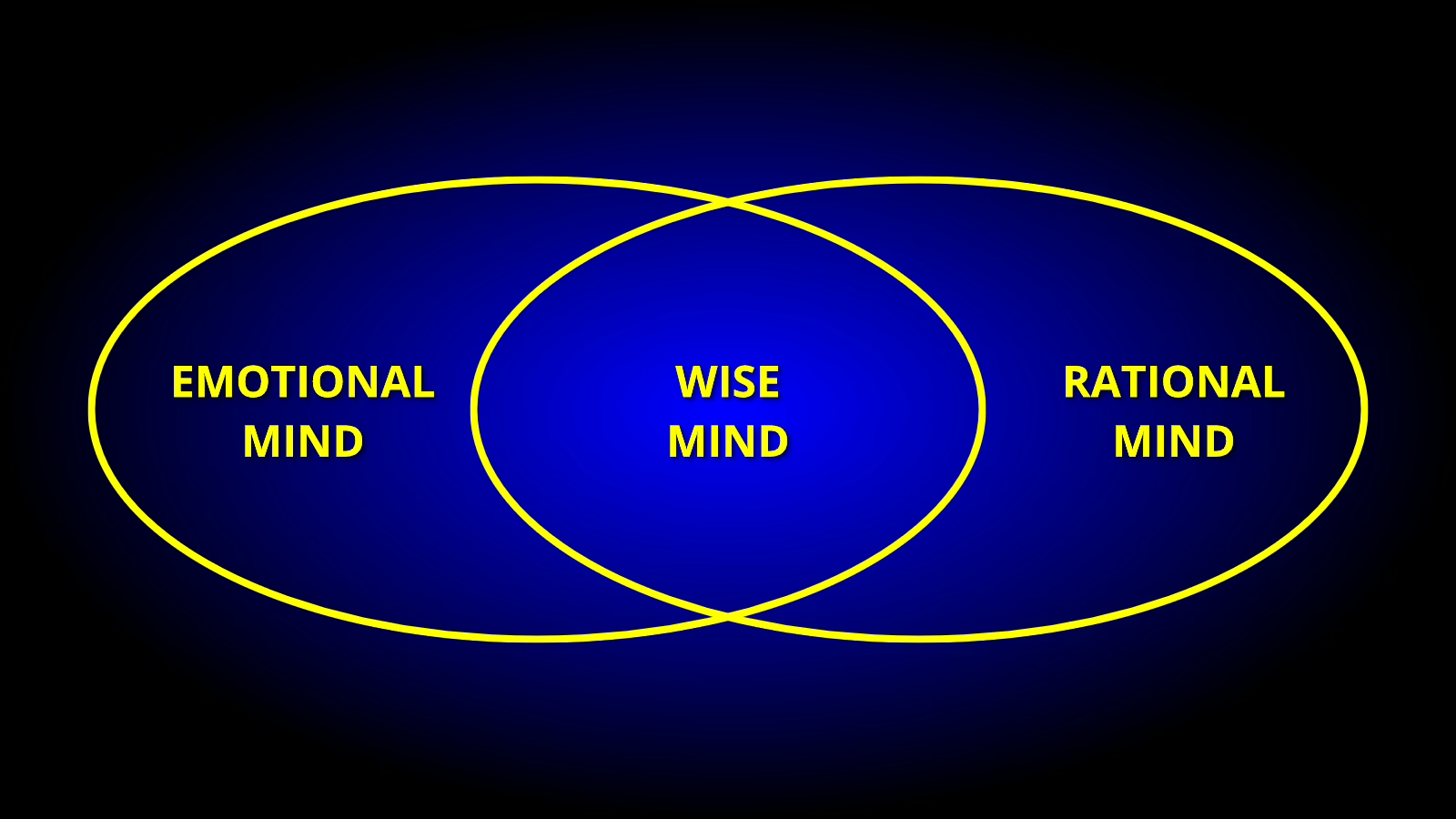
Wise Mind is the balance of emotional mind and rational mind, in perfect harmony.

To illustrate this concept, let’s suppose that a destitute woman has been arrested for stealing a loaf of bread with which to feed her hungry children. If we approach this situation from Rational Mind, we are only using logic and reason. There is no emotional content to our approach to the situation in Rational Mind. In this situation, Rational Mind would say that she broke the law, and there are penalties for breaking the law, therefore she should be punished.

Wise Mind, on the other hand, would allow logic and reason to be tempered with emotion. In this case, Wise Mind would allow some sense of compassion for the mother and her plight. While the woman in this scenario may have broken the law, she did so because she had love for her children and did not wish to see them go hungry. Wise Mind would recognize this and allow for some leniency.

On the other hand, what does Emotional Mind look like?

I’m sure we all know of someone who is subject to wild mood swings. Such a person is ruled by emotions that often run out of control. Imagine that this person is cut off in traffic. They may become very angry and chase down the offender, horn blaring and lights flashing. Perhaps this person even tries to run the offender off of the road.

In such a case, this person is being ruled by Emotional Mind. If this person could learn to live in Wise Mind, then he would realize that while the person who had cut him off in traffic had done something dangerous, it may not have been intentional. It could be that this person was distracted. Even if the person had done it intentionally, there is no need to increase the danger to himself by provoking further confrontation in an episode of road rage.

In this case, Wise Mind would accept the fact that such events are inevitable on a busy highway. Emotional Mind would then be tempered with Rational Mind, achieving the balance that is the goal of Wise Mind.

According to Follette, et al (2006), “”Wise mind is understood as a balance (or dialectic) between emotion mind and reasonable mind, where both emotion and reason are considered before taking action in life.”
This concept is often illustrated as below, where Wise Mind is the overlapping area between Rational Mind and Emotional Mind:

Wise Mind is where Rational Mind and Emotional Mind meet

In the clinical practice of Mindfulness, clients are taught the concepts of Rational Mind, Emotional Mind, and Wise Mind, and how to differentiate among these states.

Each state has its own usefulness; for example, Rational Mind might be good for solving math problems like balancing a checkbook, while Emotional Mind might be good for a romantic interlude. But there are also situations, such as those outlined above in which one mode of mind might not be as productive as another. In those cases, Rational Mind can be tempered with compassion from Emotional Mind, or Emotional Mind can be balanced with reason.

When using Mindfulness in clinical practice, it is helpful to teach clients the concepts of Rational Mind, Emotional Mind, and Wise Mind, then have them list examples of each in order to gain practice in differentiating among these states.


Follette, Victoria & Palm Reed, Kathleen & Pearson, Adria. (2006). Mindfulness and Trauma: Implications for Treatment. Journal of Rational-Emotive and Cognitive-Behavior Therapy. 24. 45-61. 10.1007/s10942-006-0025-2.

Posted on

Automatic Thinking

Learning to drive an automobile can be an overwhelming task. You have to focus on keeping the vehicle between the lines on the highway while watching for other cars, traffic signals and road signs. In addition to all of this, you must constantly glance at the speedometer to make sure that you are driving at a safe speed. You cannot look at the speedometer for too long because you must also concentrate on what may be happening on the highway. When learning to drive, you probably recited the ‘rules of the road’ to yourself over and over while driving (“Hands at two and ten,” “Watch out for animals and children running into the road,” etc.).

But as you gained knowledge and experience of driving, it became more and more of an automatic process. It may have become so automatic that now from time to time you make a routine drive without remembering anything about it. If you have ever let your mind wander and have missed an exit or a turn, then you are fully familiar with the process of automatization.

The process of automatization occurs in many areas of our lives. Just as the process of driving eventually becomes automatic, and can occur without our conscious awareness, so can thought and feeling processes become automatized.

If you have ever had a strong emotional reaction to a situation without knowing why, it is possible that one of your automatized emotional processes was activated (Moulds & Bryant, 2004).

Mindfulness is just the opposite of this automatic pilot experience. It is a way of paying close attention to your immediate experiences without getting lost in thought or shifting into automatic patterns of thinking or behaving. It is a shift from Doing Mode into Being Mode.

Doing Mode

Think about your morning routine. When you were in the shower this morning, were you actually ‘in’ the shower, or was your mind racing down the highway to your day-to-day errands? When you were there in the shower, were you feeling the warmth of the water on your skin, smelling the fragrance of the soap, and hearing the sound of the water, or was your mind elsewhere?

When we are preoccupied with thoughts of the past or the future, or with thoughts of getting things done, we are in Doing Mode. Doing Mode can also be expressed as Thinking Mode, because to get things done, we generally have to think about those things first. We make ‘to do’ lists in our minds and then do them in Doing Mode.

Thinking Mode takes us away from experiencing the world directly with our senses. When we leave Thinking Mode, and focus our awareness directly on the information provided by our senses, we have entered Sensing Mode.

Mindful Awareness teaches us to focus on the world experienced directly by our senses: touch, taste, smell, hearing, and sight. Experiencing life in sensing mode introduces us to a richer world. It’s impossible to be bored or apathetic if you treat each experience as if it is happening to you for the first time. Approaching each new situation without any assumptions or expectations is referred to as Beginner’s Mind, or sometimes as Child’s Mind.

Being Mode

Williams (2008) presents research that indicates the benefits of mindful states of being. Mindfulness is associated with decreases in levels of rumination (a process of becoming ‘trapped’ in negative thought cycles), avoidance (refusing to accept the reality of a given situation), perfectionism (attempts to control a situation), and maladaptive self-guides (attempting solutions that maintain the problem). Taken together, this reduction in negative thought and behavior patterns form what is known as Being Mode.

By focusing on the present moment, we leave Thinking Mode and enter into Sensing Mode.

In Sensing Mode, we simply allow ourselves to become fully aware of what is going on around us and within us, without attempting to control or manipulate these events and sensations. Being Mode reduces ruminations by allowing us to become aware of our thoughts and feelings as internal processes that we can choose to participate in, or choose to simply observe. In Being Mode we learn that we are not our thoughts.

In Western modes of thought, we are taught that our thoughts and feelings are our identities. Descartes said, “I think, therefore I am,” but does that mean that if you stop thinking, you cease to exist?

Being Mode allows us to detach from our cognitive and emotional processes and observe them, or stop them, if we so choose.

Being Mode reduces avoidance by allowing us to be in the present moment. If you are trying to avoid an unpleasant emotional state, you set up a cycle of denial. This denial creates anxiety and stress, which leads to more unpleasant emotional states to be avoided, which starts the avoidance cycle all over again. Being Mode allows us to participate in the unpleasant situation without internalizing it; i.e., without allowing the unpleasantness to become a part of our identity.

Perfectionism can be seen as a control mechanism. It is a displacement technique. If we feel out of control of certain areas of our lives, and we feel powerless to change those areas, we may displace our attention on the areas that we can control. By engaging in compulsive, perfectionist behaviors we assert our control over tangible areas as a substitute for areas over which we may feel we have no control. The idea of “perfection” becomes an obsessive means of anxiety management.

Being Mode allows us to realize that perfection is a subjective ideal. For example, if I asked you to describe your “perfect” day, you are likely to give me a totally different answer to that question than I would give if I were asked the same question.

Since our answers to the question, “What is your idea of the perfect day?” would not be identical, there is no objective definition to the word “perfect.” Being Mode helps one to realize that perfection is a self-defined concept.

In Being Mode we learn that every moment is perfect in and of itself, if we allow it to be.

Finally, Being Mode allows us to disengage from our own cognitive and emotional processes for a time. By doing so, we can become objective observers of our own inner states, without feeling that we must participate in them. Being Mode is a type of metacognition, or “thinking about thinking.” By observing the thoughts and feelings that have led to maladaptive consequences, we gain the ability to change those thought and feeling processes to lead to more productive conclusions.


Moulds, M. L. & Bryant, R. A. (2004). Automatic Versus Effortful Influences in the Processing of Traumatic Material in Acute Stress Disorder. Journal of Cognitive Therapy and Research, Vol. 28, No. 6, December 2004, pp. 805–817.

Williams, G. (2008). Mindfulness, Depression and Modes of Mind. Journal of Cognitive Therapy and Research, Vol. 32, No. 6, December, 2008. Pages 721-733.

Posted on

Mindful Acceptance

One of the skills we develop in the practice of mindfulness is the skill of ‘acceptance.’ Acceptance allows us to experience emotions without feeling obligated to react to them. This is done by noting the emotion, and then letting go of the negative thought processes that the emotion generates.

We can benefit from Mindfulness by learning to accept the flood of emotions that blocks rational thought. The goal of acceptance isn’t to become a totally rational person, devoid of emotion. Instead, the goal is to practice ‘Wise Mind.’ Wise Mind is the balance of emotional mind and rational mind, in perfect harmony.
To illustrate this concept, let’s suppose that a woman has been arrested for stealing a loaf of bread with which to feed her children. If we approach this situation from Rational Mind, we are only using logic and reason. There is no emotional content to our approach to the situation in Rational Mind. In this situation, Rational Mind would say that she broke the law, and there are penalties for breaking the law, therefore she should be punished.

Wise Mind, on the other hand, would allow logic and reason to be tempered with emotion. In this case, Wise Mind would allow some sense of compassion for the mother and her plight. While the woman in this scenario may have broken the law, she did so because she had love for her children and did not wish to see them go hungry. Wise Mind would recognize this and allow for some leniency.

I’m sure we all know of someone who is subject to wild mood swings. Such a person is ruled by emotions that often run out of control. Imagine that such a person is cut off in traffic. This person becomes very angry and chases down the offender, horn blaring and lights flashing. Perhaps this person even tries to run the offender off of the road. In such a case, this person is being ruled by Emotional Mind. If this person could learn to live in Wise Mind, then he would realize that while the person who had cut him off in traffic had done something dangerous, it may not have been intentional. It could be that this person was distracted. Even if the person had done it intentionally, there is no need to increase the danger to himself by provoking further confrontation in an episode of road rage. In this case, Wise Mind would accept the fact that such events are inevitable on a busy highway. Emotional Mind would then be tempered with Rational Mind, achieving the balance that is the goal of Wise Mind.

According to Follette, et al (2006), “Wise mind is understood as a balance (or dialectic) between emotion mind and reasonable mind, where both emotion and reason are considered before taking action in life.”
This concept is often illustrated as below, where Wise Mind is the overlapping area between Rational Mind and Emotional Mind:

Wise Mind is a balance between Emotional Mind and Rational Mind

In the clinical practice of Mindfulness, clients are taught the concepts of Rational Mind, Emotional Mind, and Wise Mind, and how to differentiate among these states. Each state has its own usefulness; for example, Rational Mind might be good for solving math problems like balancing a checkbook, while Emotional Mind might be good for a romantic interlude. But there are also situations, such as those outlined above in which one mode of mind might not be as productive as another. When using Mindfulness in clinical practice, it is helpful to teach clients the concepts of Rational Mind, Emotional Mind, and Wise Mind, then have them list examples of each in order to gain practice in differentiating among these states.


Follette, V., Palm, K. M. & Pearson, A. N. (2006). Mindfulness and Trauma: Implications for Treatment. Journal of Rational-Emotive & Cognitive-Behavior Therapy, Vol. 24, No. 1, Spring 2006.

Linehan, M.M. (1993). Cognitive Behavioral Treatment for Borderline Personality Disorder. New York : Guilford Press