
Posted on

Assumptions, Perceptions, and Reality

We all make assumptions every day about the way the world works and our places in it. These assumptions color our perceptions about the way things work, and these perceptions influence our reality. By changing our assumptions and our perceptions we can create a different reality for ourselves. Let’s talk about how this works.

Assumptions

We all make assumptions every day about the way the world works. I assume when I get out of bed in the morning that the sun has indeed come up again. When I make my way to the bathroom I assume power is on, so I’ll be able to turn on the lights and to hop in the shower. When I get in my truck and drive downtown, I assume that my office hasn’t burned down during the night and that I still have a place to practice. As I make my way through the day’s schedule, I assume my patients will show up for their appointments.

While some of these assumptions are more accurate and valid than others, they are all assumptions. We all have to make a certain number of assumptions every day. For most of us, the vast majority of these assumptions are effective, and they lead to positive results and positive consequences; however, on occasion we might make assumptions that lead us to negative consequences.

So assumptions can be both positive and negative. I assume my wife loves me and that our lives together will be positive and productive. Because of this, we usually have a good relationship. What if I assumed that she was cheating on me? Would that be likely to result in a positive experience for me or for my wife? What if I made such an assumption with zero evidence to back it up other than my own opinion? Would that be more likely to result in a positive, or a negative, outcome?

Our assumptions lead to our beliefs about life and our place in it. Our assumptions also lead to how we interact with others in our lives. Taken together, all of our assumptions about the way the world works create a lens through which we view the world. This lens is our perceptions.

Perceptions

Confirmation Bias is the tendency we all have to look for evidence that supports our beliefs and assumptions while rejecting any evidence to the contrary. This rejection of contradictory evidence doesn’t even have to operate on a conscious level. It can be an automatic process.

World-famous magicians Penn and Teller once did an experiment on perceptions for their television show. The experiment involved how people perceived organically-grown food versus food grown by traditional farming methods. In this experiment they divided a banana in half. Participants in this experiment were told that the two halves of the banana were from different bananas: One grown organically and one grown traditionally. Both halves of the banana were actually from the same fruit, but participants were not aware of this fact. People consistently identified the banana that was supposedly grown organically as having better flavor and texture than the other half of the same banana!

What had happened here was that the people in the experiment had a perception about organic fruit. That perception actually worked to create a different taste experience for different halves of the same banana, based on their assumptions about the superiority of organically-grown fruit.

We all have a natural tendency to allow our assumptions color our perceptions of the world. If I assume my wife loves me, I’m going to automatically look for evidence to support that theory while rejecting any evidence to the contrary. If I assume that my wife hates me, I will likewise look for evidence to support that claim while rejecting evidence to the contrary.

My assumptions about my wife’s feelings for me have created a perception filter that causes me to seek out evidence to confirm my assumptions. In this way, our assumptions and perceptions work together in ways that tend to create the day-to-day reality we experience. Together these assumptions and perceptions form our confirmation bias of our day-to-day reality. That is, we are automatically biased to create a reality based on our assumptions and perceptions.

Reality

We create our reality based on our assumptions and our perceptions about the world and our place in it. By making assumptions about the world, and using our perceptions, based on those assumptions, to look for evidence to support our beliefs, we eventually create a reality that reflects those assumptions and perceptions. We’ll look more closely at how this happens in the next section, but for now consider that each of us has a story.

This story is about us. It is our autobiography, and we are the authors. I can use my assumptions and perceptions to write this story, and I can use this story to create the reality of my life. If I assume I am a happy, well-adjusted person, and I look for evidence to support this assumption, I have set my perception filter to find such evidence.

As I write this story of a happy, well-adjusted person, I create that reality in my life. Such a story is independent of the circumstances in which I find myself. I can be happy and well-adjusted living in a cardboard box under a bridge if I have learned to seek evidence that creates that reality for myself. I can also create a story that would lead me to be an unhappy and miserable person even if I lived in a palace and had all the money in the world.

It is therefore not the external circumstances of my life that create my emotional reality. It is my assumptions and perceptions about who I am and what I choose to be that create my reality.

Posted on

New Mindfulness-Based Ecotherapy Certification

Facilitator Certification Program for Mindfulness-Based Ecotherapy (MBE)

The Mindful Ecotherapy Center, LLC has been providing continuing education in mindfulness and ecotherapy since 2007. During all of that time, students of Mindfulness-Based Ecotherapy have continually expressed a desire for an organization that specifically caters to the educational needs of counselors and therapists who practice Mindful Ecotherapy.

With these needs in mind, the Mindful Ecotherapy Center, LLC will be creating a new two-year certification in Mindfulness-Based Ecotherapy. This new certification will train and certify counselors and therapists specifically in Mindfulness-Based Ecotherapy.

This will be an intensive two-year certification process, including up-to-date training in the latest techniques, research, and education in Mindfulness-Based Ecotherapy.

Certification will require renewal every three years, and will have a continuing education requirement during each renewal period, so that MBE practitioners are up-to-date on the latest techniques and interventions. It will also require case presentations and supervision for certification.

This will be a different and much more intensive certification than our current Mindfulness-Based Ecotherapy Facilitator training. Trainees who complete the two-year training would be certified Mindfulness-Based Ecotherapists (MBE) and would be entitled to use the designation MBE in their credentials.

The new program will include the following:

  • 20 hours of continuing education in Mindfulness
  • 20 hours of continuing education in Ecotherapy/Ecopsychology
  • 30 hours of continuing education in Mindfulness-Based Ecotherapy in Clinical Practice
  • 5 hours of continuing education in suicide prevention
  • 3 hours of continuing education in ethics
  • 10 hours of continuing education in electives
  • 20 hours of supervision
  • Case presentation

NEW Ecospirituality Program

The current Mindfulness-Based Ecotherapy Facilitator Certification course will be replaced in 2024 with the Ecospirituality Program, which will expand to include a more spiritual element to the training and to the program.

Somewhere between 90% and 95% of people on Earth practice some sort of spirituality. Obviously, spirituality must be pretty important. Studies tend to back this up. What the studies show is that the type of spirituality doesn’t really matter. Whether you’re Christian, Muslim, Jew, Buddhist, Hindu or Pagan, or even agnostic or atheist, practicing some sort of spiritual path yields benefits.

Since the particular type of spirituality is secondary to the benefits gained (in other words, since all spiritual paths lead to a better quality of life for those who practice them properly), what is it about spirituality that allows it to work its magic?

Suppose you could take all the spiritual paths practiced worldwide, put them into a cauldron, and boil them down to their essence. What would remain? I believe that the common thread to all spiritual practices is a feeling of connection. Connection to others, or connection to the divine, or simply connection to nature and to ourselves. In short: Spirituality = Connectedness!

If you think back on the spiritual experiences you’ve had in your lifetime, do recall feeling connected on some level? Many describe spiritual experiences as a sense of ‘oneness.’ Oneness implies connection to something outside ourselves. In this sense, even an agnostic or an atheist could achieve spirituality through connection.

The new Ecospirituality Program scheduled for release in 2024 will incorporate elements of this connectedness!

Changes to the Mindfulness-Based Ecotherapy Certification Program

Although the Mindfulness-Based Ecotherapy Program was created to be facilitated by licensed mental health professionals, in the past we’ve had quite a few coaches who have also taken the course. While mental health professionals are highly regulated in most states and in many countries, coaches are usually not.

Due to this lack of regulation and credentialing for most coaches, some states and some organizations have restricted the use of the term ‘ecotherapy.’ Because of this, we are re-naming the current Mindfulness-Based Ecotherapy 12-week program. In 2024 the program will become the Ecospirituality Program. Current certified facilitators of Mindfulness-Based Ecotherapy will be allowed to take the new Ecospirituality Facilitator Training program for free when it is available.
The new Mindfulness-Based Ecotherapy Certification will then replace the current designation. This will be a much more in-depth two-year certification process only available to licensed mental health professionals.

The new Mindfulness-Based Ecotherapy program will require intensive study, supervision, and a case presentation prior to becoming certified. Once certified, licensed mental health professionals will be able to use the designation “MBE” in their credentials, for “Mindfulness-Based Ecotherapist.”

When the first cohort of Mindfulness-Based Ecotherapists graduates we will begin a Supervisor Training Program that will educate MBEs in supervision so that future training programs will have a variety of supervisors to choose from.

As we move forward with these changes we would love your input! Click here to visit the forum and join the discussion!

Posted on

Problem-focused and Solution-focused Memes

The idea behind using Meme Triads is to move from a problem-focused paradigm to a solution-focused paradigm. One of the goals of using Meme Triads is to begin to think in terms of solutions instead of in terms of problems. When we start thinking in terms of solutions, we begin to live with intention. The power of intention is one of the skills of mindfulness, so by living deliberately and with intention, we move to a solution-focused paradigm.

To illustrate the difference between a problem-focused paradigm and a solution-focused paradigm, and how to move from one to another, we’ll use the example of a couple in which one or both partners are engaging in emotional aggression by expecting the other partner to be responsible for making them happy.

We’ll graph it out as follows:

  1. What is the problem? The problem meme is, “My spouse must be responsible for my happiness.”
  2. Why is this a problem? This is a problem because “My spouse is getting tired of being responsible for my happiness.”
  3. How is the problem maintained? In this example, the problem is maintained because I believe my spouse must be responsible for my happiness, but my spouse has grown tired of being responsible for my happiness. If I try to solve the problem by insisting even more that my spouse be responsible for my happiness, she reacts by getting even more tired of being responsible for it.

The first step in moving towards a solution is to eliminate the problem-based meme. Since the meme has three components, and all three components are interrelated and dependent on each other, we can choose any of the three components to change. By changing any one of the components, we transform the meme.

In the example above, we’ll look at what happens when we change any of the three components. Let’s start with the ‘What’ component. This component is, “My spouse must be responsible for my happiness.” What would happen if this component was changed to, “I will be responsible for my own happiness?”

If we make this change, what does it do to the other two components?

If the ‘What’ component is now changed to “I will be responsible for my own happiness,” let’s first look at what this does to the ‘Why’ component. The ‘Why’ component above is “My spouse is getting tired of being responsible for my happiness.” If the ‘What’ component is changed to “I will be responsible for my own happiness,” then the ‘Why’ component is altered, because if I am now responsible for my own happiness, my spouse is no longer responsible for my happiness, and has no reason to get tired.

Now let’s look at the ‘How’ component when the ‘What’ component has been changed to “I will be responsible for my own happiness.” The answer to the question, “How is the problem maintained?” is that the more tired my spouse gets of being responsible for my happiness, the more I pressure her to take on that responsibility. If the ‘What’ component has changed, and I have now learned to be responsible for my own happiness, there is no need to pressure my spouse to shoulder that responsibility.

So by changing the ‘What’ component of the triad, we have changed all three components, and transformed the meme into something more productive.

Let’s now examine what happens if we focus on changing the ‘What’ component. The ‘What’ component in the problem-focused example above is, “My spouse is getting tired of being responsible for my happiness.” In this case, I cannot change the ‘Why’ component, because it deals with my spouse’s thoughts and feelings, and not my own, and I cannot force my spouse to change her feelings if she doesn’t want to. But let’s just assume that hypothetically she decides to continue to bear the burden of my happiness, even though she is tired of it. If that is the case, what happens with the ‘How’ component?

The ‘How’ component is no longer an issue, because if my spouse has agreed to continue to bear the burden of responsibility for my happiness, even if she is tired of it, then I have no reason to continue to pressure her to do so. Therefore the ‘How’ component is no longer relevant.

So if the ‘Why’ component is altered in this way, what does it do to the ‘What’ component? If the ‘What’ component is “My spouse must be responsible for my happiness,” and my spouse has agreed to be responsible for my happiness, there is no problem (not for me, at least…my spouse may feel differently!).
Finally, let’s look at what happens when we change the ‘How’ component.

If the ‘How’ component is that I pressure my spouse to be responsible for my happiness whenever she complains that she is tired of being responsible for my happiness, I could change it by not pressuring her to take on that responsibility. If I do that, the ‘What’ component of, “My spouse must be responsible for my happiness” is irrelevant, since I am no longer pressuring her. And since I am no longer pressuring her, she no longer feels tired of the responsibility for my happiness, thereby changing the ‘Why’ component as well.
In the illustration above you can already see elements of moving from a problem-focused paradigm to a solution-focused paradigm.

Let’s take it a step further by exploring the Solution-Focused Generic Meme Triad.

Looking at the problem-focused triad above, the central issue is ‘my happiness.’ The problem manifests because I am trying to derive my happiness from the actions and feelings of someone else: My spouse.
What happens when I move to a solution-focused paradigm? If the solution (or the intention) is ‘Happiness,’ the solution-focused triad becomes:

  1. What is the solution? I am responsible for my own happiness.
  2. Why is this a solution? Because if I am responsible for my own happiness, nobody else has to be responsible for my happiness. Also, if I am responsible for my own happiness, nobody else can ever take it away from me.
  3. How is the solution maintained? The more I am responsible for my own happiness, the less I am dependent on others for my happiness, and the less dependent on others I am for my own happiness, the happier I become.

With all of the meme triads that follow in future posts, the objective is to move from a problem-focused paradigm to a solution-focused paradigm by altering the memes that are leading to negative consequences.

By altering our memes to a solution-focused paradigm, we become proactive in creating positive consequences in our lives.

Posted on

Meme Triads

Contrary to popular belief, a ‘meme’ is not an internet picture with words on it. A meme is just a belief that has been passed from one person to another. We get most of our core memes from our families of origin.

If your memes (inherited beliefs) are leading to consequences you want, then nothing needs to be changed. If, however, you have memes that are leading to consequences you don’t want, you have a choice. You can change them to something more conducive to positive consequences.

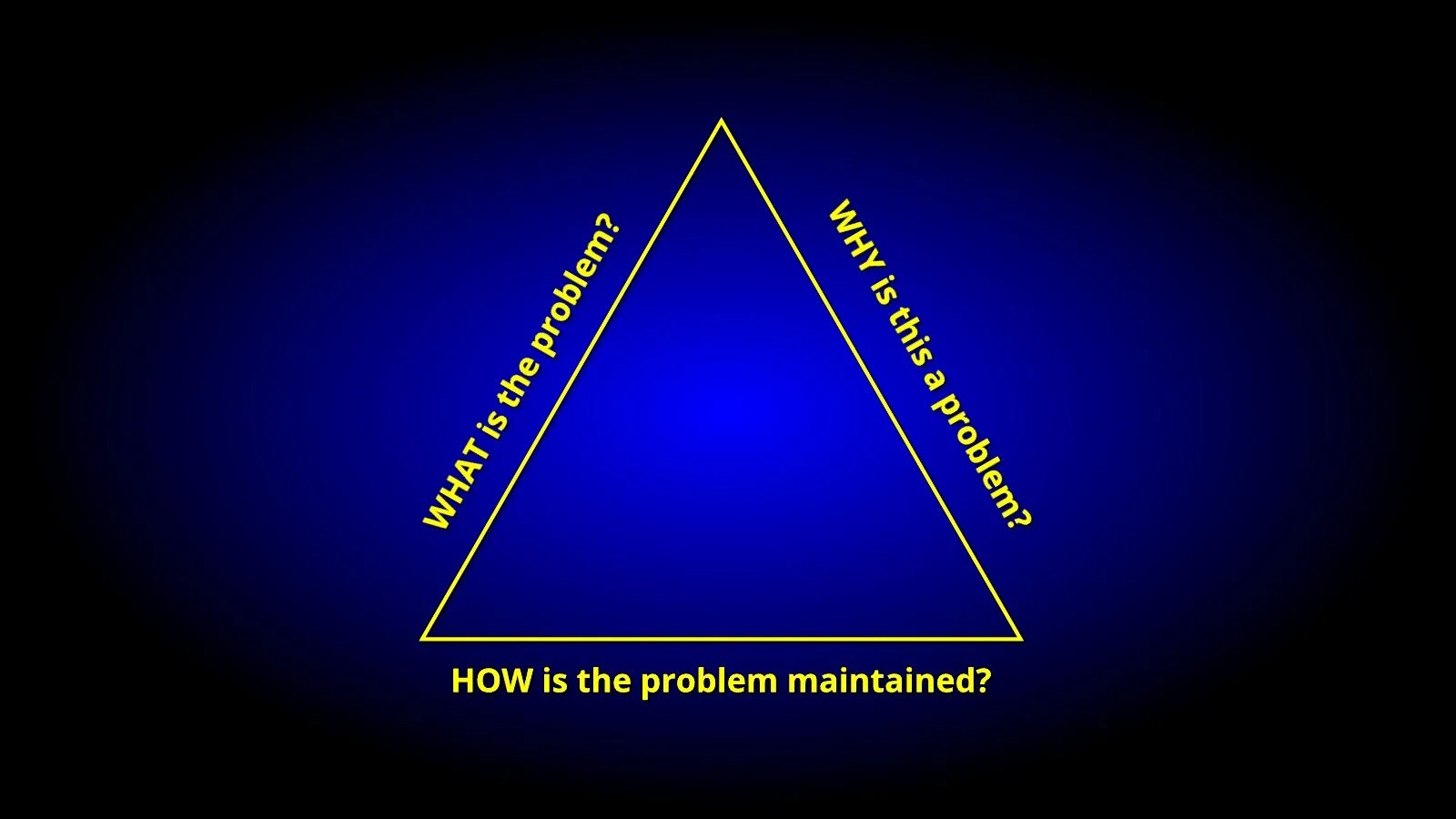
The first step in changing a meme is to examine the components of the meme. There are three basic components to a meme: What, Why and How. The explanation of these components is as follows:

  1. What is the problem? The ‘What’ component is usually the meme that is causing the problem.
  2. Why is this a problem? The ‘Why’ component of the meme indicates why the meme is leading to consequences you don’t want.
  3. How is the problem maintained? Sometimes the attempted solution to a problem only serves to make the problem worse.
    If I believe my spouse must be responsible for my happiness, but my spouse has grown tired of being responsible for my happiness, I might try to solve the problem by insisting even more that my spouse be responsible for my happiness. I might even resort to blaming, shaming, and guilt-tripping my spouse in an attempt to get her to resume responsibility for my happiness. But the more I try to force her into taking that responsibility, the more tired she gets of being responsible for it. My attempted solution to the problem is only serving to make the problem worse. It’s been said that, “Insanity is doing the same thing in the same way and expecting different results.” If what you’re doing to solve the problem isn’t working, then doing more of it isn’t going to work either.

The first step in changing a non-productive meme into a productive meme that generates positive consequences is to identify the components of the meme using the outline above.

Once you’ve identified the components of the meme, picture them as legs or sides of a triangle. Triangles have three sides. All three of those sides are connected to each other. If you take away one of the sides of a triangle, it is no longer a triangle. Furthermore, since all the sides of a triangle are connected to each other, if you change one side, the other two sides must change as well.

Memes have a similar construction. Looking at the What, Why and How components of a meme, we can see that if one side is changed, all of the other sides are changed as well. Furthermore, since all three components are necessary in order for a meme to exist, if one component is taken away, the meme ceases to exist.

Since there are three sides to a triangle, and three components to a meme, a triangle can be constructed with one component of the meme on each side. One side of the triangle would be the ‘What’ component, another side would be the ‘Why’ component, and the base of the triangle would be the ‘How’ component.

Once a meme is graphed out in this fashion, then taking away one of the sides means that it is no longer a triangle. So if one of the components is altered or removed, it eliminates the meme altogether or completely changes it.
Changing one of the sides changes the two remaining sides, and therefore the meme is changed as well. So if you have a meme that is leading you to consequences you do not want, and you graph that meme out on a triangle, you have three separate chances to change the meme. You may change the ‘What’ component, or the ‘Why’ component, or the ‘How’ component. By changing any one of these components, the other components change as well, and the meme is altered. When the meme is altered, the consequences of acting on the meme are altered as well.

This may sound confusing at first, but over the coming weeks we’ll go over it in more detail. With more practice it will start to make more sense.

Posted on

Memes are A Category of Belief

Sometimes our beliefs lead us to consequences we don’t want to experience. The way to change those beliefs is to dispute the beliefs you have that are leading you to consequences you don’t want to experience. When you’ve experienced a negative consequence in your life, examine and challenge the beliefs you hold that led you to act in such a way that you got consequences you didn’t want.

Note that this act of disputing the belief is a process of trial and error. Changing a belief is no guarantee of getting a better consequence. But it is certain that if we don’t change the belief, we will continue to get the same negative consequence. Making a change isn’t an automatic recipe for success.

We can, however, make educated guesses as to how we might change our beliefs in order to get the consequences we do want. Once we’ve found a belief that might lead to a consequence we do want, we troubleshoot it before implementing it by asking what sort of things might go wrong if we change our beliefs. By making a plan to cover any potential misfires, there’s a greater chance that the changed belief will work to change the consequences to something more to our liking.

There is a special category of beliefs called memes. ‘Meme’ comes from the Greek word mīmēma, which means “imitated thing.” Memes are to ideas as genes are to physical characteristics like hair color, height, and eye color. A meme is an idea, belief or behavior that is passed from one person to another.

We get many of our earliest memes from our parents and our family. Later on we may pick up memes from our friends, our teachers, and our culture and society. Taken together, our memes make up our belief system and the way we deal with others.

If English is your native language, you probably learned it from your family. If you had been raised in a family that only spoke Spanish, then Spanish would be your native language. Your language was handed down to you from the people who raised you. You learned the language though a process of imitation by repeating the sounds you heard.

The people who raised you taught you your native spoken language. But there is also another language they taught you: Your emotional language. Your emotional language is the language you use to deal with relationships. The language you use to express emotions is made up of memes you inherited from your parents, guardians, or other loved ones in your life.

The vast majority of memes that we inherit are good and productive memes. They help us to function in our daily lives. But sometimes the memes we inherit lead to consequences we don’t want. For example, if I have a meme that says that my spouse must make me happy, and my spouse is okay with that, then there are no negative consequences.

But what happens if my spouse gets tired of bearing the burden of carrying my happiness for me? In such a case, if my belief, or meme, is that my spouse must make me happy, and my spouse has grown tired of trying to make me happy, then the consequence will be that I cannot be happy unless I learn to be responsible for my own happiness.

If that is the case, then I need to change the meme, “My spouse must be responsible for my happiness” to something more productive, along the lines of, “I must learn to be responsible for my own happiness.”

Meme Triads are a way to change beliefs. Next time we’ll talk about the components of a meme and how to use meme triads to change our less productive beliefs.

Posted on

Ethics of Ecotherapy TOMORROW

ethics and ecotherapy

In our ongoing effort to improve the quality of the courses we offer, we will be applying to the National Board for Certified Counselors (NBCC) to be able to provide LIVE continuing education opportunities in addition to our online offerings.

As part of this process we are offering this FREE two-hour course on Ethics in Ecotherapy in June of 2023!

This course will cover some ethics issues common to the practice of ecotherapy. In addition to two free hours of continuing education on the Ethics of Ecotherapy, participants will receive a coupon code good for $25 off any course offered by the Mindful Ecotherapy Center, LLC.

This course will be conducted by Zoom, so you will need access to Zoom for the course.

This course will be live TOMORROW, June 20, at 10:00 a.m. Pacific Time.

Join Zoom Meeting
https://us06web.zoom.us/j/89945203020?pwd=YzNTYnhoT2xqYkt3M0pTYk5wSG1lQT09

Meeting ID: 899 4520 3020
Passcode: 462232

If you are attending, please make sure you have updated Zoom to the latest version! Older versions may not work with this course!


Ecotherapy usually includes doing therapy outdoors. Therapy in non-traditional settings presents unique ethical challenges. These ethical issues are usually not covered in therapy graduate school programs. In this course we will discuss how to address some common ethical issues for therapists and counselors that are unique to the process of ecotherapy.  

Course Objectives

After taking this course the student will be able to:

  • Discuss and describe confidentiality and informed consent issues common to the practice of ecotherapy
  • Discuss training recommendations regarding the practice of ecotherapy
  • Discuss assessment and client safety issues common to the practice of ecotherapy
  • Discuss and describe what constitutes dual relationships in ecotherapy
  • Discuss and describe values conflicts in ecotherapy settings
  • Develop a sense of self-awareness for counselors and therapists practicing ecotherapy  

Course Instructions

This is a LIVE course that will be offered on Tuesday, June 20, 2023 at 10 a.m. Pacific Daylight Savings Time. An email reminder containing the Zoom code to access the course will be sent the day before the conference. The conference will be presented on Zoom. You need to be present for the duration of the course to get course credit.

The course will be two hours on Zoom. At the end of the course you will have access to a link for the final exam.

Upon successful completion of the exam you will receive a Certificate of Completion in pdf format, and you will be emailed a coupon code good for $25 off any course offered by the Mindful Ecotherapy Center, LLC.

Posted on

Plateau Pride

The Mindful Ecotherapy Center has always been an advocate for the LGBTQ+ community. Representatives from the Mindful Ecotherapy Center, LLC recently attended Plateau Pride 2023 in the Tehaleh Community of Bonney Lake, Washington.

This video features interviews with many of the vendors and members of Hope Development Practice, the sponsor of the event.

We celebrated Pride Month at Plateau Pride in Bonney Lake, Washington. Watch the video highlights here!

Posted on

NEW Course: Orientation to the Mindful Ecotherapy Center

If you’ve never taken a course on our website before, this FREE course will guide you through the process!
Click here for our FREE course: Orientation to the Mindful Ecotherapy Center
This course is a FREE orientation on how to take courses with the Mindful Ecotherapy Center, LLC. If you’ve You may find it helpful to go through this tutorial to familiarize yourself with the way our courses and our website work. Since this is an orientation course to our website, and not a continuing education course for mental health professionals, there is no continuing education credit for this course.
Be informed when new courses are added by subscribing to the Mindful Ecotherapy Center’s monthly newsletter.

Target Audience: Mental Health Professionals; Professional Counselors & Therapists; the General Public

Total Online Continuing Education Hours: Not Applicable

NBCC Approval: (see explanation above)

Posted on

Living in the Moment

living in the moment

Living in the moment is a key skill of mindfulness.

We all have things that make us anxious. Think about some things that cause you anxiety or stress. Now ask yourself, “How many of them have to do with worrying about events that happened in the past?”

It doesn’t matter how recently the event took place. It could have been five years ago, five days ago, five minutes ago, or five seconds ago.

Now, how many of them have to do with anxiety over an event that may or may not happen in the future? Some events that cause you stress might involve both the past and the future, because you may be disappointed or angry about something that happened in the past and concerned that it will happen again in the future.

Do any of your worries have to do with anything that is occurring right now, at this very moment? Note that some things may have their root causes in the past, but you may be worried or anxious about them in the present. In such a case, the event that led to your present anxiety is still in the past. It’s your choice in the present moment whether or not to pay attention to the memory of that event.

Think about the things that cause you stress in your day-to-day life. As you do, ponder the fact that unless someone invents a time machine, you cannot go back and change anything in the past. The past no longer exists except in your memory. Since the only place the past exists is in your memory, you are in control of it. You can choose which memories to pay attention to and which to ignore.

Likewise, the future does not exist except as an extrapolation of the mind. When we anticipate anxiety-provoking events in the future, we are engaging in crystal ball thinking. It’s as if we imagine we have a crystal ball and we’re trying to predict negative outcomes for the future. Trying to anticipate what may or may not happen in the future is just a mental exercise, and nothing based in reality. You might think that some things are likely to happen, and some things are less likely to happen, but unless you have a crystal ball or a time machine, the only way to know for sure what will happen in the future is to wait and see.

living in the moment

The key point to remember here is that feelings are not facts. Moods are not facts. Thoughts are not facts. Moods, thoughts, and feelings are just processes of the mind. If you are stressed or depressed over past or future events, you have the choice over which feelings and moods to pay attention to, and which thoughts and feelings to let go of.

A benefit of Mindfulness-Based Ecotherapy is that when we leave Doing Mode and enter Being Mode, we stop worrying about the past or stressing over the future, if only for a moment.

Note that this doesn’t mean that leaving Doing Mode and entering Being Mode makes bad moods go away. It just means that by entering Being Mode, we allow ourselves the choice of not giving energy to those negative moods.

By living in the moment, we create some space between our True Selves and our thoughts, moods, and feelings. This space allows us some breathing room. It also allows us to come to know that we are not our moods. We are not our feelings. We get to choose who and what we are.

This all happens by living in the moment.


Share Your Thoughts About Living in the Moment!

What do you think? Share your thoughts in the comments below!


  And don’t forget to subscribe to our newsletter!

Posted on

Transgender Remembrance Day

gender affirming care

Transgender Remembrance Day is November 20, 2022. On this day we honor the memory of those who have lost their lives to anti-transgender violence.

Imagine your life was in danger on a daily basis simply for being who you are. Imagine suffering discrimination not only in the workplace, but also in your school, in your church, or in your own family or even when you visit your health care provider.

If you can imagine this then you have a good understanding of what most transgender people endure on a daily basis.

Did you know that in 2019 twenty-six Americans lost their lives due to transgender violence?

These victims were killed by acquaintances, partners and strangers, some of whom have been arrested and charged, while others have yet to be identified.

Some of these cases involve clear anti-transgender bias. In others, the victim’s transgender status may have put them at risk in other ways, such as forcing them into unemployment, poverty, homelessness and/or survival sex work and sex trafficking.

Of the victims murdered, 80% were people of color, 55% were transgender women, and 50% were transgender women of color.

Transgender women survivors of hate violence were also more likely to experience police violence, physical violence, discrimination, harassment, sexual violence, threats, and intimidation compared to those who were not transgender women.

Violence and harassment were experienced by the more than 6,000 transgender people across a variety of contexts, including educational settings, at work, in interactions with police and with family members, at homeless shelters, accessing public accommodations, and in jails and prisons.

Additionally, murders of transgender people often go unreported, and the identity of transgender murder victims is often misreported, so the actual numbers are probably far higher.

So what can you do? Start by calling attention to local victims of anti-transgender violence.

Highlight positive stories of transgender individuals, and the dehumanizing discrimination they have faced in their every day lives.

Familiarize yourself with statistics on transgender violence and make your community aware.

Statistics from the Gay, Lesbian and Straight Education Network (GLSEN) show that in schools, 16.2% of transgender students report being physically assaulted as a result of gender expression, while 32.5% experience physical harassment including bullying and physical assault. You can talk with transgender youth about their experiences growing up and create educational networks to fight such discrimination.

Contact local transgender and LGBTQ organizations to find out how they plan to observe Transgender Day of Remembrance.

Many universities and high schools, through their Gay-Straight Alliances and other organizations, hold candlelight vigils or other events to recognize the day.

You can also get involved in a local event or start one of your own.
Here are types some events to Look For:

  • Candlelight vigils are the most common way that local communities recognize Transgender Day of Remembrance, Such events may also include:
  • Marches
  • Forums and panel discussions with local advocates
  • Poetry or spoken word readings
  • Art exhibits
  • Movie screenings of feature films or documentaries that center on transgender characters or subjects
  • Representations of the number of transgender people murdered, such as tombstone cutouts, memorials with photographs, or chalk outlines.

To learn more about what you can do, visit some of the resources listed below.

National Center for Transgender Equality
https://transequality.org/

Gay & Lesbian Alliance Against Defamation
https://www.glaad.org/transgender/resources

Parents and Friends of Lesbians and Gays
https://pflag.org/

The Trevor Project for Young LGBTQ Lives
https://www.thetrevorproject.org/

If you are a transgender person who has experienced discrimination, contact one of the organizations listed here for a list of resources and support in your area.

And remember…having a transgender child doesn’t mean you’ve failed as a parent. Rejecting your transgender child means you’ve failed as a parent.

If you are currently feeling suicidal or know someone who is, contact the National Suicide Prevention Hotline at 800-273-TALK (8255) or dial 988 on your smart phone.

Together we can make a difference!