
Posted on

Externalization: Experiencing the Person, not the Problem

One way to live a life of compassion is to see the person, not the problem. This is done through externalization. If we are able to take the viewpoint that the person is separate from the problem, then we are able to experience the person, and not the problem. Such a perception sees the person as separate from the problem. From such a perspective, I am not an “addict,” I am a person with a substance abuse problem. I am not an “angry person,” I am a person with an anger management problem.

If a friend or family member has cancer, do you say that they are a cancer? Or do you see the cancer as something separate, a problem that can be treated and possibly even cured? If I had such a person in my life, I might abhor the cancer and what it is doing to them, but I most certainly wouldn’t abhor the person.

When we are able to see things in this way, we are able to externalize the problem. Externalizing the problem is seeing it as separate from the individual. If I have an issue with emotional aggression, I’m not an emotionally aggressive person. I’m a person who may consciously choose to change my tendency to act in emotionally aggressive ways. By externalizing this tendency in myself, I can come to see it as just a process of the brain, and not a part of my identity. If it’s just something my brain does from time to time, I can choose to avoid the temptation to act on it. If I refuse to feed it, it may eventually go away. Even if it doesn’t, I am still in control. I still have the choice not to act on it.

Likewise, if a friend or loved one has a tendency to act in emotionally aggressive ways, by exercising my non-judgmental skill of compassion, I can see this tendency as separate from their identity as a person if I so choose. The less I react to their emotional aggression, the less effective their emotional aggression becomes. When they see that their attempts to manipulate me by acting in emotionally aggressive ways have failed, then there is no reward for the behavior, and therefore there is no need to continue with the behavior.

Even if they decide to be stubborn and persist in their attempts at manipulation after seeing that they no longer work, I can refuse to participate by refusing to react to their aggression.

When you are able to do this consistently, you will have learned to use the tool of externalization.

Posted on

The Pygmalion Effect

the Pygmalion effect

In the Greek myth of Pygmalion, an artist falls in love with a statue he has created. The great sculptor Pygmalion creates his ideal woman in marble. The statue is so beautiful that he falls in love with her. In the myth, his love for the statue is so powerful that the statue springs to life and becomes a real woman.

In psychology there is a concept based upon this myth. This idea is known as the Pygmalion Effect. The Pygmalion Effect states that people have a tendency to become what you believe them to be based on how you treat them. If you expect good behavior from your friends and loved ones, then that is usually what you get. On the other hand, imagine a family member who is basically a ‘good’ person who wants to please his loved ones. Yet every time this person interacts with his family members, they greet him with suspicion, always expecting the worst from him. How long do you think it would take for this person to live up to their ‘bad’ expectations?

American school teacher Jane Elliot did a famous experiment that perfectly illustrates the power of the Pygmalion Effect. During the racial tensions of the 1960s, this teacher created the Blue Eyes/Brown Eyes Experiment.

The first day of the experiment, she told her class that “blue-eyed people are superior to brown-eyed people.” She spent the day praising the blue-eyed students, while condemning the brown-eyed students. She gave the blue-eyed students privileges that the brown-eyed students didn’t get, and punished the brown-eyed students more severely than the blue-eyed students for behavioral infractions.

On the second day of the experiment, she reversed the roles, with the brown-eyed students receiving extra privileges while the blue-eyed students received more severe criticism and punishments.

As a result of the experiment, the ‘superior’ students had better behavior, better interactions, and better grades. The ‘inferior’ students had just the opposite results. In just a single day, the students had lived up (or down) to her expectations of them.

The way to harness the power of the Pygmalion Effect in your life is to always remember to be compassionate with your friends and loved ones. Let them know you love them with every word and deed.

One way to do this is to eliminate judgment from your style of interacting with others. By consciously choosing to be compassionate with them, you allow the Pygmalion Effect to work its magic. If you judge your loved ones to be unsuccessful, then your expectations will be to have an unsuccessful loved one. When you are expecting an unsuccessful partner, you tend to ignore the times when your partner does succeed, and to focus only on the times when your partner does not. By your assumptions, you have set your perception filter to only notice the times when your partner does not succeed.

If you change your assumptions to more positive outcomes, you will re-set your perception filter and thereby create a different reality in your life and in the lives of your loved ones.

People are very good at picking up on your expectations. Others tend to fulfill our expectations of them, no matter whether those expectations are positive or negative. If you have only positive expectations for your friends and family, free of judgment, your loved ones will tend to rise to the occasion and fulfill those expectations. And of course if you have only negative assumptions and expectations about your friends and family, they tend to live up to those expectations as well.

Sometimes we may think we are holding positive expectations for our loved ones, but our words and actions may convey a different message. For example, suppose you have a son named Adam. You want Adam to clean his room. This is a positive expectation because it is a positive behavior that you wish to encourage. Now take a look at the two statements below, and see which one would convey the more positive expectation, in your opinion:

Statement A:
“Adam, I can’t believe you didn’t clean your room again! This is the third time this week! I just don’t know what I’m going to do with you!”

Statement B:
“Adam, I noticed you didn’t clean your room again today. I know you didn’t mean to forget. I’m sure you’ll get around to it before the day is over. Remember, if you need help, you can always ask me.”

Which statement do you think conveys a more positive expectation? Which one would you be more likely to respond to if you were Adam?

By consciously choosing to re-frame our responses, we are able to expect the best from our loved ones and our friends. When we do so, we can harvest the power of the Pygmalion Effect.

Posted on

Ruminating Cycles and Triggers

Ruminating Cycles and Triggers

In previous blogs we’ve talked about the idea of ruminating cycles. If I have a negative thought, and that negative thought leads to two or three more negative thoughts, then those negative thoughts lead to a couple of dozen more negative thoughts, I am ruminating on negative thoughts. “Ruminating” literally means “to chew on.” So a ruminating cycle is a cycle in which I am “chewing on” a chain of thoughts.

Ruminating is sometimes called snowballing because of the way it behaves. Negative thoughts tend to naturally multiply, attracting more and more negative thoughts and growing like a snowball rushing downhill. It’s much easier to stop a snowball at the top of the hill before it has accumulated mass, momentum and speed. Likewise, it is much easier to stop a negative ruminating cycle when it begins than it is to try to stop it once it has gained momentum.

This is accomplished by identifying triggers that lead to negative rumination. The earlier in the ruminating cycle it can be stopped, the easier it is to stop the cycle. The way to catch a ruminating cycle and to stop it before it begins is to identify your triggers for negative rumination.

Suppose your husband isn’t paying attention to you, and that this lack of attention becomes a trigger for a negative ruminating cycle. Your negative ruminating cycle in this case might look something like this:

“He’s not paying attention to me. Is he giving me the ‘cold shoulder’? What have I done this time? Is he mad about something? Great…now he’s going to ignore me for the rest of the day! Why do I put up with this? I don’t see how this relationship can continue if he’s going to keep acting like this!”

This entire cycle of negative rumination was started with the simple observation that, “My husband isn’t paying attention to me.” The rest of the cycle was perpetuated by the assumption that his lack of attention had a negative origin. If that assumption hadn’t been made, then the negative cycle of rumination would not have been necessary. In order to stop the cycle before it began, the original assumption could have been challenged.

Challenging Ruminating Cycles

One way to challenge such negative ruminating triggers is to reframe them by making a different assumption about the observation. In the example above, you could reframe that trigger in such a way that it starts a positive ruminating cycle. Some possible reframes might be:

My partner’s busy right now, so that means I can have some ‘me’ time!
Maybe he has a lot on his mind. I shouldn’t take it personally.
This is an opportunity to show my support!
Each of these reframes assumes a positive rather than a negative intent from the observation, “My partner isn’t paying attention to me.”

Note also that even if the original assumption was correct, it is still possible to reframe the trigger so that it doesn’t lead to a negative ruminating cycle. Remember that the original assumption about the observation was, “He’s not paying attention to me. Is he giving me the ‘cold shoulder’?”

This correct negative assumption could be reframed in the following positive way:
“Well, just because he is choosing not to interact with me right now, I don’t have to let his mood spoil my own mood.”

Such a reframe allows you to validate your husband’s feelings without having them impact negatively on your own. Negative ruminating cycles can act as barriers to compassion. By assuming compassionate motives from our loved ones, we tend to act in ways that create a compassionate environment. By choosing to avoid negative ruminating cycles, we can act out of compassion even if our loved ones choose not to.

This doesn’t mean that we have to be doormats. We can still set firm boundaries while acting out of compassion. The way to do this is to expect the best from our loved ones while preparing for less than the best if necessary. When they choose to act in ways that are not compassionate, we can make it clear that we love them and care about them even when we may not agree with the way they’re acting right now.

Posted on

The Assumptions-Perceptions-Reality Triad

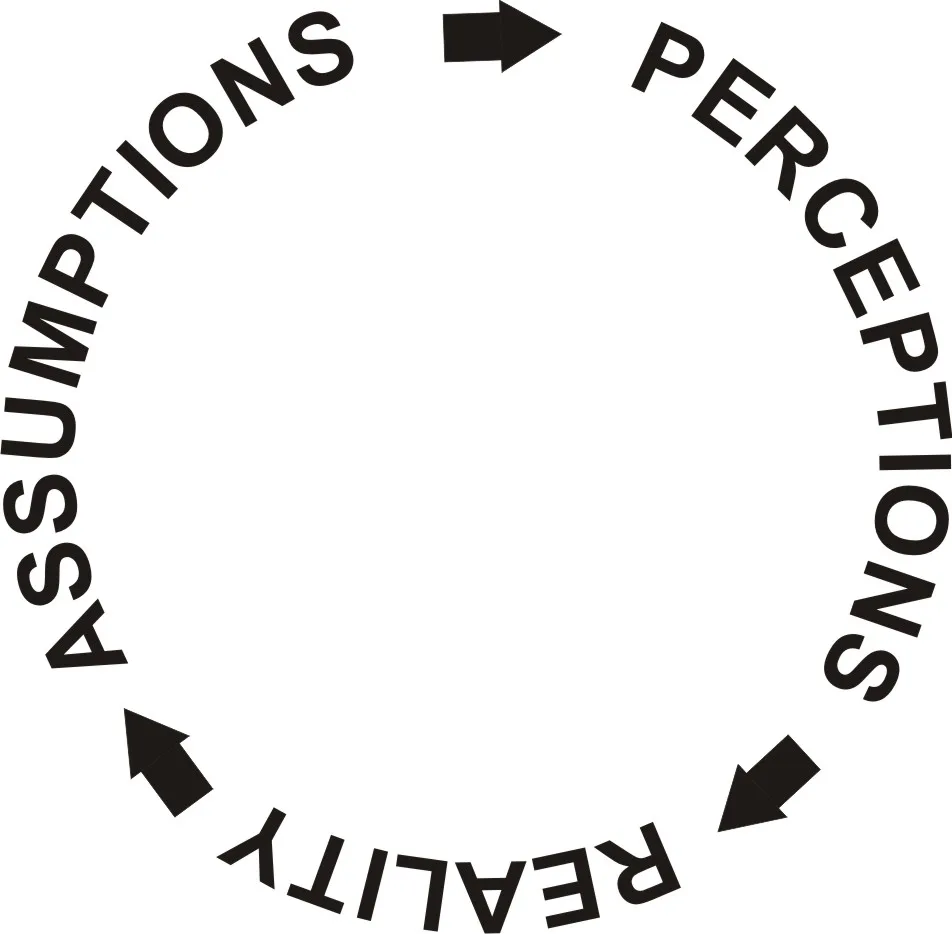
The Assumptions Perceptions Reality Triad and Cycle

Our assumptions work together to create our perceptions, and our perceptions create our reality. Let’s take a closer look at how this process works.

Suppose I have an assumption that, “Everybody in the world is out to get me.” That assumption will set my perception filter to look for evidence that supports my assumption. So any time anyone acts towards me in a way that can be interpreted as negative, I add that to my collection of evidence that “everybody is out to get me.”

At the same time, something interesting happens. Because my perception filter is set to look for evidence that people are out to get me, I’m going to look for that evidence even when people aren’t out to get me. Suppose someone isn’t out to get me, but is instead trying to do something nice for me. Since my perception filter is set for “people are out to get me,” how am I going to interpret this person’s nice actions? The answer is that since my assumption is that everyone is out to get me, this person can’t really be doing anything nice just to be nice. So I’m going to conclude instead that this person is only being nice in order to get something from me or to take advantage of me. My perceptions will cause me to believe that the reason this person is being nice is to set me up so that I’ll be caught off-guard.

So with my perception filter set in this way, everybody looks like they’re out to get me, and I’ve found evidence to confirm my assumption, because to me, even people who aren’t out to get me look like people who are out to get me.

Assumptions, Perceptions, and Reality

How do these assumptions and perceptions work together to create my reality? In the example above, imagine I’m someone trying to do something nice for you. I’m doing it because I think you’re a good person and I’d like to be your friend. But since your perception filter is set to only look for evidence that confirms your assumption that “everyone is out to get me,” you’re going to treat my attempts at being nice as attempts to take advantage of you.

How long would I continue to try to be nice to you if you continue to treat me as if I’m out to get you? Probably not for very long. Eventually I’m going to get tired of being treated like I’m out to get you, and I’ll give up and go away. The longer you continue to act on this particular assumption and perception, the more nice people you’re going to drive away. Eventually the only people left willing to interact with you will be people who are out to get you. So your assumptions and your perceptions have worked together to create a reality in which everybody remaining in your life really is out to get you.

Emotional aggression is usually the result of assumptions that others should be responsible for our emotional states. One way this could occur is if I assume that my partner should be responsible for my happiness. If I make such assumptions, then I’ve given up responsibility for my own emotional states. If I do that, then my moods will always be at the mercy of someone else’s whims, since I’ve placed my own emotional freedom in their hands.

If I instead choose to assume that only I can be responsible for my own emotional well-being, I set my perception filter to reflect that assumption. I can then look for evidence to support that assumption. By looking for evidence that supports my assumption that “I must be responsible for my own emotional well-being,” I create a reality in which I can choose to be happy and content no matter how others respond or react to me.

Think about some assumptions you may be making about your emotions and moods. How have these assumptions altered your perceptions? How have these perceptions created your present reality? How might you change your assumptions to get different perceptions so that you can create a different reality?

Posted on

Setting Boundaries: 7 Key Phrases to Use

boundaries connecting

You may download the worksheet using the button below.

The way to deal with conflict in positive ways is to realize that you are not responsible for anyone’s feelings but your own. If you avoid conflict out of a fear of upsetting others, first ask yourself why you think they would be upset.

boundaries - how to set healthy ones

Worrying about the emotional reactions others might have in a given situation is usually a sign of poor boundaries with the other person. Either they routinely cross your boundaries, or you routinely cross theirs, and when this happens, the result is usually conflict. Conflict is the root of most emotional aggression. The way to solve this problem is to establish good boundaries in all of your relationships. A sign of poor boundaries is the belief that another can be responsible for your emotional well-being, or that you can be responsible for another’s emotional well-being.

Do You Have Poor Boundaries?

A good rule of thumb when establishing boundaries is to ask yourself, “Am I being asked to do something that I wouldn’t ask (the other person) to do?” If the answer is ‘yes,’ then there’s probably an issue of poor boundaries in the relationship. Here are some signs that you may have poor boundaries with others:

  • Conversations on emotional topics result in anxiety and discomfort
  • You avoid conflict until things build up, then you explode
  • You feel responsible for other people’s feelings
  • You’re afraid to say ‘no’
  • You feel guilty when you do say ‘no’
  • You rarely speak up for yourself because you fear it may lead to conflict
  • You sometimes feel disrespected if you do stand up for yourself
  • You feel that you’re constantly giving and never getting back
  • Others ask you to do things for them that you would never ask them to do for you

If you answered “yes” to more than half of the items above, then you probably have poor boundaries.

Why It’s Important

Why is it important to set boundaries? If we have poor boundaries, we begin to feel responsible for the emotional well-being of others. We may also expect others to be responsible for our emotional well-being. By learning to set healthy boundaries, we minimize frustration, guilt, and anxiety for both ourselves and others. Healthy boundaries keep others from manipulating us, and help us to avoid the temptation to manipulate others.

7 Key Boundary-Setting Phrases

Here are some statements that you may use in your relationship with others to help you practice setting good and healthy boundaries. Use these statements when you feel that one of your boundaries has been crossed, or is about to be crossed:

  • “I care about you, but I cannot be responsible for your problems.”
  • “I care about you, but right now I need time to be alone.”
  • “I will not be the object of your hostility.”
  • “Just because I disagree with you, that doesn’t mean I don’t still care about you.”
  • “I enjoy spending time with you, but today I have other plans.”
  • “I don’t allow others to make me feel guilty about myself.”
  • “Even though I disagree with you, I still respect your right to feel the way you feel.”

Core Issues and Compromise Issues

In any relationship, there are core issues, and there are issues that can be compromised upon. A core issue is one in which there can be no compromise. Refusing to accept physical or verbal abuse would be an example of a core issue. It would be ridiculous for an abuser to offer a compromise of, “I’ll only physically abuse you on Tuesdays.” Physical abuse is an issue that is not open to compromise. It is therefore a core issue. Other examples of core issues might include drug abuse, marital infidelity, and verbal or emotional abuse.

A compromise issue, on the other hand, is an issue that you are willing to compromise on. An example of a compromise issue might be the question of where to have lunch with a friend or family member. You might have a lunch preference, but the choice is something that you would be willing to compromise on to some extent.

The way to distinguish a core issue from a compromise issue is that in order to compromise on a core issue, you would have to give up who you are. In other words, you would have to change your core identity. You can set a healthy boundary by refusing to compromise on your core values and your core identity. In mindfulness, we call this core identity your True Self.

Healthy Boundaries

People who lack clear limits often feel used, disrespected, and walked on. It’s easier to establish firm limits at the start of a relationship and then relax them over time than it is to strengthen weak ones. If you catch yourself saying, “I’ll do this just this one time…,” it’s a sign you need to reinforce your personal limits.

You cannot force anyone else to take responsibility for your happiness, and you cannot take responsibility for someone else’s emotional well-being. By setting and maintaining healthy limits, you make life easier for both yourself and those around you.


Share Your Thoughts!

What do you think about setting healthy boundaries? Share your thoughts in the comments below! And don’t forget to subscribe to our newsletter!

Posted on

Managing Beliefs with Mindfulness-Based Ecotherapy

managing beliefs

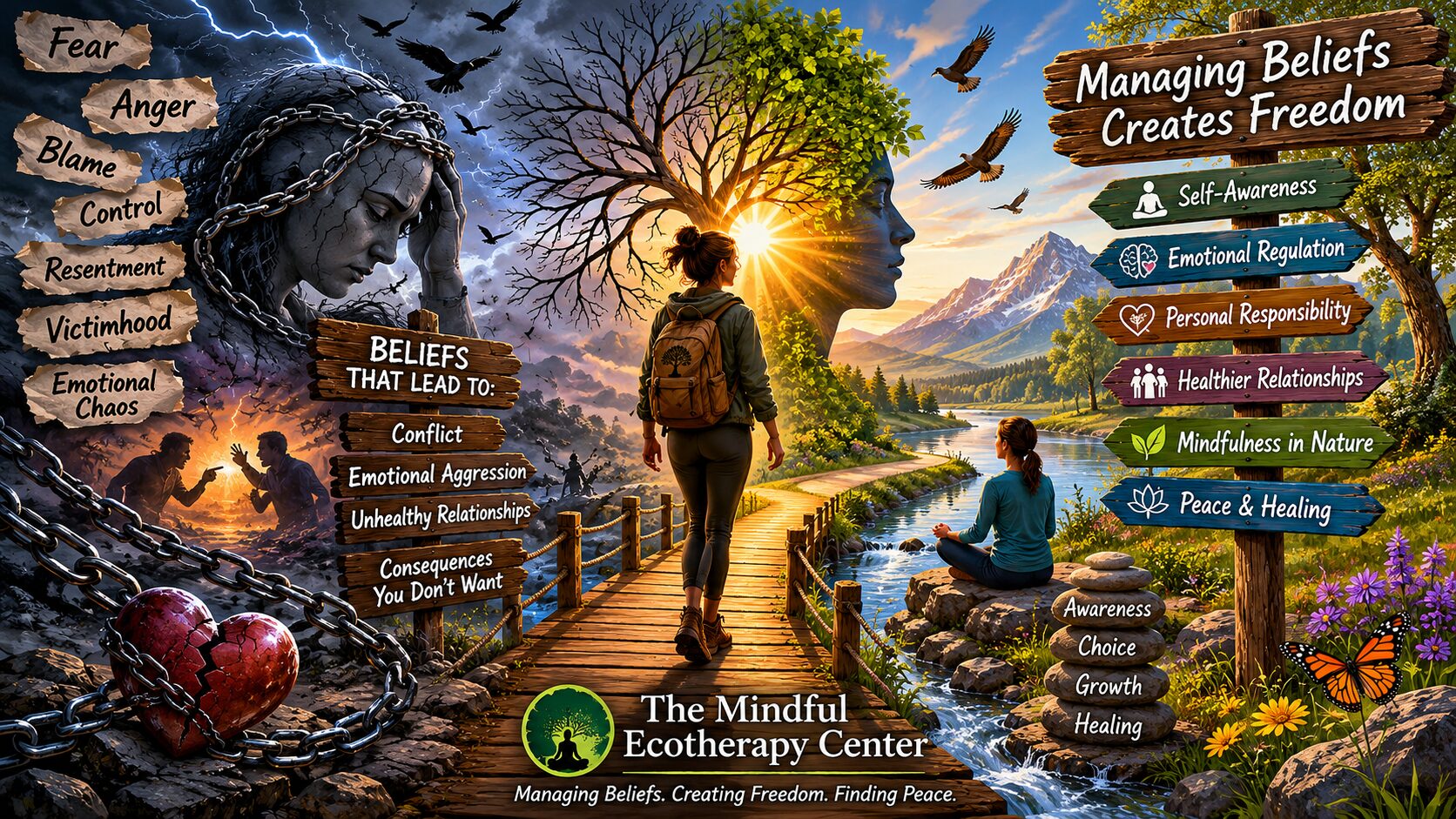
Managing beliefs is a way of dealing with patterns of behavior that lead to emotional aggression. When we examine the assumptions that support our beliefs, we can better manage our behavior and avoid the tendency to respond with emotional aggression. Managing beliefs is an essential part of emotional healing and personal growth. The beliefs you hold about yourself, other people, relationships, and the world often shape your emotional reactions and behavioral patterns. When these beliefs are rooted in fear, shame, insecurity, resentment, or unresolved trauma, they can contribute to emotionally aggressive behaviors that damage relationships and create emotional chaos.

From a mindful ecotherapy perspective, managing beliefs begins with awareness. You cannot change emotional patterns that you do not first recognize. By mindfully examining the assumptions underneath your reactions, you can begin to understand why certain situations trigger anger, defensiveness, manipulation, or emotional withdrawal.

In mindfulness-based ecotherapy, many people discover that their emotional responses are connected to deeply ingrained beliefs formed through past experiences, family systems, cultural conditioning, trauma, or unhealthy relationship dynamics.

Recognizing Beliefs That Lead to Harmful Consequences

One of the most important aspects of managing beliefs is recognizing when certain beliefs consistently lead to unwanted consequences. These consequences may include conflict in romantic relationships, damaged friendships, family tension, workplace problems, or even legal difficulties caused by emotional dysregulation or aggression.

For example, a person who unconsciously believes, “People will always abandon me,” may become emotionally controlling or reactive in relationships. Someone who believes, “I must always be in control,” may respond with anger or intimidation when feeling vulnerable. Another person may believe, “If I admit I’m wrong, I’m weak,” which can prevent accountability and healthy communication.

Mindful self-reflection allows you to ask difficult but necessary questions:

  • Are my beliefs helping or hurting my relationships?
  • Do my reactions create peace or emotional chaos?
  • Are my behaviors producing the kind of life I truly want?

The first step in healing is personal responsibility. Nobody else can change your beliefs for you. Managing beliefs requires a willingness to honestly examine your own patterns without blaming others for every emotional reaction.

Emotional Chaos and Emotional Aggression

Emotional aggression and emotional dysregulation often create emotional chaos both internally and externally. Many people who struggle with regulating difficult emotions unconsciously create conflict around them as a way of distracting themselves from their own pain, fear, insecurity, or unresolved trauma.

Managing beliefs

In addiction recovery, there is a pattern sometimes referred to as “drinking at” or “drugging at” someone. A person struggling with addiction may provoke arguments or create conflict so they can justify substance use by blaming another person for their emotional state. Instead of taking responsibility, they externalize blame.

This same pattern can occur with emotional aggression. A person who struggles with emotional regulation may provoke conflict, escalate arguments, manipulate emotions, or create instability to justify their reactions. In this way, emotional chaos becomes both a distraction and a coping mechanism.

From a mindful ecotherapy perspective, this cycle often reflects deep nervous system dysregulation. When people feel disconnected from themselves, from others, and from the natural world, they may unconsciously seek stimulation through conflict and emotional intensity.

Can People Become Addicted to Emotional States?

Neuroscience research suggests that emotional states trigger chemical responses within the brain. Intense anger, fear, conflict, drama, and emotional volatility can stimulate neurotransmitters that create temporary feelings of energy, control, excitement, or emotional release.

Over time, some individuals may develop what is known as a process addiction. Unlike substance addictions, process addictions involve becoming psychologically dependent on patterns of behavior or emotional states rather than chemicals themselves.

A person may become addicted to:

  • Conflict
  • Drama
  • Emotional intensity
  • Control
  • Anger
  • Victimhood
  • Relationship chaos

When emotional aggression becomes a repeated coping strategy, the nervous system may begin to normalize chaos as familiar and emotionally stimulating.

This does not make someone “bad” or hopeless. It means their nervous system may have adapted to unhealthy emotional environments and developed patterns that now require healing and conscious change.

Managing Beliefs Through Mindful Ecotherapy

Mindful ecotherapy offers a holistic approach to managing beliefs and emotional regulation by reconnecting people with self-awareness, embodiment, and the calming rhythms of nature.

Nature provides an environment that slows emotional reactivity and supports nervous system regulation. Forest walks, mindful breathing outdoors, gardening, grounding practices, and observing natural ecosystems can help create the internal space necessary for honest self-reflection.

When you spend time in nature mindfully, you often become more aware of your emotional patterns without immediately reacting to them. This awareness helps interrupt cycles of emotional aggression and allows healthier responses to emerge.

Mindfulness practices can also help you identify the beliefs beneath emotional reactions. Instead of automatically responding with anger or blame, you learn to pause and ask:

  • What belief is driving this reaction?
  • Is this belief actually true?
  • Is this belief helping me heal or harming my relationships?
  • What would happen if I chose a different response?

Managing beliefs does not mean suppressing emotions. It means learning to respond consciously instead of reacting impulsively.

Healing Emotional Aggression Through Responsibility and Awareness

Healing emotional aggression requires courage, accountability, and compassion for yourself and others. Blaming others for every emotional reaction keeps people trapped in cycles of conflict and emotional suffering. Taking responsibility for your beliefs and behaviors creates the possibility for genuine transformation.

From a mindful ecotherapy perspective, healing is not about perfection. It is about becoming more aware, more grounded, and more connected to yourself, your relationships, and the living world around you.

The more consciously you begin managing beliefs, the more freedom you create within your emotional life. Emotional peace often begins when you stop trying to control others and begin understanding yourself.


References

Singh R, Sharma R, Chauhan VS, Chatterjee K. Neurobiological underpinnings of emotions. Ind Psychiatry J. 2021 Oct;30(Suppl 1): S308-S310. doi: 10.4103/0972-6748.328838. Epub 2021 Oct 22. PMID: 34908718; PMCID: PMC8611534.


Share Your Thoughts About Managing Beliefs!

What do you think? Share your thoughts in the comments below!


  And don’t forget to subscribe to our newsletter!

Posted on

Process Addictions

process addiction and emotional aggression

Emotional aggressors can sometimes become addicted to their gaslighting behaviors.

The three major symptoms of an addiction are withdrawal, tolerance, and loss of control. In substance abuse, “withdrawal” manifests in physical and psychological symptoms upon abstaining from the drug of choice. “Tolerance” means that it takes more and more of the same drug to get the same effect. “Loss of control” means that as a person becomes addicted to a substance, they start giving up other things in pursuit of the next “high.”

People with addiction issues lose control over their behavior to the point that their drug of choice is the only thing that matters. They’ll forsake family, friends, work, school and any social interaction in pursuit of their drug of choice.

With emotional aggressors the “high” comes from manipulating others emotionally. For the emotional aggressor, withdrawal manifests as getting irritated, upset or angry when they can’t control you. Tolerance shows up as needing more and more control over the emotional states of others to get the same “high.”

Eventually this leads to loss of control. The emotional aggressor becomes more and more abusive over time, losing control of their ability to respect appropriate boundaries. Over time loss of control means that the gaslighting behaviors have become automatic. They don’t have to think about it and may not even be aware that they’re doing it.

Sometimes these automatic emotional processes can become what is known as process addictions. Robert Minor (2007) defines process addiction as:

“A process becomes an addiction when the process becomes the center of life, the most important reasons for living, when a person becomes dependent upon the process for mood-altering relief from the rest of life. For someone addicted to a process, the process with all its using activities substitutes for taking actions that would change the circumstances of one’s personal life and society that demand addictions to relieve the distress.”

What this means is that emotional aggression can become a conditioned response to a given emotional situation. If emotional aggression is consistently used as an anxiety-management strategy in your interactions with others, then you may be in danger of developing a process addiction. Conversely, if your partner or loved one seems to go on auto pilot whenever there’s a problem that needs to be addressed, they might have a process addiction.

How do you recognize a process addiction? If you’ve ever found yourself interacting with your partner or another friend or family member in a predictable pattern, there may be a process addiction at work. This is especially true if you are using emotionally aggressive responses in such a situation.

Suppose you’ve had an argument so many times that you can predict what your partner is going to say, and your partner can predict what you’re going to say. In other words, you’ve had this argument so many times that it’s almost as if there is an unwritten script somewhere that dictates your responses to each other. You keep going through the motions of this argument, but nothing ever gets resolved. Does this sound familiar?

I call such arguments Index Card Arguments, because it’s as if you’ve both written the argument down on an index card somewhere. You know that if you say this, your partner is going to say that, and your partner knows that if they say that, you’re likely to say this. If you could agree to write these arguments out on index cards and number them, you could both save yourselves a lot of time by saying, “Okay, we both know how this argument is going to turn out, so let’s just skip the argument and say that we had Index Card Argument #45, and take it from there.”

If you find yourself constantly having Index Card Arguments, it could be a sign that there is a process addiction occurring.

If nothing ever gets resolved from these repetitive arguments, then ask yourself honestly why you continue to engage in them. Do you feel better afterwards? Do these arguments cause you to feel more keyed up and anxious? Do they change your emotional state in any way? Are they taking your mind off of anxiety, depression, or bad feelings?

If you or your partner are using emotionally aggressive arguments as a means of managing your mood, then you may have a process addiction.


Minor, Robert N. (2007). When Religion is an Addiction. Humanity Works, St. Louis, MO.