Table of Contents
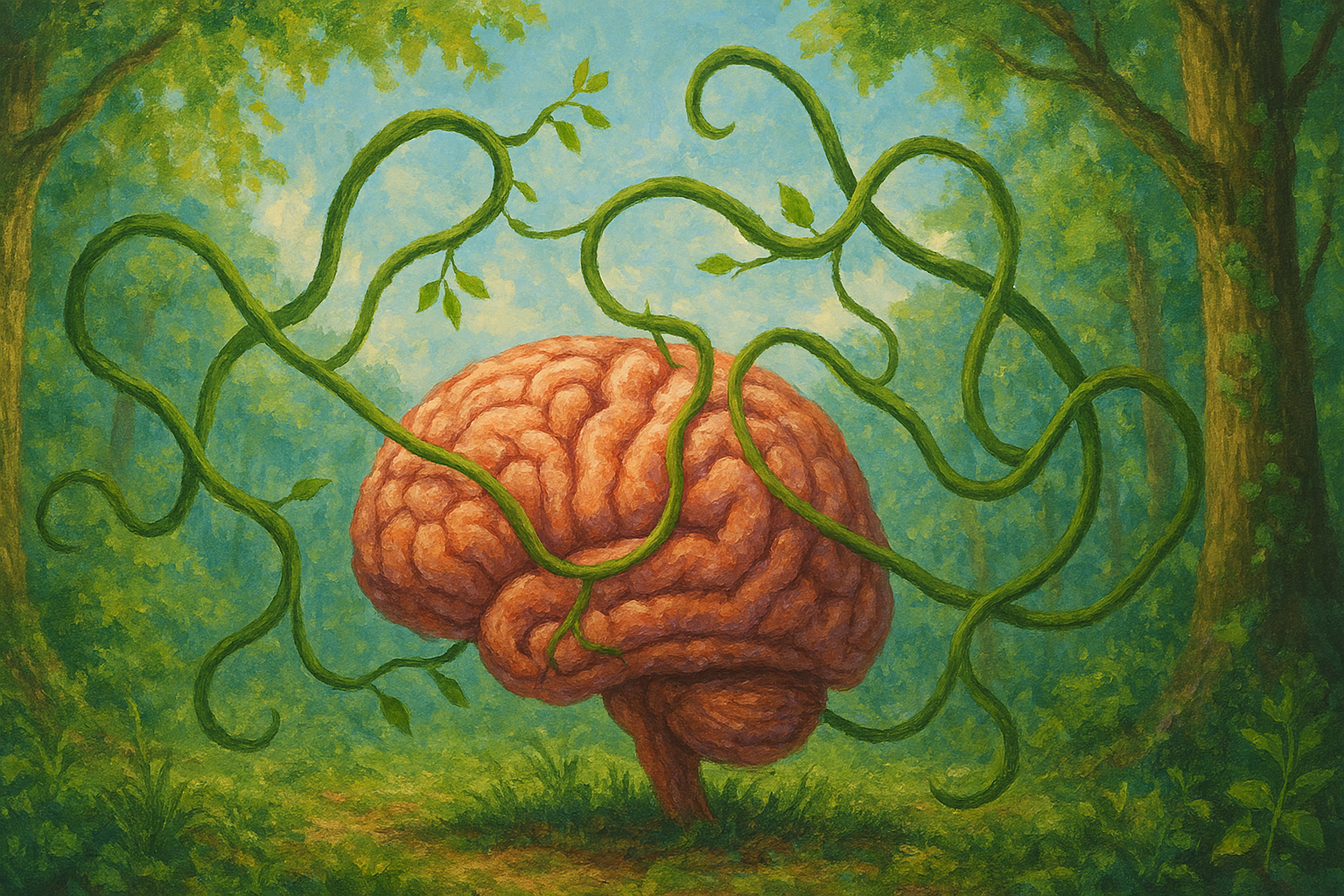
For most of its existence, homo sapiens has lived in harmony with nature as hunter/gatherers. Such a lifestyle requires a vast knowledge of the seasons, and of the patterns and habits of wildlife, and of plants and herbs and their healing powers. Industrialization and urbanization are fairly recent phenomena on an evolutionary scale. We still carry the genetic memory of our ancestors who lived in untamed nature. Our brains are wired for the outdoors and nature. A growing body of research demonstrates that not only do we feel better when we make time for nature, but it is also actually a requirement for good physical and mental health!
Ecopsychology and Ecotherapy
The field of ecopsychology studies how humans interact with nature. Ecopsychology is a philosophy combining elements of psychology and ecology. It is the philosophy that mental health is contingent upon the health of the environment. Humankind and the environment are part of an interrelated system. We are not separate from nature. We are a part of nature.
Ecopsychology suggests that there is a synergistic relation between planetary and personal well-being; that the needs of the one are relevant to the needs of the other. In short, what we do to the environment, we do to ourselves. Ecotherapy is the practical application of this knowledge. In ecotherapy, nature is the “therapist.” In practicing the techniques of ecotherapy, we allow the healing power of nature to work its magic on us. Hölzel et al (2011) demonstrated that meditative states of mindfulness stimulate neural growth in the cerebral cortex in the areas of the brain responsible for emotional regulation, good judgment, insight, and impulse control. Nature experiences have been demonstrated in several studies to produce meditative states (fascination, relaxation, and mindfulness).
Ecotherapy: Natural Experiences with Nature
Experiences in and with nature, or natural experiences, are ways in which we consciously choose to allow nature to work its healing magic on us. Some types of natural experiences include:
Facilitated Wilderness Experiences
In these types of experiences, a trained facilitator takes you into the woods for an adventure. These events can be anything from a wilderness experience in ecotherapy led by a therapist or counselor to a hunting trip led by a wilderness guide. Kuo & Taylor (2004) demonstrated that therapy and other activities conducted in outdoor settings reduced symptoms of Attention-Deficit Hyperactivity Disorder. Whittington (2006) found that wilderness skills training gave adolescent girls increased self-esteem and self-confidence and helped to shatter gender stereotypes.
Animal-Assisted Therapy
Animal therapy in the form of contact with pets and/or wild or domesticated animals enhances self-actualization and can lessen symptoms of depression. Antonioli & Reveley (2005) found that simply swimming with dolphins can greatly reduce symptoms of depression. Other studies have shown that owning pets, or even just watching fish in an aquarium, can greatly reduce stress. Equine Therapy uses horses to facilitate mental and physical well-being. There are many other ways that animals can help us lead happier lives, as any pet owner can tell you!
Therapeutic Gardens
Sempik & Spurgeon (2006) demonstrated that therapeutic gardening reduces stress and lessens symptoms of depression. Blair (2009) discovered that gardening can be used as a means of helping school children to enhance self-sufficiency, social identity, meaning, and self-integration. There’s just something very healing about planting something and nurturing it as you watch it grow.
Vacations
Berto (2014) discovered that outdoor activities reduce stress and restore energy. If you’ve ever had to miss a vacation, you’re probably painfully aware of the regenerative power of taking a week or so off to spend time in nature. Cole (2012) found that you don’t need a facilitator or guide to enjoy health and well-being benefits from the use of wilderness areas. There’s a reason we’re attracted to beaches and national parks!
Architecture Incorporating Natural Spaces
Nature can be incorporated into the home environment through the use of plants, an aquarium, or even recorded nature sounds. Alvarsson et al (2010) studied the positive mental health effects of listening to nature sounds.
Outdoor Classrooms
Dennis, Wells & Bishop (2014) revealed that outdoor classrooms enhanced many critical factors of the educational experience, including: Enhanced retention, better focus, more attention to detail, less hyperactivity, more relaxation, increased confidence and self-esteem, and better cognitive functioning
Why Mindfulness-Based Ecotherapy?
Mindfulness-based ecotherapy (MBE) enhances traditional ecotherapy by combining the restorative benefits of nature with the self-regulation and awareness skills cultivated through mindfulness practices. Ecotherapy alone has been shown to reduce stress, improve mood, and increase feelings of connectedness to the natural environment (Berto, 2014).
By integrating mindfulness, participants are encouraged to attend fully to present-moment sensory experiences within natural settings, which can deepen emotional processing, reduce rumination, and amplify psychological restoration (Kabat-Zinn, 2003). This combination strengthens the therapeutic impact, particularly for individuals prone to anxiety or depression, by not only providing exposure to nature but also fostering intentional engagement with it. Mindfulness enhances attentional control, allowing participants to notice subtle natural cues, reflect without judgment, and cultivate a sense of grounded presence, thereby making ecotherapy sessions more effective and transformative (Berto, 2014; Kabat-Zinn, 2003).
References
Alvarsson JJ, Wiens S, Nilsson ME. Stress recovery during exposure to nature sound and environmental noise. Int J Environ Res Public Health. 2010 Mar;7(3):1036-46. doi: 10.3390/ijerph7031036. Epub 2010 Mar 11. PMID: 20617017; PMCID: PMC2872309.
Antonioli C, Reveley MA. Randomised controlled trial of animal facilitated therapy with dolphins in the treatment of depression. BMJ. 2005 Nov 26;331(7527):1231. doi: 10.1136/bmj.331.7527.1231. PMID: 16308382; PMCID: PMC1289317.
Berto, R. (2014). The role of nature in coping with psycho-physiological stress: A literature review on restorativeness. Behavioral Sciences, 4(4), 394–409. https://doi.org/10.3390/bs4040394
Blair, D. (2009). The child in the garden: An evaluative review of the benefits of school gardening. Journal of Environmental Education, 40(2), 15–38.
Cole, D. N. (2012). Wilderness visitor experiences: A selective review of 50 years of research. Park Science, 28(3), Winter 2011‑2012. https://www.fs.usda.gov/rm/pubs_other/rmrs_2012_cole_d001.pdf
Dennis, S. F., Wells, A., & Bishop, C. (2014). A post-occupancy study of nature-based outdoor classrooms in early childhood education. Children, Youth and Environments, 24(2). https://doi.org/10.7721/chilyoutenvi.24.2.0035
Fieldhouse J, Sempik J. ‘Gardening without Borders’: Reflections on the Results of a Survey of Practitioners of an ‘Unstructured’ Profession. British Journal of Occupational Therapy. 2007;70(10):449-453. doi:10.1177/030802260707001006
Hölzel BK, Carmody J, Vangel M, Congleton C, Yerramsetti SM, Gard T, Lazar SW. Mindfulness practice leads to increases in regional brain gray matter density. Psychiatry Res. 2011 Jan 30;191(1):36-43. doi: 10.1016/j.pscychresns.2010.08.006. Epub 2010 Nov 10. PMID: 21071182; PMCID: PMC3004979.
Kabat-Zinn, J. (2003). Mindfulness-based interventions in context: Past, present, and future. Clinical Psychology: Science and Practice, 10(2), 144–156. https://doi.org/10.1093/clipsy/bpg016
Taylor AF, Kuo FE. Children with attention deficits concentrate better after walk in the park. J Atten Disord. 2009 Mar;12(5):402-9. doi: 10.1177/1087054708323000. Epub 2008 Aug 25. PMID: 18725656.
Share Your Thoughts!
What do you think? What courses would you like the Mindful Ecotherapy Center to add in the future? Share your thoughts in the comments below! And don’t forget to subscribe to our newsletter!