
Posted on

The “What” and “How” Skills of Mindful Awareness

skills of mindful awareness

There are six skills of mindful awareness in Dialectical Behavior Therapy (DBT). They are divided up into “what” skills and “how” skills. The “what” skills are what you do to be mindful, and the “how” skills are how you do what you do to be mindful. The worksheet linked below lists and briefly describes each of these skills.

The “What” Skills of Mindful Awareness

Observing

When we are preoccupied with thoughts of the past or the future, we are in thinking mode. Thinking mode takes us away from experiencing the world directly with our senses. In thinking mode, we are living in our heads instead of living in the moment.

The first of the skills of Mindful Awareness teaches us to focus on the world experienced directly by our senses: touch, taste, smell, hearing, and sight. Experiencing life in sensing mode introduces us to a richer world. It’s impossible to be bored or apathetic if you treat each experience as if it is happening to you for the first time, through your senses.

The skill of observing involves shifting out of thinking mode and into sensing mode by observing what you are experiencing in the present moment through all of your senses.

Describing

diagnosis skills of mindful awareness

The next of the skills of Mindful Awareness involves observing the smallest details of an object, event, or activity, then describing the experience in a non-judgmental fashion. Describing means approaching each daily activity as if you are experiencing it for the first time. Explore as many dimensions of it as you can. When we gain experience with this technique, we can apply it to other areas of our lives as well.

For example, by looking at your negative thought processes and identifying and labeling them as such, you are better able to recognize them simply as processes, and not as part of who you are as a person. DBT teaches you to describe experiences without judging them or labeling them as “good” or “bad.” Instead, you can label them as merely thoughts or feelings, while remembering that thoughts and feelings are not facts.

Participating

Mindful Awareness allows you to experience every aspect of an activity. We have a tendency, when in thinking mode, to see things and activities as either “all bad” or “all good.” This is not necessarily an accurate depiction of reality. Most activities aren’t inherently good or bad. We’ve taught ourselves to think of them in such terms, but we can also teach ourselves to think differently.

Think about an unpleasant activity that you have to engage in regularly, such as washing the dishes or taking out the trash. Can you think of any pleasant aspects of these activities? There are enjoyable aspects to every experience if we train ourselves to look for them. Even if we find ourselves caught in an activity in which we can find no pleasure at all, at least we have the pleasure of thinking about how good we’ll feel when the activity is over!

Life occurs in the present moment. Mastering the art of participation allows us to get the most out of life in the present.


The “How” Skills of Mindful Awareness

Non-judgmental

The first of the “how” skills of Mindful Awareness teaches us the art of acceptance. Emotional reactions to our circumstances are natural, but that doesn’t mean that we have to respond to these emotions. There’s no such thing as a “wrong” feeling. What may be “wrong,” or less effective, is how we choose to respond to the feeling.

The mindful skill of being non-judgmental teaches us that we can experience emotions without engaging in cycles of behavior that lead us to negative consequences. We can choose which thoughts and emotions we wish to respond to, and which just to sit quietly with, in “being mode.”

Being non-judgmental means seeing the world as it is, without judgments or assumptions. When we can do so, we have achieved Beginner’s Mind or Child’s Mind, which is the art of experiencing everything as if seeing it for the first time, without judgment.

One-mindful

Being “one mindful” simply means focusing on one thing at a time. Being one-mindful allows us to live in the present moment.

Emotional dysregulation often occurs because we tend to focus on all the emotionally overwhelming aspects of a situation while thinking we have to do something to fix it. Wanting to fix it is “Doing Mind.” Being one-mindful allows us to shift to “Being Mind” and just be with the emotion without having to do anything about it.

A journey of a thousand miles begins with a single step. If you focus on the thousand-mile journey, you’ll become so emotionally overwhelmed you’ll never take the first step; but if you instead just focus on the step that’s in front of you, and then the next step, and then the next, you will eventually complete the entire journey.

The most effective way to do this is to first ask yourself, “What is the smallest thing I can do in this situation that will make a difference? Do that, and then if you have any energy left over, you can focus on the next step, and so on, until the journey is completed.

When you learn to do this, you will have learned to be one-mindful.

Effective

This is probably the most important of the skills of mindful awareness because it teaches us to focus on solutions, not problems. We can talk about problems all day, but until we start talking about solutions, nothing will ever get solved. The way to solve a problem is to take positive, intentional steps towards finding a solution.

A mindful life is a life lived deliberately and effectively. It is a purposeful life. Being effective means solving problems in a purposeful, intentional manner. The way to be effective is to begin by asking two questions:

  1. What is my intention in this situation?
  2. Are my thoughts, feelings, and behaviors going to help me to achieve this intention?

When we live using the skills of mindful awareness, our thoughts, behaviors, and actions always support our intention. When we learn to do this, we have learned how to be effective.


Mindful Ecotherapy Center on YouTube

Subscribe to the Mindful Ecotherapy Center’s YouTube channel to bring peace, presence, and healing into your daily life. Our videos guide you through mindfulness-based ecotherapy practices, including forest bathing, tree planting rituals, nature meditations, and reflective exercises for grief, stress, and emotional well-being.

Whether you’re seeking to reconnect with the natural world, cultivate inner calm, or find restorative tools for personal growth, our content offers practical guidance, inspiration, and community support. Join us to explore the transformative power of nature and the skills of mindfulness, and start your journey toward balance, resilience, and deeper connection today!


Share Your Thoughts!

What do you think? Share your thoughts in the comments below! And don’t forget to subscribe to our newsletter!
Posted on

Upstairs Brain vs. Downstairs Brain

upstairs brain nature rewires the brain
upstairs brain

Feelings of depression, anxiety, sadness, and other emotions are generated in a part of the brain called the limbic system. This ‘downstairs’ portion of the brain is only interested in three things: Fighting, fleeing, or freezing. In ‘fight’ mode, the downstairs brain wants to protect you from harm by fighting against the threat. When it is triggered, your heart may race, your palms may get sweaty, and you may have a sharp increase in irritability and anger. In ‘flee’ mode, you may experience a similar adrenaline rush, but in this instance, your brain is preparing your body to run away from the danger. In ‘freeze’ mode, we tend to retreat inside ourselves. This is the deer-in-the-headlights feeling of “If I’m very quiet and still, the bad thing won’t see me.”

How the Upstairs Brain Interacts with the Downstairs Brain

Whether you’re in fight, flee, or freeze mode, your downstairs brain is preparing you to deal with a real or perceived threat in the only way it knows how. When your downstairs brain is engaged, the upstairs part of your brain tends to get overwhelmed. The upstairs brain, which consists of the neocortex of the brain, is the part responsible for thinking things through, figuring things out, and solving problems. When the downstairs brain takes over, the upstairs brain is out to lunch. That’s why when you’re emotionally overwhelmed, it is nearly impossible to figure out a way to deal with it. The upstairs brain is all about finding solutions to problems, but the downstairs brain is all about fighting, fleeing, or freezing. When your upstairs brain is overwhelmed, thinking things over isn’t going to work. That’s because at that point, your downstairs brain is in charge. For those times when your downstairs brain is running the show, mindfulness is a way of disengaging from the thinking cycle for a while so that you can re-center yourself and reconnect with yourself and the world around you.

How Mindfulness-Based Ecotherapy Supports the Upstairs Brain, the Downstairs Brain, and a Calmer Nervous System

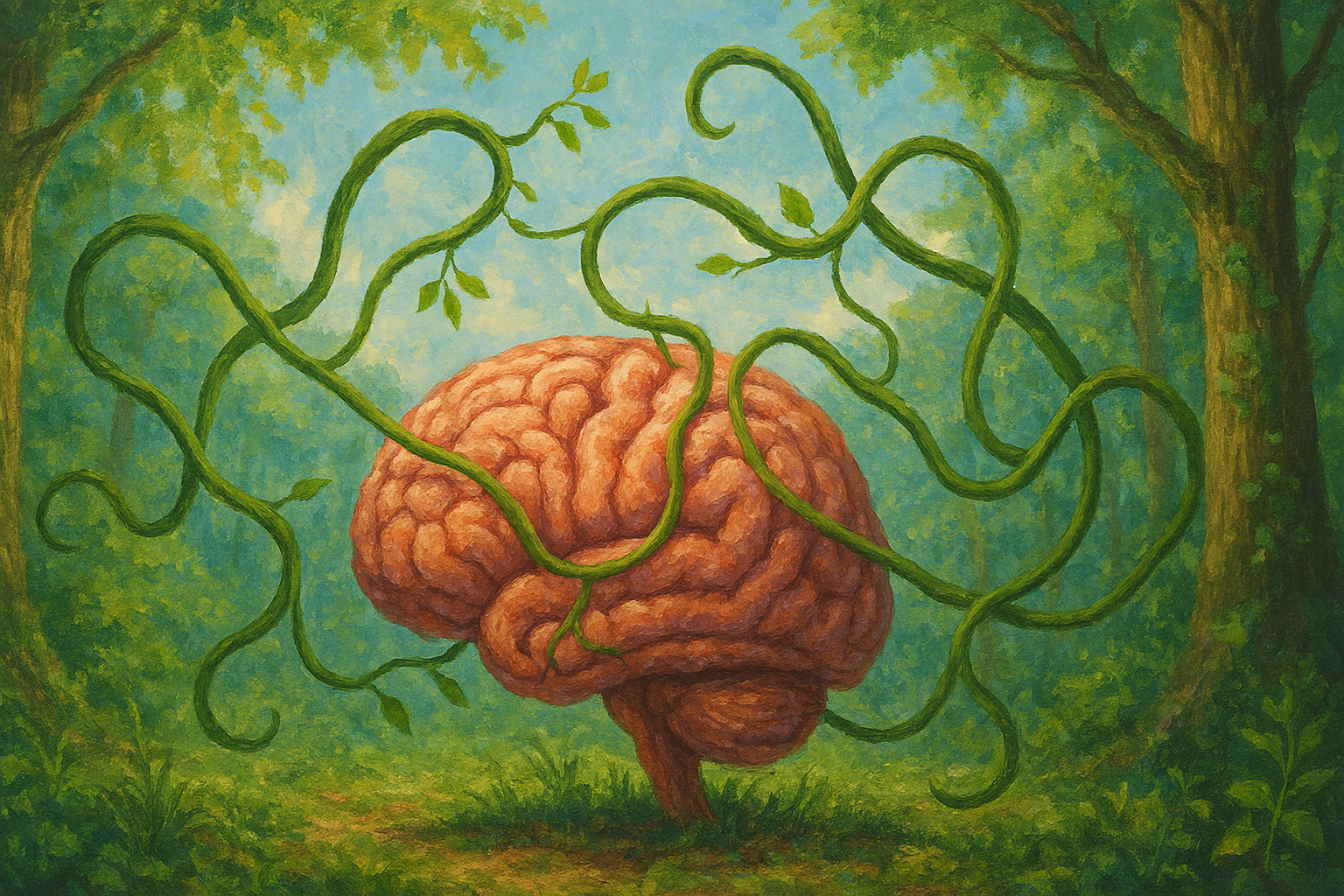
The “upstairs brain vs. downstairs brain” model offers a simple way to understand how our minds react to stress. The “downstairs brain” refers to evolutionarily older structures such as the amygdala, brain stem, and limbic regions. These areas handle survival instincts, fight-or-flight responses, and quick emotional reactions. The “upstairs brain” includes the prefrontal cortex and other regions responsible for reasoning, emotional regulation, empathy, and long-term decision-making. In moments of stress, the sympathetic nervous system activates the downstairs brain, often overwhelming the upstairs brain’s ability to respond calmly. This imbalance can lead to impulsive reactions, emotional flooding, or a sense of being perpetually on edge.

Mindfulness-Based Ecotherapy: A Practical Solution

Mindfulness-Based Ecotherapy offers a practical, grounded way to restore balance between these two systems. By integrating mindfulness practices with nature-based experiences, it supports regulation of the sympathetic nervous system while strengthening the upstairs brain’s capacity to stay engaged even during difficult moments.

One of the most powerful aspects of nature-based mindfulness is how quickly it downshifts the nervous system. Being outdoors, or even visualizing natural environments, has been shown to reduce sympathetic arousal and increase activity in the parasympathetic system. This shift creates the physiological conditions necessary for the upstairs brain to come back online. When the body stops signaling danger, the prefrontal cortex is freed to resume its role in planning, reflection, and problem-solving. Mindfulness in nature makes this transition smoother by encouraging sensory awareness, present-moment attention, and slower breathing, each of which directly supports parasympathetic activation.

How Mindfulness Trains Attention

Another key component is how mindfulness trains attention. The downstairs brain often hijacks the mind by pulling attention toward perceived threats. Mindfulness practice teaches individuals to notice this pull without automatically following it. In ecotherapy, this awareness is supported by grounding elements: the texture of tree bark, the rhythm of waves, and the sound of wind through leaves. These sensory anchors provide a natural counterweight to the internal storm generated by the sympathetic nervous system. Over time, this helps strengthen neural pathways associated with emotional regulation, making it easier for the upstairs brain to remain active even when the downstairs brain fires up.

Interoceptive Literacy and the Upstairs Brain

Mindfulness-Based Ecotherapy also promotes what some therapists refer to as “interoceptive literacy,” the ability to recognize and interpret internal body signals. A dysregulated sympathetic system often produces sensations such as a tight chest, rapid heartbeat, or restlessness. When people learn to identify these early cues without judgment, they gain a moment of choice. This pause allows the upstairs brain to intervene before the downstairs brain drives behavior. Practices like mindful walking, breath-based grounding, or observing natural cycles help individuals connect more deeply with these signals in a supportive, non-threatening environment.

Emotional Processing and the Upstairs Brain

Nature-based mindfulness also supports emotional processing. The downstairs brain often stores unresolved emotional material that surfaces during stress. Natural environments provide a calming backdrop for working through these experiences without becoming overwhelmed. The sense of spaciousness and the absence of artificial stimuli reduce cognitive load, giving the upstairs brain more bandwidth to integrate emotional information. This creates a more flexible, resilient nervous system that can adapt to challenges rather than reacting automatically.

Connectedness and the Upstairs Brain

Finally, Mindfulness-Based Ecotherapy strengthens the sense of connectedness that is crucial for nervous system regulation. Feelings of isolation can intensify sympathetic activation, while experiences of belonging and connection activate systems of safety and social engagement. Ecotherapy offers a double form of connection: with nature and with one’s own internal experience. This sense of being part of something larger reduces the perception of threat and supports long-term regulation of both the upstairs and downstairs brain.

In this way, Mindfulness-Based Ecotherapy provides a holistic path to balancing instinctive emotional responses with thoughtful, grounded awareness. By soothing the sympathetic nervous system and strengthening the upstairs brain, it helps people respond to life’s challenges with clarity, resilience, and a greater sense of peace.


References

Jo H, Song C, Miyazaki Y. Physiological Benefits of Viewing Nature: A Systematic Review of Indoor Experiments. Int J Environ Res Public Health. 2019 Nov 27;16(23):4739. doi: 10.3390/ijerph16234739. PMID: 31783531; PMCID: PMC6926748.


Share Your Thoughts!

What do you think? Share your thoughts in the comments below! And don’t forget to subscribe to our newsletter!