Posted on Leave a comment

Nature as Teacher: A Grounded Path to Growth and Healing

nature as teacher

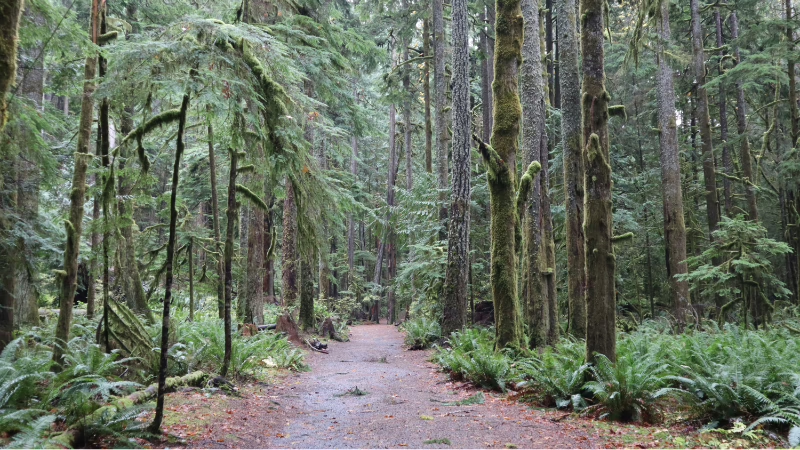
Nature as Teacher is one of the core ecotherapy skills in Mindfulness-Based Ecotherapy, and it rests on a simple but often forgotten truth: the natural world is already instructing you. Whether you are paying attention or not, nature is constantly modeling resilience, adaptation, balance, and renewal. When you approach nature mindfully, you stop treating it as scenery or background noise and begin engaging with it as an active source of learning. In this way, nature becomes not just a place you visit, but a teacher you relate to.

Observing and Reflecting

In Mindfulness-Based Ecotherapy, Nature as Teacher invites you to observe the rhythms, cycles, and processes of the natural world and reflect on how they mirror your own internal experiences. Seasons change without apology. Storms come and go. Trees lose their leaves and grow them back. Nature is a perpetual cycle of birth, growth, and decay. All of it is part of a natural process. Nothing in nature clings to a single state forever, and yet everything belongs. When you allow yourself to learn from these patterns, you begin to see your own emotions, challenges, and transitions differently. Growth no longer feels like a personal failure or moral test. It becomes a natural process.

Nature Teaches Mindful Presence

Mindfulness is essential here because learning from nature requires presence. You cannot learn from what you rush past. When you slow down and observe mindfully, nature starts offering lessons without words. A fallen tree teaches impermanence without judgment. A river teaches persistence without force. A forest teaches interdependence without hierarchy. These lessons land not because you analyze them to death, but because you experience them directly. This is where mindfulness-based ecotherapy differs from abstract self-help concepts. You are not just thinking about resilience. You are watching it happen.

Reframing with Nature as Teacher

Nature as Teacher also helps you reframe struggle. In human culture, struggle is often treated as something gone wrong. In nature, struggle is information. A plant that grows crooked adapts to light. A trail eroded by water reveals where pressure accumulates. When you view your own anxiety, grief, or uncertainty through this lens, you stop asking, “What is wrong with me?” and start asking, “What is this teaching me?” That shift alone can reduce shame and increase self-compassion.

This skill is particularly powerful for people who feel stuck or disconnected from their own intuition. Nature teaches without lectures and without demands. You are free to notice what resonates and leave the rest. A long winter can teach patience. A controlled burn can teach the necessity of endings. Migration can teach you when it is time to move on. These lessons emerge organically when you permit yourself to listen.

Nature Teaches Adaptability

Within the framework of Mindfulness-Based Ecotherapy, Nature as Teacher is not about romanticizing the outdoors or pretending that nature is always gentle. Nature is honest. It includes decay, loss, and disruption alongside beauty and growth. That honesty makes it a trustworthy teacher. When you sit with nature as it is, you learn to sit with yourself as you are. You begin to understand that healing does not mean avoiding pain, but moving through it with awareness and respect.

Over time, engaging with Nature as Teacher strengthens your sense of belonging. You are no longer a separate, broken thing trying to fix yourself. You are part of a living system that knows how to adapt, recover, and continue. That perspective can be deeply regulating for your nervous system and profoundly reassuring during times of change.

Mindfulness-Based Ecotherapy integrates this skill intentionally, helping you translate what you observe in nature into meaningful insights for your daily life. When nature becomes your teacher, learning no longer feels forced. It feels remembered.

To learn more about Mindfulness-Based Ecotherapy and how nature-based practices can support your growth and healing, visit www.mindfulecotherapycenter.com


References

Dahl, C. J., Wilson-Mendenhall, C. D., & Davidson, R. J. (2020). The plasticity of well-being: A training-based framework for the cultivation of human flourishing. Proceedings of the National Academy of Sciences, 117(51), 32197–32206. https://doi.org/10.1073/pnas.2014859117

Kuo, M. (2021). How might contact with nature promote human health? Promising mechanisms and a research agenda. Frontiers in Psychology, 12, 691399. https://doi.org/10.3389/fpsyg.2021.691399

Mathieson, F., Jordan, J. R., & Carter, J. D. (2020). Metaphor in psychotherapy: A systematic review. Clinical Psychology Review, 81, 101892. https://doi.org/10.1016/j.cpr.2020.101892

Neff, K. D., & Germer, C. K. (2022). The mindful self-compassion program: Effects on self-compassion, mindfulness, and well-being. Journal of Clinical Psychology, 78(2), 389–402. https://doi.org/10.1002/jclp.23297

Passmore, H. A., & Howell, A. J. (2020). Nature involvement increases hedonic and eudaimonic well-being: A two-week experimental study. Ecopsychology, 12(1), 1–11. https://doi.org/10.1089/eco.2019.0025

Piff, P. K., Dietze, P., Feinberg, M., Stancato, D. M., & Keltner, D. (2021). Awe, the small self, and prosocial behavior. Journal of Personality and Social Psychology, 120(1), 1–23. https://doi.org/10.1037/pspi0000267

Schutte, N. S., & Malouff, J. M. (2021). Mindfulness and connectedness to nature: A meta-analytic investigation. Personality and Individual Differences, 179, 110984. https://doi.org/10.1016/j.paid.2021.110984


Share Your Thoughts About Nature as Teacher!

What do you think? Share your thoughts in the comments below!


  And don’t forget to subscribe to our newsletter!
Posted on

Mindful Awareness: The Transformative Power of Unlocking Clarity

mindful awareness

Mindful awareness is the foundational skill in Mindfulness-Based Ecotherapy, providing a gateway to living fully in the present moment. Unlike our habitual Doing Mode, where thoughts, tasks, and future planning dominate our attention, mindfulness represents a deliberate shift into Being Mode. In Being Mode, we are fully present, observing our internal and external worlds without distraction or judgment. This practice is a profound way of engaging with life as it unfolds in the now.

About Mindful Awareness: The “What” Skills

Mindful awareness is composed of several core capacities that guide practitioners toward deeper presence. The “what” skills are what you do to be mindful. Observing allows individuals to notice thoughts, feelings, bodily sensations, and environmental cues without immediately reacting. This skill helps cultivate self-awareness and clarifies patterns that may contribute to stress or maladaptive behavior. Describing encourages the labeling of experiences with words, which enhances understanding and cognitive processing of emotional and sensory information. Participating involves fully engaging in activities without detachment or avoidance, nurturing an embodied connection to the present.

About Mindful Awareness: The “How” Skills

The “how” skills of mindfulness involve how to be mindful. Being non-judgmental, another essential element of mindful awareness, allows people to witness experiences without categorizing them as good or bad. This non-reactive stance diminishes self-criticism and promotes psychological flexibility. One-mindfulness refers to focusing on a single task or experience at a time, preventing the mind from scattering across multiple distractions. Finally, being effective emphasizes skillful engagement with life, encouraging actions that align with personal values and goals rather than automatic impulses.

Mindful Awareness and Ecotherapy

The skill of mindful awareness is particularly powerful when paired with ecotherapy techniques, which provide tangible avenues for grounding attention in the natural world. For example, observing the rhythm of waves, the texture of leaves, or the sounds of birds allows individuals to anchor their attention in sensory experience. This integration of mindfulness and nature enhances present-moment awareness, promotes stress reduction, and strengthens the connection between inner states and the external environment.

Mindfulness deepens when you step into nature because the natural world gives you fewer places to hide from the present moment. When you are outside, your senses are gently but persistently engaged. The sound of wind in trees, the uneven texture of a trail under your feet, and the shifting light on water all pull your attention out of Doing Mode and into Being Mode. You are not trying to be mindful.

Trying is doing, and mindful awareness is about being, not doing. You are responding to what is actually happening around you. This sensory richness makes it easier to observe without judgment, to notice thoughts as they arise, and to return again and again to direct experience instead of mental commentary and ruminating thoughts.

Nature also supports the specific skills that make up mindful awareness. When you watch clouds move or leaves sway, you practice observing without needing to intervene. When you silently name what you notice, cool air, birdsong, tightness in your chest, you strengthen the skill of describing. Walking slowly through a forest or along a shoreline invites one-mindfulness, because multitasking stops working out there in nature.

Even emotional experiences become clearer in the natural world. If frustration or sadness arises while sitting near a river, you can practice non-judgment by allowing those feelings to exist alongside the steady flow of water. In this way, nature becomes a living practice space where mindfully living in the moment feels less forced, more embodied, and easier to access. You are not striving for presence. You are already inside it, surrounded by cues that continually bring you back to now.

At the Mindful Ecotherapy Center, we guide clients through the practice of mindful awareness, helping you recognize the difference between Doing Mode and Being Mode, and teaching you how to embody this skill in daily life. By developing mindful awareness, you not only increase self-knowledge and emotional regulation but also lay the groundwork for engaging fully with the subsequent skills of Mindfulness-Based Ecotherapy.


Share Your Thoughts About Mindful Awareness!

What do you think? Share your thoughts in the comments below!


  And don’t forget to subscribe to our newsletter!

Posted on

Being One-Mindful

strawberries

I love strawberries. I can nibble on them all day long. There have been times when I have been engaged in other activities while eating strawberries. I may be sitting at the computer, typing away, blissfully chewing strawberries.

As I munch away, with my attention on the computer and not on the strawberries, I am sometimes surprised and disappointed when I reach into the bowl in a mindfulness fashion only to realize that I have eaten the last one.

On those occasions when I’ve eaten the last strawberry without realizing that it was the last one, the thought that came to mind was, “If I had known that I was eating the last one, I would have enjoyed it more!”

What is it about knowing that I’m about to eat the last strawberry that makes eating it more enjoyable? That particular strawberry isn’t going to taste any different from the rest of the ones in the bowl. What makes the experience of the last strawberry different and more enjoyable is the fact that I have focused all of my attention on enjoying it, because it is the last one.

What if we could learn to make every strawberry the last one?

Singer/songwriter Ray Charles once said, “Live every day as if it will be your last, because one of these days, you’re going to be right.”

What if you knew that today would be your last day on Earth? What would you do differently? How would you respond to those around you? What would you say to your loved ones? Would you treat them any differently if you knew that this might be the last time you would ever see them? What would be different about your to do list? Would your priorities change if you knew that this was your last day?

Looking at your life from this perspective tends to help you focus on what’s really important. If you could really live up to the idea that today may be your last day on Earth, it would probably cause you to slow down and enjoy each experience that comes your way. Each day could be the last strawberry.

The ability to do this is what practitioners of Mindfulness call Mindful Awareness. Mindful Awareness is the skill of focusing on one thing at a time. It is the ability to make each strawberry the last strawberry. It is also the ability to enjoy each day of our lives as if it were the last one. Mindful Awareness teaches us that the way to live every day as if it will be your last, is to focus on the moment, savoring every bit of every experience the world has to offer.

(Kabat-Zinn, 1994, p. 4) identifies three major components of mindfulness. These are:

  1. “On purpose” or intention,
  2. “Paying attention” or attention,
  3. “In a particular way” or attitude (mindfulness qualities

These components may be summed up as focusing on one thing at a time or being one-mindful.

By intentionally paying attention in a particular way (i.e., mindfully), we are able to focus only on the experience that is before us, without judgments or expectations. We are also able to approach the situation without assumptions by focusing only on the experience itself.

According to Shapiro, et al (2006), “In the context of mindfulness practice, paying attention involves observing the operations of one’s moment-to moment, internal and external experience. This is what Husserl refers to as a “return to things themselves,” that is, suspending all the ways of interpreting experience and attending to experience itself, as it presents itself in the here and now. In this way, one learns to attend to the contents of consciousness, moment by moment.”

By focusing on one thing at a time, we also place ourselves in the present moment, and take ourselves out of thoughts about the past or the future. In this way, we avoid the temptation to interpret the experience based on what has gone before or what may come in the future. The experience simply is what it is, with no interpretation required.


Kabat-Zinn, J. (1994). Wherever you go, there you are: Mindfulness meditation in everyday life. New York: Hyperion

Shapiro SL, Carlson LE, Astin JA, Freedman B. Mechanisms of mindfulness. J Clin Psychol. 2006 Mar;62(3):373-86. doi: 10.1002/jclp.20237. PMID: 16385481.

Posted on

Being Mode, Doing Mode and Two Powerful Wolves

being mode

Being Mode is where we make a change in our lives. A key aspect of mindfulness is stepping outside of doing mode and entering into being mode.

being mode

When we’re caught up in thought and feeling cycles that lead to depression and anxiety, we usually feel that we should be doing something to fix it. The problem with this is that sometimes there is nothing you can do to fix a problem. Mindfulness is a way to escape this cycle of trying to fix things by simply focusing on our moment-to-moment experience. When we are doing this, we are in being mode. In being mode, we are not trying to fix anything. We are not trying to go anywhere. We are not trying to do anything. We are not trying, period. Trying is doing, and being mode isn’t about doing.

Being Mode and the Downstairs Brain

In being mode, we are free to enjoy our experiences from moment to moment by focusing on what our senses are telling us, rather than focusing on trying to find a way out of a problem. When the downstairs brain is engaged, and the upstairs brain is temporarily disconnected, moving into being mode allows us a little breathing room.

The way to move from doing mode to being mode is to shift our mental energy from thinking mode to sensing mode. Our brains only have a finite amount of energy to spend on any given task at any given time. If we have a stressful or depressing thought cycle going on, we can shift energy from what our thoughts are telling us by engaging our internal observer to start focusing on what our senses are telling us. As you read this paragraph, can you feel your breath going in and out of your lungs? Were you even aware you were breathing before you read the previous sentence? When caught up in thinking cycles, we’re focusing on the boomerang. But by shifting our attention to our direct experiences and focusing on what our senses are telling us, we’re able to move into sensing mode.

Sensing Mode: The Way to Being Mode

When in sensing mode, we are no longer giving energy to ruminating cycles that are leading us to states that we do not want to experience. We are able to move to sensing mode by focusing first on our breathing, then on our direct experiences of the current situation. We do this by using all of our senses, in the moment, to explore the environment around us. What do we hear? What do we see? What do we smell? What do we taste? What do we feel? By asking ourselves these questions, we are able to move into sensing mode.

Two Wolves: The Being Wolf

The more energy we spend on sensing, the less energy we have to spend on thinking. Based on the tale of two wolves, we could see the two wolves as “thinking wolf” and “sensing wolf.” The more energy you give to the sensing wolf, the less energy you give to the thinking wolf. The less energy the thinking wolf receives, the weaker the thinking wolf becomes. Conversely, the more energy the sensing wolf receives, the stronger the sensing wolf becomes. By shifting from thinking to sensing, you’re not trying to ‘kill’ the thinking wolf. You’re not engaging in doing by trying to make the thinking wolf go away. You’re simply depriving it of energy so that it may eventually go away on its own. Even if it doesn’t go away on its own, you’re not focusing your attention on it. Since your attention isn’t on it, thinking wolf can’t grab you by the throat, refusing to let go.

It could be said that focusing on what your senses are telling you is a type of thinking as well, and that is partially true; however, the difference is that focusing on what your senses are telling you is a type of thinking devoid of emotional content. If you’re in a thinking cycle that is causing you anxiety or depression, then anxiety and depression are emotions. But unless you hate trees for some reason, simply sitting quietly in a forest and observing a tree as if you are an artist about to draw that tree is an exercise devoid of emotional content. By focusing on the emotionally neutral stimuli found in nature, we give ourselves the opportunity to feed the sensing wolf.

Mindfulness-Based Ecotherapy and Being Mode

Mindfulness-based ecotherapy can be a powerful tool for facilitating being mode. By combining mindful awareness with direct engagement in natural environments, this approach gently redirects attention away from the habitual “doing mode,” which is dominated by planning, problem-solving, and ruminating.

Nature’s rhythms, such as the sound of leaves rustling, water flowing, or birds singing, provide sensory anchors that draw the mind into immediate experience. Through guided practices like mindful walking, focused breathing outdoors, or reflective observation of natural phenomena, we learn to notice thoughts and emotions without automatically reacting, creating space for a deeper sense of presence. Over time, repeated experiences of this mindful immersion in the environment can quiet your sympathetic nervous system, lower stress, and cultivate an enduring capacity to remain in being mode even outside of therapeutic sessions.


References

Ilomäki M, Lindblom J, Salmela V, Flykt M, Vänskä M, Salmi J, Tolonen T, Alho K, Punamäki RL, Wikman P. Early life stress is associated with the default mode and fronto-limbic network connectivity among young adults. Front Behav Neurosci. 2022 Sep 23;16:958580. doi: 10.3389/fnbeh.2022.958580. PMID: 36212193; PMCID: PMC9537946.


Share Your Thoughts!

What do you think? Share your thoughts in the comments below! And don’t forget to subscribe to our newsletter!