Posted on

Thought Streams

thought streams

Thought streams can impact one’s ability to cross the First Threshold. Setting out on the path by Crossing the First Threshold means being open to new ways of thinking and new ways of being. One way to do this is to change your thoughts by learning to live in the present moment, with intention.

Imagine that your thought streams and feelings are like a river. The river is always flowing, ever changing. In this river of the mind, sometimes positive thoughts float to the top, and sometimes negative thoughts float to the top. If we find ourselves in a spot on the river where those negative thoughts are floating to the top, our goal isn’t to stop the river by trying to dam it up. If we try to dam up the river, the water will only continue to back up behind the dam until either the dam bursts or the water overflows.

This is what happens when people have panic attacks or “nervous breakdowns.” The water behind the dam has no place to go, and it eventually builds up until a catastrophe happens.

Trying to stop negative thought streams and feelings by damming up the river isn’t the answer, since it could lead to catastrophe. So how do we deal with such thoughts?

What if there was an alternative to trying to stop the river by building a dam across it?

Thought Streams and the River

If we find ourselves at a place on the river where those negative thought streams are flowing to the top, we can consciously decide not to drown in the river by choosing instead to get out of the river, sit on the riverbank, and watch those thoughts and feelings flow by.

When we make this choice, the river is still flowing. We haven’t tried to dam it up. We’re just not swimming in it. From our viewpoint on the banks of the river, we can watch those thoughts and feelings flow by without being carried downstream. Using our intentional powers of observing and describing our own internal states, we can acknowledge the river’s presence without being at the river’s mercy.

In our analogy of the river, the thing that makes it flow from Point A to Point B is the presence of time. The sage has said, “You can’t step twice on the same piece of water.” This is because the water is always changing from moment to moment.

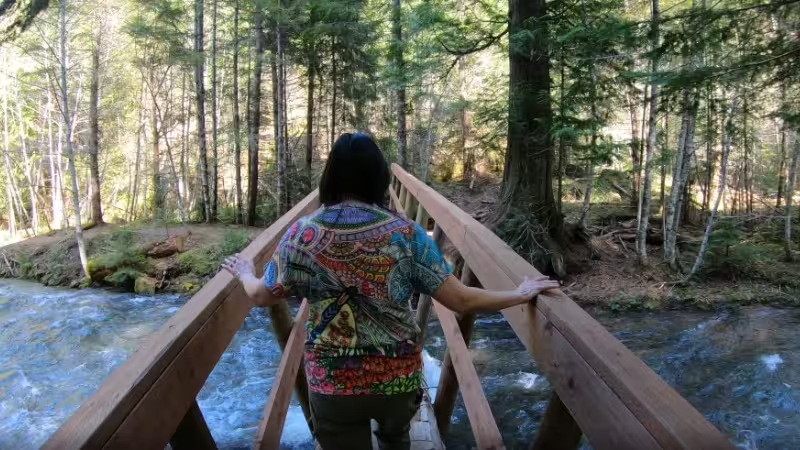
If you have the opportunity, find a gently flowing river near you. This should be a river where the water isn’t flowing too rapidly, and where the water isn’t too deep. Remember, safety first! This should be a river you know well, and it’s best not to do this activity alone.

Once you have found your river, go out into it. Don’t go any deeper than your waist. It’s preferable to find a spot on the river where nature surrounds you. If in doubt, find a footbridge you can walk across instead of going into the river.

Now stand in the river and do a little deep breathing. Inhale and exhale deeply for at least three breaths. Ground and center yourself. You may wish to do a brief meditation before continuing.

Now call upon your own Supernatural Aid. You may call upon the archetypal energy of your spirit animal, or it may help to hold a talisman in your hands. When you are ready, contemplate the river.

This is a river of the mind. Upstream, your thought streams about the past spread out behind you. Downstream, the river flows into the future. To return to the past would involve wading upstream against the current. To visit the future would require swimming downstream with the tide.

Suppose you tried to wade upstream or swim downstream. Once you got to your new location, the past would still lie behind you upstream relative to where you are now. Likewise, the future would still lie downstream ahead of you.
No matter which direction you move, you will always find yourself right here, right now, in the river.

Imagine yourself turning now to face upstream, towards the past. You already know what lies behind you. There may be rocky shoals and rapids behind you. There may even be high waterfalls and boulders. But the fact that you are standing right now at this place and this time in the river means that you survived the journey. Regardless of what lies behind you on the river, you have made it this far. This means that you are a survivor! You have met the challenges on the river and have gotten to where you are today.

Now turn to face downstream. The thought streams in this part of the river are unknown to you. You haven’t ventured there yet. There is no way of knowing whether more rapids lie ahead, or whether there is smooth sailing for the rest of the journey. You might try to make educated guesses as to what the downstream journey might be, based on the parts of the river you have already traveled, but there is no way to know with any certainty whether or not those guesses are correct. Rivers can suddenly change, and if you spend all your time worrying about what lies downstream, you miss the moment in which you find yourself. Worrying too much about what might lie downstream takes energy away from enjoying the pleasant experience of the river here and now.

Even if the worst happens, and we encounter catastrophes downstream, the choice to remain in the river is still ours. We can, at any time, make the conscious choice to step outside of the river for a while to watch it flow by.
We can’t know what lies downstream, but we can prepare ourselves for it. We can’t change the river, but we can change ourselves in order to increase the likelihood of a safe journey.

Life is like a river. When we learn to go with the flow, we decrease our chances of running aground.
Now cultivate an open and accepting attitude towards everything you are experiencing. What do you see? What do you hear? Can you feel the river’s currents with your body? Are there pleasant aromas on the breeze? Enjoy the experience of being in the river right here, and right now.

When you feel at peace with your surroundings, take a mental snapshot of all you have experienced here in the river. Mentally record the river in as much detail as possible. When you have done so, you may recall and retrieve this experience the next time you are feeling stressed out.

When you are ready, leave the river and sit on the riverbank while thinking over these questions:

  1. Once you were grounded and centered, did you find yourself thinking about what lies upstream or what lies downstream, or neither?
  2. Once you were grounded and centered, did you find your mind wandering to your mental “to do” list of daily activities, or did your thought streams subside?
  3. What was it about the river that made this experience different than your day-to-day life?
  4. Is there a way to carry this experience with you into your day-to-day life?
  5. How might this experience help you to see things in new ways that will lead you to your True Self?
  6. How might this teaching metaphor help you to cross the first threshold on your own Call to Adventure?

Though Streams and the First Threshold

thought streams

So, here we are, in the middle of the river. On one riverbank is the life we are leaving behind. On that other, unknown shore is the new life we’re moving towards. Crossing this river of the mind is consciously making the spiritual quest that is the Way of the Coyote the first and foremost quest in our lives. Rather than making pleasures of the flesh and accumulating material goods our goal and ambition in life is seeking a higher calling.

Seeking True Self doesn’t mean that we’re leaving our loved ones behind. It’s just the opposite. The more we are able to live according to our own true nature, the more we are able to help others. This is because when we are able to be the person we were born to be, we set aside the obligations that others have placed on us against our will. When we learn to do this, we learn to act for others because it is what we have chosen to do for ourselves, and not out of a sense of guilt, or shame, or self-blaming. This frees us to fully act for others of our own free will and to set aside resentments.

As we cross the river into the realm of the shaman, it’s not that we are leaving the material world behind either. We are instead learning a new way of seeing and being in the world. That way of seeing shows us that there is more to life than the trinkets and baubles of material possessions and status symbols. It is the path of true wealth that leads to love, connection, and ecospirituality.

This phase of the quest that is the Way of the Coyote involves emptying your cup. In order to be reborn as a seer, one must leave behind the former life. This means setting aside a life of pursuing material wealth just for the sake of owning things and instead seeking a life that makes room for nature and the spirit.

It’s very easy to get caught up in the idea that material things are the key to happiness, and a certain amount of material goods are necessary to survive. But if that is the sole motivation for life, our lives become meaningless and empty. The vision seeker instead searches for, and finds, things of spiritual significance. These spiritual things guide and enhance the quest. It is the path of true success and personal power.

Crossing the First Threshold, or crossing the river, involves announcing to the world and to yourself that the old ways have passed away. From this moment on, now and forever, a new journey begins. By announcing your intent to yourself and to others, you hold yourself accountable to staying on the path until the journey’s end. It is an acknowledgement that things will never again be as they were before.

Are you ready?


Share Your Thoughts!

What do you think? Let us know in the comments below!

Posted on

Choices and Ruminating Cycles

Snowballing ruminating cycle

Our choices are sometimes a result of our ruminating cycles. Have you ever had a thought that led to another thought, and then another, and so on until your thoughts are snowballing out of control? If so, you’ve experienced a ruminating cycle. When we make choices after engaging in ruminating cycles like this, our choices aren’t usually the type of decisions that yield positive consequences.

Sometimes we make choices in an effort to quell such ruminations. When that happens, those choices may not produce the optimal outcome.

This is because our beliefs are a result of our thoughts and feelings. If our beliefs and choices are leading us to experience consequences that we don’t want, we can learn consciously change those thoughts and beliefs to create consequences that we do want. Poor choices are the result of negative cycles. Stress and anxiety are also usually the results of negative ruminating cycles.

Ruminating Cycle Exercise

Think about a time when you had a negative cycle and acted on it. How did the choices you made lead to consequences you didn’t want? It may help to write down that cycle on a piece of paper, using as much detail as possible. Feel free to get as personal as necessary to complete the exercise.

Here are the instructions for writing down your negative snowballing cycle:

  1. In the circle in the center of the page, write down the trigger that began the negative cycle. What happened that started the negative thought process? What did you think about what happened?
  2. Next, look at the trigger in the center circle, and write down the first thing that comes to mind. Write it next to the circle, and draw a circle around that thought and connect it back to the center circle.
  3. Now write down the next thing that comes to mind when you think about your trigger statement, and write it down as well. Draw a circle around it and connect it back to the center circle as well.
  4. Continue this process until you can’t think of anything else, or until the center circle is surrounded by other circled thoughts.
  5. Next, pick one of those circled thoughts and think about the first thing that comes to mind in response to that thought. Write it in a circle and connect it back to the thought that originated it.
  6. Go on in a similar fashion, listing all the thoughts in your ruminating cycle and linking them back to the thoughts that spawned them. Work outward in concentric ‘circles of circles’ until complete.

Choices and Ruminations

Triggers can lead to ruminating cycles if we choose to let them. Negative ruminating cycles can lead to poor choices, and poor choices can lead to adverse consequences. The more steps in a ruminating cycle we can identify, the more opportunities we have to change them or to stop them completely!
Refer to the Ruminating Cycle Graph you just completed in the previous exercise, and answer the following questions:

  • What are the triggers that activate your ruminating cycle?
  • What assumptions are sustaining your snowballing?
  • What perceptions are sustaining your cycle?
  • What feelings are sustaining your ruminating cycle?
  • What thoughts are sustaining your snowballing?
  • What beliefs are sustaining your cycle?
  • What physiological cues are sustaining your ruminating cycle?
  • What choices are sustaining your negative cycles?
  • What are the consequences of sustaining your snowballing?
  • What is your intention in engaging in this negative cycle?

Look at your answers to the questions above. Which of these answers would help you to either stop your negative ruminating cycle or to change it to a positive ruminating cycle? Why?

Posted on

Mindful Acceptance: Letting Go with Mindfulness-Based Ecotherapy

mindful acceptance

“Never underestimate your power to change yourself; never overestimate your power to change others.”

— H. Jackson Brown, Jr.

One of the most powerful skills in mindfulness-based ecotherapy is mindful acceptance. Mindful acceptance is the art of letting go of unnecessary suffering while remaining fully present with life as it is. Unlike some approaches that focus only on changing thoughts or managing symptoms internally, mindfulness-based ecotherapy (MBE) emphasizes reconnecting with the natural world, the body, the senses, and the present-moment experience as pathways toward healing and resilience.

Mindfulness-based ecotherapy differs from many traditional mindfulness practices because it does not view mindfulness as something that occurs only inside the mind. Instead, MBE recognizes that humans are part of an interconnected ecological system. Healing happens not only through awareness of thoughts and emotions, but also through restoring a relationship with the earth, the body, community, and the rhythms of nature itself.

The skill of mindful acceptance teaches you to recognize the difference between what you can change and what you cannot. Once you have done everything realistically within your power to address a problem, continued anxiety and rumination no longer serve a useful purpose. At that point, mindful acceptance asks you to loosen your grip on the stress attached to the situation.

Mindful Acceptance Doesn’t Mean Giving Up

Importantly, letting go of anxiety does not necessarily mean giving up on solving the problem.

Suppose you have a car payment due and you do not currently have the money to pay it. Naturally, this situation may trigger fear, worry, and stress. You may brainstorm solutions, ask for help, reduce expenses, or search for additional income. However, once you have taken every practical step available in the present moment, the constant cycle of worry becomes emotionally exhausting and often counterproductive.

In mindfulness-based ecotherapy, one of the twelve core skills involves learning to observe your thoughts and feelings nonjudgmentally while grounding yourself in sensory awareness. You might sit outdoors beneath a tree, feel your feet on the earth, notice the movement of the wind, or listen to birdsong while observing the anxious thoughts moving through your awareness. Nature becomes an anchor that reminds you that life continues unfolding even during uncertainty.

Unlike purely cognitive approaches that may focus primarily on changing thought patterns, MBE integrates embodied awareness and ecological connection. The natural world helps regulate the nervous system by drawing your attention away from repetitive mental loops and back into the present moment.

Mindful Acceptance, Observing, and Describing

Another essential MBE skill is mindful observing. Instead of immediately reacting to anxiety, you learn to notice it with curiosity. What does the anxiety feel like in your body? Is your chest tight? Is your breathing shallow? Are your thoughts racing toward worst-case scenarios? By observing rather than fighting the experience, you create space between yourself and the anxiety.

This space allows you to make conscious decisions rather than reacting automatically.

The same principle applies in relationships. Imagine you feel disconnected from your partner because they rarely spend time with you. You suggest activities, initiate conversations, and communicate your feelings honestly, yet nothing changes. Many people respond to this situation by escalating their efforts to control the outcome. They may criticize, plead, withdraw emotionally, or become consumed with resentment.

Mindfulness-based ecotherapy approaches this differently.

Self-Compassion and Mindful Acceptance

One of the MBE skills involves recognizing the limits of personal control while strengthening self-awareness and self-compassion. You cannot force another person to change. However, you can change how you respond internally and externally. Practicing mindful acceptance means acknowledging your sadness, frustration, or disappointment without allowing those emotions to dominate your life.

In ecotherapy, the natural world often serves as a mirror for this process. Seasons change without resistance. Trees release leaves when it is time to let go. Rivers flow around obstacles instead of endlessly struggling against them. Nature teaches flexibility, adaptation, and resilience.

This ecological perspective is one of the major ways MBE differs from other mindfulness approaches. While many mindfulness practices emphasize internal awareness alone, mindfulness-based ecotherapy intentionally uses nature as both teacher and therapeutic partner.

Another of the twelve skills of MBE involves reducing rumination through present-moment sensory grounding. Rumination occurs when the mind repeatedly replays fears, regrets, or imagined future disasters. The more mental energy you feed into these cycles, the stronger they become.

Mindful acceptance interrupts this process.

You may notice the anxious thought arise, acknowledge it compassionately, and then redirect your awareness toward immediate sensory experience: the smell of rain, the warmth of sunlight, the sound of leaves moving in the wind, or the sensation of breathing deeply in fresh air. These practices help regulate emotional overwhelm by reconnecting you with the physical world instead of remaining trapped inside mental narratives.

Anxiety Has a Purpose

Mindfulness-based ecotherapy also recognizes that anxiety itself has a purpose. Anxiety evolved as a protective system designed to alert us to danger. In mindful acceptance, you are not trying to destroy anxiety or suppress difficult emotions. Instead, you learn to relate to them differently.

You might silently say:

“Thank you, anxiety, for trying to protect me. I am listening carefully, but I will also trust my own wisdom.”

This compassionate inner dialogue reflects another MBE principle: developing a collaborative relationship with your emotions instead of waging war against them.

Finally, mindful acceptance teaches that mistakes are not evidence of failure, but growth opportunities. In nature, growth rarely occurs without struggle. Forests regenerate after fires. Rivers carve canyons through persistence over time. Ecosystems adapt continuously to changing conditions.

Human beings are no different.

Every mistake contains information that can deepen wisdom, resilience, and self-understanding. Through mindful acceptance, you learn that healing does not require perfection. It requires awareness, compassion, flexibility, and the willingness to remain present even during uncertainty.

Mindfulness-based ecotherapy reminds you that while you cannot always control life’s circumstances, you can learn to live more peacefully within them. By reconnecting with nature, practicing mindful awareness, and letting go of unnecessary struggle, you create space for healing, growth, and inner balance.


Share Your Thoughts About Mindful Acceptance!

What do you think? Share your thoughts in the comments below!


  And don’t forget to subscribe to our newsletter!