
Posted on

Living in True Self: A Courageous Path to Meaning and Harmony

living in true self

Living in True Self is the culminating skill of Mindfulness-Based Ecotherapy, and it asks something both simple and deeply uncomfortable: that you stop living in reaction to expectations, conditioning, and fear, and start living in alignment with who you actually are. Your True Self is the part of you that knows what matters, recognizes your limits, and acts from values rather than avoidance. When you live in True Self, your actions, aspirations, and relationships begin to line up instead of pulling you in opposite directions.

In Mindfulness-Based Ecotherapy, living in True Self begins with self-awareness. You cannot align with what you refuse to notice. Mindfulness helps you observe your thoughts, emotions, and bodily signals without immediately obeying them. Over time, you start to recognize patterns. You notice where you abandon yourself to keep the peace, where you override your values for approval, and where fear quietly makes your decisions for you. This awareness is not meant to shame you. It gives you information. And information creates choice.

Accepting Yourself

Acceptance is the next step. Living in True Self does not mean eliminating flaws or becoming endlessly serene and “perfect.” It means accepting that you are complex, imperfect, and still worthy of compassion. When you stop fighting who you are, you free up energy to live intentionally. Research since 2020 shows that self-acceptance and values-based living are associated with greater psychological flexibility, reduced distress, and increased life satisfaction (Hayes et al., 2020; Kashdan et al., 2020). In other words, alignment works better than self-criticism, even if your inner critic insists otherwise.

Ecotherapy and Living in True Self

Nature plays a critical role in this process. In ecotherapy, you are not treated as separate from the natural world, but as part of it. Nature models authenticity relentlessly. A tree does not apologize for growing crooked. A river does not justify its course. Seasons change without consulting public opinion. When you spend time in nature mindfully, you are reminded that living in alignment is not a personal failure waiting to happen. It is how life actually functions. This perspective can dissolve the pressure to perform and replace it with permission to be.

Being Compassionate with Others…and with Yourself

Living in True Self also involves compassion, both toward yourself and others. When you are aligned internally, you are less reactive and less defensive. You listen more clearly. You set boundaries without hostility. You recognize that other people are also navigating their own misalignment. Studies on mindfulness and compassion show that increased self-compassion is linked to improved emotional regulation and more authentic relationships (Neff & Germer, 2022). You stop trying to manage how you are perceived and start focusing on how you are living.

From an ecotherapeutic lens, living in True Self is inseparable from interconnectedness. You are not an isolated unit trying to optimize yourself in a vacuum. You exist within systems, relationships, and ecosystems. When you live out of alignment, the cost shows up as burnout, resentment, and disconnection. When you live in alignment, your choices tend to support sustainability, reciprocity, and care. This is not accidental. When you remember you belong to the natural world, your values often expand beyond survival toward meaning.

Living in True Self: Not Always Comfortable

Living in True Self does not guarantee ease. It often requires courage. You may disappoint people. You may have to grieve paths you did not take. But what you gain is coherence. Your thoughts, values, and actions start telling the same story. That coherence is deeply regulating to your nervous system and profoundly grounding over time.

At the Mindful Ecotherapy Center, Living in True Self is not framed as a destination, but as a practice. Alignment is something you return to again and again, especially when life pulls you off course. Mindfulness gives you awareness. Ecotherapy gives you the context. Together, they support a way of living that is honest, grounded, and sustainable.

To learn more about Mindfulness-Based Ecotherapy and how living in alignment with your True Self can support healing and meaning, visit www.mindfulecotherapycenter.com


References

Hayes, S. C., Strosahl, K. D., & Wilson, K. G. (2020). Acceptance and commitment therapy: The process and practice of mindful change (2nd ed.). Guilford Press.

Kashdan, T. B., Disabato, D. J., Goodman, F. R., Doorley, J. D., & McKnight, P. E. (2020). Understanding psychological flexibility: A multimethod exploration of pursuing valued goals despite the presence of distress. Journal of Personality and Social Psychology, 119(2), 1–21. https://doi.org/10.1037/pspp0000266

Neff, K. D., & Germer, C. K. (2022). The mindful self-compassion program: Effects on self-compassion, mindfulness, and well-being. Journal of Clinical Psychology, 78(2), 389–402. https://doi.org/10.1002/jclp.23297

Schutte, N. S., & Malouff, J. M. (2021). Mindfulness and connectedness to nature: A meta-analytic investigation. Personality and Individual Differences, 179, 110984. https://doi.org/10.1016/j.paid.2021.110984


Share Your Thoughts About Living in True Self!

What do you think? Share your thoughts in the comments below!


  And don’t forget to subscribe to our newsletter!

Posted on

Embodied Mindfulness: A Positive Integration of Wise Mind and Wise Body

embodied mindfulness

Embodied mindfulness is understood as the lived experience of Wise Mind and Wise Body working together. This skill teaches you that wisdom does not live only in your thoughts, and regulation does not happen only in your head. Instead, awareness, choice, and healing emerge when mind and body are experienced as a single, integrated system. Embodied mindfulness is not abstract. It is something you feel, sense, and practice moment by moment.

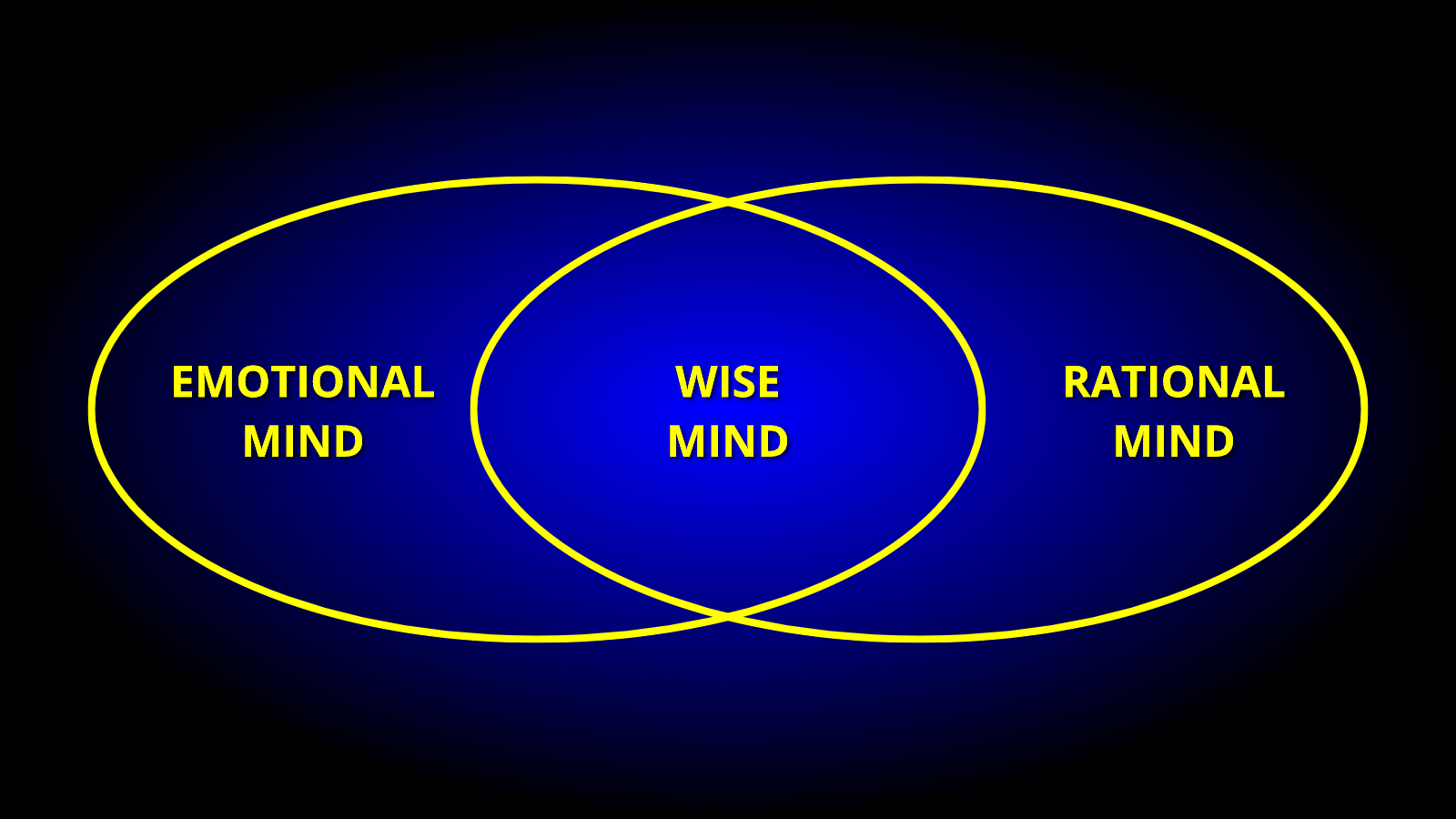
You are likely familiar with the pull between Rational Mind and Emotional Mind. When you are operating from Rational Mind, you rely on logic, facts, planning, and analysis. Emotion is minimized or dismissed in favor of efficiency and control. When you are operating from Emotional Mind, your thoughts and behaviors are driven primarily by feelings. Logic takes a back seat, and reactions tend to be fast, intense, and sometimes regrettable. Neither state is inherently wrong, but both become problematic when they dominate.

Embodied Mindfulness and Wise Mind

Wise Mind is the balanced integration of Rational Mind and Emotional Mind. It is the place where logic and emotion inform each other rather than compete. From Wise Mind, you can acknowledge how you feel without being ruled by it, and you can apply reason without disconnecting from what matters. Research in mindfulness-based therapies consistently shows that this integration supports emotional regulation, distress tolerance, and psychological flexibility, all of which are core factors in long-term mental health (Linehan, 2020; Hayes et al., 2020).

embodied mindfulness

Embodied mindfulness takes this integration a step further by recognizing that there is no real line between mind and body. The idea that the mind and body are separate entities is a cultural and philosophical habit, not a biological reality. Your thoughts change your physiology. Your posture, breath, and muscle tension change your thoughts. Neuroscience and embodied cognition research since 2020 continue to demonstrate that cognition is shaped by bodily states and sensory experience, not just abstract reasoning (Mehling et al., 2021; Critchley & Garfinkel, 2022).

Practicing Embodied Mindfulness

When you begin to practice Wise Body, you learn to listen to physical sensations as sources of information rather than nuisances to be ignored. Tightness in your chest may signal anxiety before you consciously label it. Fatigue may reflect emotional overload rather than laziness. Grounding through breath, movement, or contact with the earth can shift your mental state without a single thought needing to change. This is embodied mindfulness in action. The body becomes a partner in awareness rather than an obstacle to overcome.

Wise Mind and Wise Body in Mindfulness-Based Ecotherapy

In Mindfulness-Based Ecotherapy, embodied mindfulness is strengthened through intentional engagement with nature. Natural environments make the mind–body connection harder to deny. When you walk on uneven terrain, your body must pay attention. When you sit near water or under trees, your nervous system often downshifts automatically. Studies since 2020 show that nature-based mindfulness practices improve interoceptive awareness, reduce stress reactivity, and enhance emotional regulation by engaging both physiological and psychological processes simultaneously (Schutte & Malouff, 2021; Passmore et al., 2021).

This is where Wise Mind and Wise Body come together. You might notice an anxious thought arise while hiking, then feel your breath deepen as you slow your pace. The body calms the mind. Or you might intentionally reframe a stressful situation while feeling your feet on the ground, allowing the mind to support bodily regulation. Over time, you experience directly that change does not have to start in one place. It can start anywhere in the system.

Embodied mindfulness also moves you beyond the false choice between “thinking your way out” of distress and “feeling your way through” it. You learn that insight without embodiment often fades, and embodiment without awareness can become avoidance. Wise Mind and Wise Body together offer a sustainable path forward. You respond to life with clarity, compassion, and grounded presence rather than reactivity or numbness.

At the Mindful Ecotherapy Center, embodied mindfulness is taught as a core skill because it reflects how people actually live and heal. You are not a mind dragging a body around, nor a body burdened by thoughts. You are a whole, responsive system capable of balance and wisdom. When you practice embodied mindfulness, you begin to trust that system again.

To learn more about embodied mindfulness and other Mindfulness-Based Ecotherapy skills, visit www.mindfulecotherapycenter.com


References

Critchley, H. D., & Garfinkel, S. N. (2022). Interoception and emotion: Shared neural mechanisms. Nature Reviews Neuroscience, 23(9), 539–551. https://doi.org/10.1038/s41583-022-00606-1

Hayes, S. C., Strosahl, K. D., & Wilson, K. G. (2020). Acceptance and commitment therapy: The process and practice of mindful change (2nd ed.). Guilford Press.

Linehan, M. M. (2020). DBT skills training manual (2nd ed.). Guilford Press.

Mehling, W. E., Acree, M., Stewart, A., Silas, J., & Jones, A. (2021). Body awareness: Construct and self-report measures. PLoS ONE, 16(5), e0250616. https://doi.org/10.1371/journal.pone.0250616

Passmore, H. A., Howell, A. J., & Holder, M. D. (2021). Positioning nature-based mindfulness as a mechanism for well-being. Ecopsychology, 13(2), 83–91. https://doi.org/10.1089/eco.2020.0047

Schutte, N. S., & Malouff, J. M. (2021). Mindfulness and connectedness to nature: A meta-analytic investigation. Personality and Individual Differences, 179, 110984. https://doi.org/10.1016/j.paid.2021.110984


Share Your Thoughts About Wise Mind and Wise Body!

What do you think? Share your thoughts in the comments below!


  And don’t forget to subscribe to our newsletter!
Posted on

Acceptance and Commitment Therapy (ACT) Worksheets

ACT Worksheets

About Acceptance and Commitment Therapy (ACT)

Acceptance and Commitment Therapy (ACT) is an evidence-based behavioral therapy that helps people develop psychological flexibility, the ability to stay present, open up to difficult thoughts and feelings, and take meaningful action guided by their values.

Rather than trying to eliminate distress, ACT teaches skills like mindfulness, acceptance, and cognitive defusion to change one’s relationship with inner experiences. The goal isn’t to feel better all the time. It’s to live better, even when life is uncomfortable.

About ACT Worksheets

These Acceptance and Commitment Therapy (ACT) worksheets are designed to enhance psychological flexibility and support meaningful change. These resources help you to clarify personal values, defuse unhelpful thoughts, practice mindfulness, and take committed action toward a more fulfilling life.

These tools are ideal for therapists, coaches, or individuals seeking growth. Each worksheet is grounded in ACT’s core principles and easy to integrate into sessions or daily routines, and incorporates the principles of Mindfulness-Based Ecotherapy.

ACT Worksheets

These worksheets are provided for personal, educational, and clinical use. You are welcome to download, print, and share them with clients or students, provided that all copyright and attribution information remains intact and unaltered.

These materials may not be resold, redistributed for profit, or incorporated into commercial products, training, or publications without prior written permission from the copyright holder, Mindful Ecotherapy Center, PLLC.

All rights reserved. All ACT Worksheet materials ©2026 by the Mindful Ecotherapy Center, PLLC, and Charlton Hall, MMFT, PhD, unless otherwise noted.