
Posted on

Embodied Mindfulness: A Positive Integration of Wise Mind and Wise Body

embodied mindfulness

Embodied mindfulness is understood as the lived experience of Wise Mind and Wise Body working together. This skill teaches you that wisdom does not live only in your thoughts, and regulation does not happen only in your head. Instead, awareness, choice, and healing emerge when mind and body are experienced as a single, integrated system. Embodied mindfulness is not abstract. It is something you feel, sense, and practice moment by moment.

You are likely familiar with the pull between Rational Mind and Emotional Mind. When you are operating from Rational Mind, you rely on logic, facts, planning, and analysis. Emotion is minimized or dismissed in favor of efficiency and control. When you are operating from Emotional Mind, your thoughts and behaviors are driven primarily by feelings. Logic takes a back seat, and reactions tend to be fast, intense, and sometimes regrettable. Neither state is inherently wrong, but both become problematic when they dominate.

Embodied Mindfulness and Wise Mind

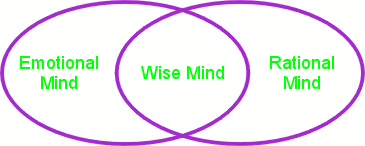
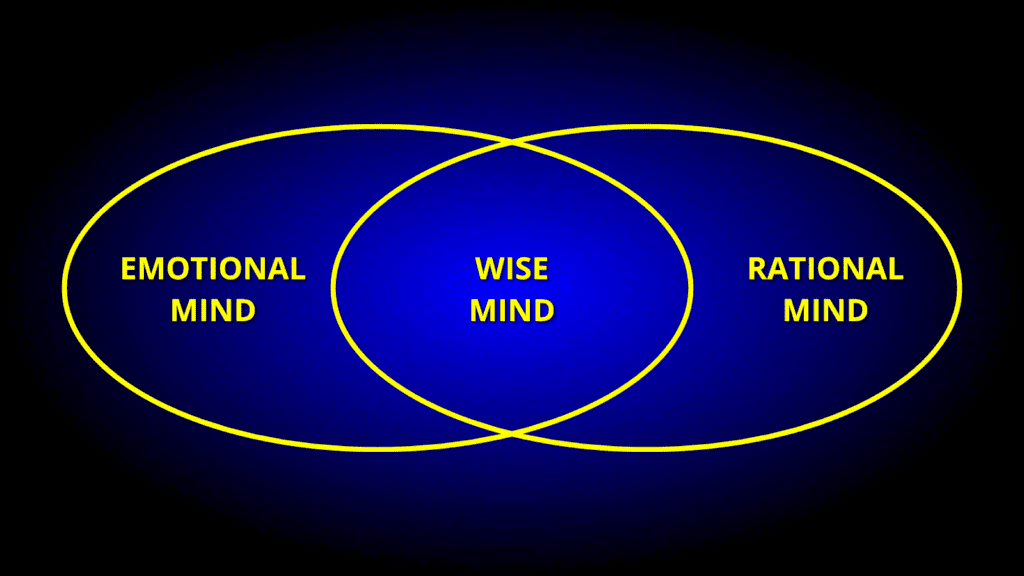
Wise Mind is the balanced integration of Rational Mind and Emotional Mind. It is the place where logic and emotion inform each other rather than compete. From Wise Mind, you can acknowledge how you feel without being ruled by it, and you can apply reason without disconnecting from what matters. Research in mindfulness-based therapies consistently shows that this integration supports emotional regulation, distress tolerance, and psychological flexibility, all of which are core factors in long-term mental health (Linehan, 2020; Hayes et al., 2020).
embodied mindfulness

Embodied mindfulness takes this integration a step further by recognizing that there is no real line between mind and body. The idea that the mind and body are separate entities is a cultural and philosophical habit, not a biological reality. Your thoughts change your physiology. Your posture, breath, and muscle tension change your thoughts. Neuroscience and embodied cognition research since 2020 continue to demonstrate that cognition is shaped by bodily states and sensory experience, not just abstract reasoning (Mehling et al., 2021; Critchley & Garfinkel, 2022).

Practicing Embodied Mindfulness

When you begin to practice Wise Body, you learn to listen to physical sensations as sources of information rather than nuisances to be ignored. Tightness in your chest may signal anxiety before you consciously label it. Fatigue may reflect emotional overload rather than laziness. Grounding through breath, movement, or contact with the earth can shift your mental state without a single thought needing to change. This is embodied mindfulness in action. The body becomes a partner in awareness rather than an obstacle to overcome.

Wise Mind and Wise Body in Mindfulness-Based Ecotherapy

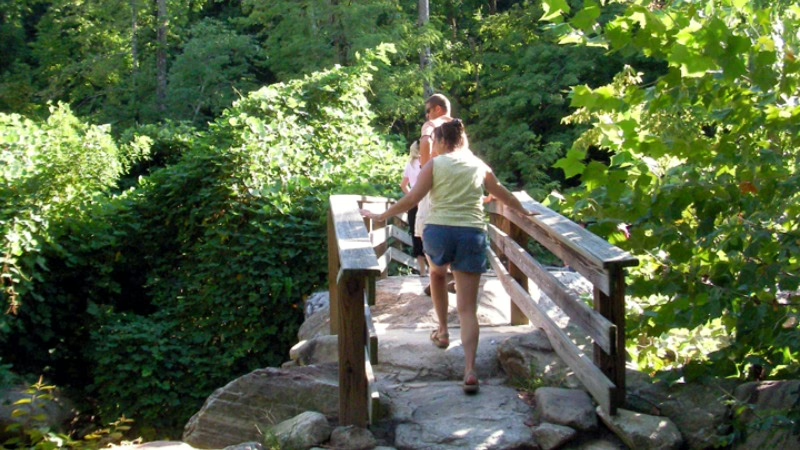
In Mindfulness-Based Ecotherapy, embodied mindfulness is strengthened through intentional engagement with nature. Natural environments make the mind–body connection harder to deny. When you walk on uneven terrain, your body must pay attention. When you sit near water or under trees, your nervous system often downshifts automatically. Studies since 2020 show that nature-based mindfulness practices improve interoceptive awareness, reduce stress reactivity, and enhance emotional regulation by engaging both physiological and psychological processes simultaneously (Schutte & Malouff, 2021; Passmore et al., 2021).

This is where Wise Mind and Wise Body come together. You might notice an anxious thought arise while hiking, then feel your breath deepen as you slow your pace. The body calms the mind. Or you might intentionally reframe a stressful situation while feeling your feet on the ground, allowing the mind to support bodily regulation. Over time, you experience directly that change does not have to start in one place. It can start anywhere in the system.

Embodied mindfulness also moves you beyond the false choice between “thinking your way out” of distress and “feeling your way through” it. You learn that insight without embodiment often fades, and embodiment without awareness can become avoidance. Wise Mind and Wise Body together offer a sustainable path forward. You respond to life with clarity, compassion, and grounded presence rather than reactivity or numbness.

At the Mindful Ecotherapy Center, embodied mindfulness is taught as a core skill because it reflects how people actually live and heal. You are not a mind dragging a body around, nor a body burdened by thoughts. You are a whole, responsive system capable of balance and wisdom. When you practice embodied mindfulness, you begin to trust that system again.

To learn more about embodied mindfulness and other Mindfulness-Based Ecotherapy skills, visit www.mindfulecotherapycenter.com


References

Critchley, H. D., & Garfinkel, S. N. (2022). Interoception and emotion: Shared neural mechanisms. Nature Reviews Neuroscience, 23(9), 539–551. https://doi.org/10.1038/s41583-022-00606-1

Hayes, S. C., Strosahl, K. D., & Wilson, K. G. (2020). Acceptance and commitment therapy: The process and practice of mindful change (2nd ed.). Guilford Press.

Linehan, M. M. (2020). DBT skills training manual (2nd ed.). Guilford Press.

Mehling, W. E., Acree, M., Stewart, A., Silas, J., & Jones, A. (2021). Body awareness: Construct and self-report measures. PLoS ONE, 16(5), e0250616. https://doi.org/10.1371/journal.pone.0250616

Passmore, H. A., Howell, A. J., & Holder, M. D. (2021). Positioning nature-based mindfulness as a mechanism for well-being. Ecopsychology, 13(2), 83–91. https://doi.org/10.1089/eco.2020.0047

Schutte, N. S., & Malouff, J. M. (2021). Mindfulness and connectedness to nature: A meta-analytic investigation. Personality and Individual Differences, 179, 110984. https://doi.org/10.1016/j.paid.2021.110984


Share Your Thoughts About Wise Mind and Wise Body!

What do you think? Share your thoughts in the comments below!


  And don’t forget to subscribe to our newsletter!
Posted on

Embodied Mindfulness: 4 Essential Ways Wise Mind and Wise Body Help

embodied mindfulness

Embodies mindfulness is crucial to good physical and mental health. At the Mindful Ecotherapy Center, we understand that mindfulness is not just something that happens in the mind. True, lasting change occurs when awareness moves out of abstract thought and into lived, physical experience. This is where the mindfulness-based ecotherapy skill of Wise Mind and Wise Body becomes central to cultivating embodied mindfulness, a state of awareness in which thoughts, emotions, bodily sensations, and the natural environment are experienced as an integrated whole.

What Is Embodied Mindfulness?

Embodied mindfulness refers to the capacity to be fully present in one’s body, moment by moment, with openness and curiosity. Rather than observing experience from a distance, embodied mindfulness invites individuals to inhabit their physical selves. Breathing, posture, muscle tension, heart rate, and sensory input all become sources of information rather than background noise.

For many people, especially those with chronic stress, trauma histories, or anxiety, embodiment does not come easily. The mind may be active and reflective while the body remains tense, numb, or disconnected. This split undermines emotional regulation, self-trust, and overall well-being. Embodied mindfulness closes this gap.

Embodied mindfulness aligns closely with Bessel van der Kolk’s central insight in The Body Keeps the Score: that the body remembers what the mind would rather forget. Van der Kolk demonstrates that trauma, stress, and emotional learning are stored not just as memories but as patterns of muscle tension, breath restriction, posture, and autonomic reactivity.

From this perspective, mindfulness that stays purely cognitive is incomplete at best and actively unhelpful at worst. Embodied mindfulness brings awareness to these somatic patterns in real time, allowing you to notice how the past shows up in the present body and to intervene gently before old survival responses take over. Mindfulness-based ecotherapy extends this work by engaging the body within a regulating natural environment, making it safer and more intuitive to reconnect with bodily sensations. Rather than forcing awareness inward, nature helps the nervous system settle enough for the body’s story to be felt, understood, and gradually rewritten through Sensing Mode.

Wise Mind and Wise Body: An Integrated Skill

The concept of Wise Mind originates in dialectical approaches, describing the integration of rational mind and emotional mind. Mindfulness-based ecotherapy expands this framework by explicitly including the body and the natural world, giving rise to the combined skill of Wise Mind and Wise Body.

Wise Mind represents discernment, values-based awareness, and a balanced perspective. Wise Body represents the body’s innate intelligence: interoception, intuition, and the physiological signals that guide safety, connection, and rest. Together, they form a feedback loop. Wise Mind listens to Wise Body, and Wise Body grounds Wise Mind in lived reality.

This integration is essential for embodied mindfulness. Without Wise Body, mindfulness risks becoming intellectualized. Without Wise Mind, bodily sensations may feel overwhelming or confusing. Mindfulness-based ecotherapy trains you to move fluidly between the two.

embodied mindfulness

Why Embodied Mindfulness Matters

Embodied mindfulness is foundational for psychological health.

First, it improves emotional regulation. Emotions arise in the body before they are labeled by the mind. When individuals are embodied, they can notice early signals of emotional activation and respond skillfully rather than reactively.

Second, embodied mindfulness supports trauma recovery. Trauma often disrupts the relationship between mind and body, leading to dissociation or hyperarousal. By gently reconnecting awareness to bodily experience within a supportive ecological context, mindfulness-based ecotherapy restores a sense of safety and agency.

Third, embodied mindfulness enhances decision-making. Wise choices are rarely made through logic alone. The body often signals alignment or misalignment long before the mind catches up. Learning to trust Wise Body allows decisions to emerge from coherence rather than pressure.

The Unique Contribution of Mindfulness-Based Ecotherapy

Mindfulness-based ecotherapy offers a distinctive approach to Wise Mind and Wise Body by situating this skill within a relationship to the natural environment. In mindfulness-based ecotherapy, nature is not treated as a backdrop or metaphor alone, but as an active co-regulator.

Natural settings provide rhythmic, nonjudgmental sensory input that supports embodiment. The sound of wind, the feeling of ground underfoot, and the steady presence of trees or water all help anchor awareness in the present moment. This makes embodied mindfulness more accessible, especially for individuals who struggle with traditional seated practices.

In mindfulness-based ecotherapy, Wise Body is understood as part of a larger ecological system. Clients are invited to notice how their breath syncs with outdoor air, how muscle tension responds to natural textures, and how emotional states shift in different environments. Wise Mind then reflects on these experiences, integrating insight with sensation.

This ecological framing reduces self-blame and isolation. Dysregulation is seen as a signal of disconnection that can be addressed through reconnection with both body and environment.

Practicing Wise Mind and Wise Body for Embodied Mindfulness

Cultivating embodied mindfulness through Wise Mind and Wise Body involves intentional practice. This may include mindful walking in nature, body scans conducted outdoors, or grounding exercises that explicitly reference environmental cues. Reflection is encouraged, but never at the expense of sensory experience.

Over time, we learn to recognize bodily wisdom as a reliable source of guidance. Embodied mindfulness becomes less of a technique and more of a way of being.

Embodied Mindfulness and Healing

Embodied mindfulness is essential for genuine presence, resilience, and healing. The mindfulness-based ecotherapy skill of Wise Mind and Wise Body offers a powerful pathway to this state by honoring the intelligence of both cognition and sensation within an ecological context. By integrating mind, body, and nature, mindfulness-based ecotherapy provides a uniquely effective framework for living with awareness, balance, and authenticity.


Share Your Thoughts on Embodied Mindfulness!

What do you think? Have you experienced embodied mindfulness? Did mindfulness-based ecotherapy help? Share your thoughts in the comments below! And don’t forget to subscribe to our newsletter!