Table of Contents
Nature as Metaphor is a core ecotherapy skill that helps you understand your internal world by reflecting it through the natural one. Instead of analyzing your experiences in isolation, you learn to see emotions, thoughts, and life transitions mirrored in forests, rivers, seasons, and ecosystems. Nature becomes a symbolic language, one that often communicates more clearly and compassionately than words alone.
Nature as Metaphor refers to using elements of the natural world as symbolic representations of internal experiences, emotional states, and life processes. When you draw parallels between natural phenomena and your psychological dynamics, insight often arises without force. You do not have to dig for meaning. It emerges organically through observation, reflection, and resonance. Research since 2020 supports the idea that metaphor-based reflection enhances emotional processing, self-understanding, and cognitive flexibility, particularly when paired with mindfulness practices (Stott et al., 2021).
Why Nature as Metaphor Works
Metaphor works because the brain naturally thinks in images and patterns. Long before formal language, humans understood life through cycles, movement, growth, and decay. When you notice that your grief feels like winter, or your anxiety feels like a storm that keeps looming on the horizon without fully breaking, you gain distance without detachment. You are no longer trapped inside the experience. You are in a relationship with it. Studies in psychotherapy research suggest that metaphor allows you to engage difficult emotions safely, reducing defensiveness and increasing insight through externalization (Mathieson et al., 2020).
The Power of Intention
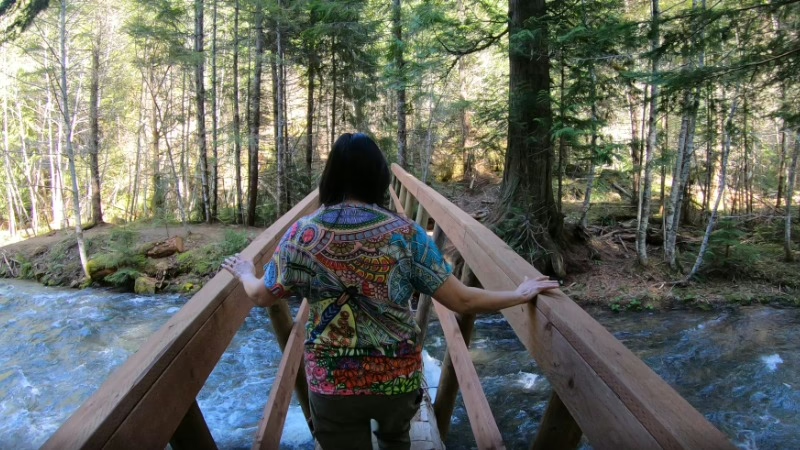
In Mindfulness-Based Ecotherapy, Nature as Metaphor is practiced intentionally. You might observe how a river moves around obstacles instead of resisting them and recognize how this mirrors the skill of radical acceptance. You might notice how a tree bends in the wind without snapping and reflect on resilience rather than rigidity. These metaphors are not imposed. They arise through mindful awareness and personal meaning-making. This process strengthens self-trust because the insight comes from your own observation, not external interpretation.
Nature’s cycles are particularly powerful metaphors for change. Growth, decay, rest, and renewal exist simultaneously in healthy ecosystems. When you witness this directly, you may begin to question the belief that you should always be productive, happy, or improving. Ecotherapy research since 2020 highlights that exposure to natural cycles supports emotional regulation and reduces shame by normalizing fluctuation and impermanence (Passmore & Howell, 2020). Nature shows you that pauses are not failures. They are part of the process.
Self-Compassion and Nature
Using nature metaphorically also deepens self-compassion. When you view yourself through mechanistic or moralistic lenses, mistakes feel like flaws. When you view yourself through ecological metaphors, struggle becomes understandable. A burned forest is not broken. It is responding to conditions. A flooded river is not immoral. It is overwhelmed. This shift reduces self-judgment and supports acceptance-based coping, which is strongly linked to psychological well-being (Neff & Germer, 2022).
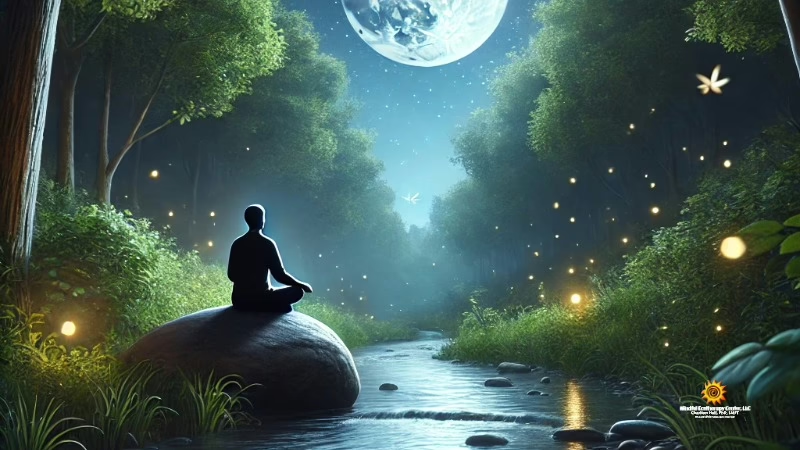
Mindfulness is essential here. Without mindful awareness, nature becomes scenery. With mindfulness, it becomes communication. You slow down. You notice. You reflect. You allow symbolic meaning to arise rather than forcing interpretation. Research on mindfulness and meaning-making suggests that present-moment awareness enhances your ability to integrate metaphor into self-understanding, supporting emotional clarity and resilience (Dahl et al., 2020).
Nature Offers a New Perspective
Nature as Metaphor also promotes perspective. When you feel overwhelmed, nature reminds you of scale and context. A mountain does not erase your pain, but it may help you see that your current struggle is part of a much larger story. Studies on awe and nature exposure since 2020 show that experiences of vastness reduce rumination and increase cognitive flexibility and prosocial attitudes (Piff et al., 2021). Perspective does not minimize your experience. It softens its grip.
At the Mindful Ecotherapy Center, Nature as Metaphor is taught as a contemplative, experiential skill. You are not asked to interpret nature “correctly.” You are invited to listen. Over time, you begin to recognize that insight does not always come from thinking harder. Sometimes it comes from watching leaves fall, tides turn, or seeds break open underground.
To learn more about Nature as Metaphor and other Mindfulness-Based Ecotherapy skills, visit www.mindfulecotherapycenter.com
References
Dahl, C. J., Wilson-Mendenhall, C. D., & Davidson, R. J. (2020). The plasticity of well-being: A training-based framework for the cultivation of human flourishing. Proceedings of the National Academy of Sciences, 117(51), 32197–32206. https://doi.org/10.1073/pnas.2014859117
Mathieson, F., Jordan, J., & Carter, J. D. (2020). Metaphor in psychotherapy: A systematic review. Clinical Psychology Review, 81, 101892. https://doi.org/10.1016/j.cpr.2020.101892
Neff, K. D., & Germer, C. K. (2022). The mindful self-compassion program: Effects on self-compassion, mindfulness, and well-being. Journal of Clinical Psychology, 78(2), 389–402. https://doi.org/10.1002/jclp.23297
Passmore, H. A., & Howell, A. J. (2020). Nature involvement increases hedonic and eudaimonic well-being: A two-week experimental study. Ecopsychology, 12(1), 1–11. https://doi.org/10.1089/eco.2019.0025
Piff, P. K., Dietze, P., Feinberg, M., Stancato, D. M., & Keltner, D. (2021). Awe, the small self, and prosocial behavior. Journal of Personality and Social Psychology, 120(1), 1–23. https://doi.org/10.1037/pspi0000267
The Mindful Ecotherapy Center on YouTube
Subscribe to the Mindful Ecotherapy Center’s YouTube channel to bring peace, presence, and healing into your daily life. Our videos guide you through mindfulness-based ecotherapy practices, including forest bathing, tree planting rituals, nature meditations, and reflective exercises for grief, stress, and emotional well-being.
Whether you’re seeking to reconnect with the natural world, cultivate inner calm, or find restorative tools for personal growth, our content offers practical guidance, inspiration, and community support. Join us to explore the transformative power of nature and mindfulness, and start your journey toward balance, resilience, and deeper connection today!
Share Your Thoughts!
What do you think? Share your thoughts in the comments below! And don’t forget to subscribe to our newsletter!