Posted on Leave a comment

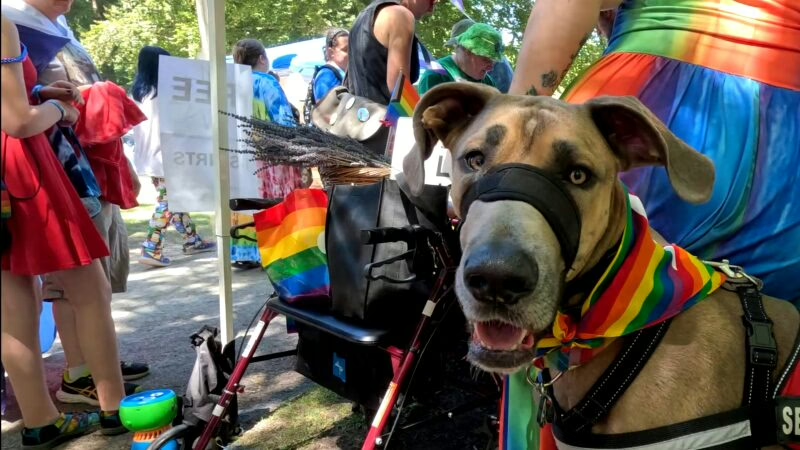
Happy Pride Month from the Mindful Ecotherapy Center

Happy Pride Month 2026

June marks Pride Month, a time of celebration, reflection, visibility, and advocacy for LGBTQ+ communities. At the Mindful Ecotherapy Center, we recognize Pride Month not only as a cultural observance but as an essential reminder of the importance of dignity, inclusion, and psychological safety for all people, regardless of sexual orientation, gender identity, or expression.

From its earliest foundations, the Mindful Ecotherapy Center has supported LGBTQ+ individuals and communities through affirming, trauma-informed, and nature-based therapeutic approaches. This commitment is woven into the fabric of our work, our teaching, and our understanding of what it means to heal in relationship with both self and environment.

You can learn more about our work here: Mindful Ecotherapy Center

A Commitment to Inclusion and Affirming Care

The Mindful Ecotherapy Center has always recognized that mental health cannot be separated from social context. For LGBTQ+ individuals, experiences of discrimination, marginalization, and identity invalidation have historically contributed to increased rates of anxiety, depression, and trauma-related symptoms, not because of identity itself, but because of societal responses to identity.

Our approach to mental health emphasizes affirmation, presence, and ecological connection. We believe healing happens when people are allowed to exist fully as themselves in safe relational and environmental spaces. This includes honoring diverse gender identities, relationship structures, cultural backgrounds, and lived experiences.

In practice, this means we intentionally integrate mindfulness-based ecotherapy principles with a commitment to inclusivity. Clients are met without assumptions. Language is inclusive and adaptable. Nature-based practices are used to support grounding, embodiment, and reconnection with a sense of belonging in the wider living world.

Pride Month as a Healing and Reflective Practice

Pride Month is both celebratory and deeply reflective. It honors the courage of those who have fought for visibility and rights, while also acknowledging ongoing challenges faced by LGBTQ+ people around the world.

From a mindfulness-based ecotherapy perspective, Pride Month can be understood as a collective practice of awareness. It invites reflection on questions such as:

  • What does it mean to feel safe in one’s identity?
  • How does the body carry experiences of acceptance or rejection?
  • How can connection to nature support resilience and self-acceptance?

Mindfulness-Based Ecotherapy integrates awareness practices with nature connection to support emotional regulation and meaning-making. For LGBTQ+ clients, this can be especially powerful in reclaiming embodied safety and grounding in environments that are nonjudgmental and restorative.

Rather than pathologizing identity, we focus on strengthening resilience, cultivating compassion, and restoring connection both internally and within community systems.

LGBTQ+ Mental Health and the Importance of Affirming Spaces

Affirming care is not optional; it is clinically significant. Research consistently shows that LGBTQ+ people experience better mental health outcomes when they are supported in environments that validate identity and reduce minority stress.

Organizations such as the Human Rights Campaign continue to highlight the importance of equality, visibility, and policy advocacy in reducing systemic harm and improving well-being.

At the Mindful Ecotherapy Center, we align with these values by creating educational content, training opportunities, and therapeutic frameworks that emphasize inclusion and respect.

Pride Month Resources for Education and Support

For those looking to learn more, connect with the community, or access support during Pride Month, the following resources offer valuable information:

These resources provide education, community connection, and pathways for advocacy and support, especially for individuals who may be exploring identity or seeking affirming spaces.

Continuing the Work Beyond Pride Month

While Pride Month is a dedicated time of visibility and celebration, the work of inclusion must continue throughout the entire year. At the Mindful Ecotherapy Center, we see Pride as an ongoing practice of presence, respect, and relational awareness.

We are committed to continuing to develop programs, trainings, and therapeutic resources that support LGBTQ+ individuals in their healing journeys. This includes integrating mindfulness practices with ecological awareness to foster resilience, self-acceptance, and connection to the more-than-human world.

Healing is not only personal. It is also ecological and communal. At the Mindful Ecotherapy Center, we believe that when people are supported in being their authentic selves, entire systems become more compassionate and sustainable.

Closing Reflection

As we honor Pride Month, we extend gratitude to LGBTQ+ communities for their resilience, creativity, and continued advocacy for dignity and equality. We recognize the importance of holding space for both celebration and reflection, joy and struggle, visibility and ongoing work.

At the Mindful Ecotherapy Center, we remain committed to standing alongside LGBTQ+ people not only in June, but in every season of the year.


Share Your Thoughts!

What do you think? Share your thoughts in the comments below!


  And don’t forget to subscribe to our newsletter!

Posted on

Conversion Therapy: Legal Shifts Do Not Change Clinical Reality

conversion therapy

Recent developments at the level of the U.S. Supreme Court (SCOTUS) have created confusion for many people regarding the legality and ethics of so-called conversion therapy. While legal interpretations may shift over time, one fact remains firmly grounded in decades of research and clinical consensus: conversion therapy is harmful, ineffective, and potentially life-threatening.

At the Mindful Ecotherapy Center, we believe it is essential to separate legal discourse from clinical truth. The absence of a ban, or the striking down of one, does not make a practice safe, ethical, or acceptable within professional mental health care.

What Is Conversion Therapy?

Conversion therapy refers to a range of discredited practices aimed at changing an individual’s sexual orientation or gender identity. These approaches may include talk therapy framed around shame, aversion techniques, or spiritual coercion. Despite how they are presented, these interventions are not supported by credible psychological science.

Leading organizations such as the American Psychological Association, American Psychiatric Association, and National Association of Social Workers have all issued clear statements opposing conversion therapy, citing overwhelming evidence of harm and lack of efficacy.

The Evidence of Harm

Research consistently shows that individuals subjected to conversion therapy are at significantly increased risk for:

  • Depression
  • Anxiety
  • Substance use disorders
  • Self-harm
  • Suicidal ideation and attempts

A large-scale study by Ryan et al. (2020) found that exposure to conversion therapy was associated with more than double the likelihood of attempting suicide compared to those who were not exposed. Similarly, Turban et al. (2020) demonstrated that LGBTQ+ youth who underwent conversion efforts had significantly higher rates of severe psychological distress and suicidality.

These findings are not isolated. They reflect a broader pattern: attempts to suppress or alter core identity traits create profound internal conflict, shame, and psychological fragmentation. From a mindfulness and ecotherapy perspective, this represents a forced disconnection from the self. This is an outcome that is fundamentally at odds with healing.

Ethical Violations in Clinical Practice

Any licensed counselor or therapist who implements conversion therapy is violating core ethical principles, including:

  • Nonmaleficence (do no harm)
  • Beneficence (promote well-being)
  • Respect for client autonomy and dignity

Modern therapeutic approaches, including mindfulness-based therapies, trauma-informed care, and ecotherapy, emphasize acceptance, integration, and self-awareness, not suppression or eradication of identity.

Practitioners who continue to use conversion therapy are not practicing evidence-based care. They are engaging in interventions that have been widely discredited and condemned by the mental health community.

What You Can Do

If you become aware of a licensed therapist in your area practicing conversion therapy, it is important to take action:

  • Report them to their state licensing board immediately. Licensing boards exist to protect the public and uphold professional standards.
  • If someone is offering therapy services without a license, report them as well. Practicing psychotherapy without a license is illegal in most jurisdictions and may constitute a felony offense.
  • If you or someone you know has been harmed by conversion therapy, legal recourse may be available, including civil lawsuits.

Taking these steps is not punitive. It is protective. It safeguards vulnerable people from further harm and reinforces ethical standards within the profession.

A Mindful Ecotherapy Perspective

Healing involves reconnection to self, to body, to community, and to the natural world. Conversion therapy does the opposite. It fosters disconnection, self-rejection, and internalized stigma.

Mindfulness-based ecotherapy offers a radically different path:

  • Observing thoughts and feelings without judgment
  • Cultivating self-compassion
  • Reconnecting with natural rhythms and embodied experience
  • Supporting identity integration rather than suppression

From this perspective, the goal is not to change who someone is, but to help them fully inhabit and accept themselves.

Final Thoughts

Legal decisions may evolve, but the science is clear: conversion therapy is harmful. No court ruling can override decades of empirical evidence and clinical consensus. Mental health professionals have an ethical obligation to reject harmful practices and provide care that affirms and supports the whole person.

If you encounter conversion therapy in your community, do not ignore it. Speak up, report it, and advocate for safe, ethical care. Lives quite literally depend on it.


References

American Psychological Association. (2009). Report of the task force on appropriate therapeutic responses to sexual orientation. APA.

Ryan, C., Toomey, R. B., Diaz, R. M., & Russell, S. T. (2020). Parent-initiated sexual orientation change efforts with LGBT adolescents: Implications for young adult mental health and adjustment. Journal of Homosexuality, 67(2), 159–173. https://doi.org/10.1080/00918369.2018.1538407

Turban, J. L., Beckwith, N., Reisner, S. L., & Keuroghlian, A. S. (2020). Association between recalled exposure to gender identity conversion efforts and psychological distress and suicide attempts among transgender adults. JAMA Psychiatry, 77(1), 68–76. https://doi.org/10.1001/jamapsychiatry.2019.2285


Share Your Thoughts!

What do you think? Share your thoughts in the comments below!


  And don’t forget to subscribe to our newsletter!
Posted on

Optum Medicaid: Charlton Hall, MMFT, PhD is Now Accepting Optum!

Optum Medicaid

Charlton Hall, MMFT, PhD, is now accepting Optum Medicaid in Washington State.

That means if you have Optum Medicaid, you can access therapy at Mindful Ecotherapy Center, PLLC, without scrambling to figure out how to afford it. Mental health care should not be a luxury service for people with high-deductible plans and a credit card they’re willing to suffer over.

Access matters. And now, if you’re covered by Optum Medicaid, you have another solid option for thoughtful, evidence-based care.

But insurance coverage is only half the story. What actually happens in therapy?

What Therapy Is Like with Charlton Hall

Optum Medicaid
Charlton Hall, MMFT, PhD

Therapy with Charlton is active, collaborative, and grounded in research-backed approaches.

Charlton integrates:

The goal is simple: help you build skills, increase clarity, and move toward a life that feels more aligned with who you actually are.

If you are using Optum Medicaid, you are getting structured, high-quality care.

Acceptance and Commitment Therapy (ACT)

ACT focuses on psychological flexibility. In practical terms, that means learning how to:

  • Make room for painful thoughts and emotions
  • Stop fighting your internal experience
  • Clarify your values
  • Take meaningful action even when anxiety or trauma shows up

Many people spend years trying to eliminate anxiety, erase trauma responses, or silence intrusive thoughts. ACT takes a different approach. Instead of getting stuck in an endless internal battle, you learn how to change your relationship to those thoughts and feelings.

You build a life that is bigger than your symptoms.

Dialectical Behavior Therapy (DBT)

If emotions feel overwhelming or relationships feel chaotic, DBT offers structure and tools.

DBT focuses on four core areas:

  • Mindfulness
  • Distress tolerance
  • Emotion regulation
  • Interpersonal effectiveness

You learn how to tolerate difficult emotions without self-destructive behavior. You learn how to set boundaries. You learn how to navigate conflict without imploding or exploding.

In therapy, these skills are practiced, not just discussed. Sessions often include concrete strategies you can apply immediately in real-world situations.

Whether you’re coming in through Optum Medicaid for anxiety, trauma, relationship stress, or mood instability, these skills are powerful and practical.

Mindfulness-Based Ecotherapy

Mindfulness-Based Ecotherapy integrates traditional psychotherapy with nature-based and embodied practices. Humans are not designed to live entirely indoors under fluorescent lighting and constant digital stimulation, even if modern life seems committed to that experiment.

Sessions may include:

  • Outdoor walk-and-talk therapy
  • Grounding exercises in natural environments
  • Sensory awareness practices
  • Nature-based metaphors for growth and resilience

For trauma survivors, reconnecting with the body and the natural world can support nervous system regulation in ways that purely cognitive approaches sometimes cannot.

Therapy is not just about thinking differently. It is also about experiencing safety differently.

Gender-Affirming Care

Charlton specializes in gender-affirming therapy. If you are transgender, nonbinary, gender-expansive, or questioning, therapy is not a space where your identity is debated or pathologized.

Instead, it is a space where:

  • Your identity is respected
  • Your lived experience is validated
  • Your goals are centered

Gender-diverse clients often face chronic stress related to discrimination, family conflict, medical systems, and social pressure. Therapy becomes a place of stability and affirmation rather than another place of scrutiny.

If you have Optum Medicaid and are looking for affirming care in Washington State, this coverage now makes that support more accessible.

Trauma-Informed and Solution-Focused

Trauma-informed care means prioritizing safety, collaboration, and empowerment. Trauma is understood as a nervous system response to overwhelming experiences, not a personal flaw.

At the same time, therapy does not have to be an endless excavation of the past. Solution-Focused Therapy brings attention to strengths and momentum. It asks:

  • When is the problem less intense?
  • What is already working?
  • What would progress look like in small, concrete steps?

You are not defined by your worst experiences. Therapy helps you build forward movement, even if that movement starts small.

What Clients Experience with Charlton Hall, MMFT, PhD

Clients often describe therapy with Charlton as:

  • Grounded and structured
  • Direct but compassionate
  • Skills-based and practical
  • Thoughtful and affirming

Sessions may include mindfulness practices, values clarification, behavioral experiments, and reflection on real-life situations. You will likely leave with something tangible to work on between sessions.

This is not therapy as a passive conversation. It is therapy as engaged growth through experiential exercises.

Expanding Access Through Optum Medicaid

The addition of Optum Medicaid means more individuals and families in Washington State can access consistent mental health care without the barrier of private-pay fees.

Early support prevents crises. Ongoing support builds resilience. Coverage through Optum Medicaid opens the door to therapy that is evidence-based, affirming, and oriented toward real-life change.

If you are covered by Optum Medicaid and seeking therapy that integrates ACT, DBT, Mindfulness-Based Ecotherapy, gender-affirming care, trauma-informed practice, and solution-focused work, Charlton Hall, MMFT, PhD, is now accepting new clients through Mindful Ecotherapy Center, PLLC.

You do not have to wait until everything falls apart.

You can begin with where you are.

And from there, you build something stronger.