
Table of Contents
These CBT Worksheets are based on Cognitive Behavioral Therapy (CBT). CBT is a structured, evidence-based approach to psychotherapy that helps you understand how your thoughts, feelings, and behaviors interact. The core idea is that it is not only events themselves that affect you, but also how you interpret those events. By learning to identify and shift unhelpful thinking patterns, you can change emotional responses and behavioral outcomes in practical, measurable ways (Beck, 2011).
At the Mindful Ecotherapy Center, CBT is often integrated with nature-based and mindfulness-informed practices, helping you connect cognitive awareness with present-moment grounding. This combination supports emotional regulation while encouraging a deeper sense of connection with yourself and your environment.
How CBT Works in Practice
CBT is typically structured, goal-oriented, and time-limited. You and a therapist work together to identify specific challenges such as anxiety, depression, stress, or unhelpful habits. From there, you learn to recognize automatic thoughts—those quick, often unconscious interpretations of situations that can shape emotional reactions.
For example, if you think, “I always mess things up,” CBT helps you examine the evidence for and against that belief. You then learn to replace distorted thinking patterns with more balanced, realistic alternatives. Over time, this process can reduce emotional distress and increase effective coping strategies.
Research shows that CBT is highly effective for a wide range of mental health concerns, including anxiety disorders and depression, and its benefits often persist after treatment ends (Hofmann et al., 2012).
CBT Worksheets and Skill Building
A key part of CBT involves practical exercises that help you apply what you learn in daily life. These exercises are often provided in the form of structured handouts or journaling tools commonly referred to as CBT Worksheets.
These worksheets may include thought records, behavioral activation plans, cognitive restructuring exercises, and mood tracking logs. The goal is to help you slow down your thinking process so you can observe patterns more clearly and make intentional changes rather than reacting automatically.
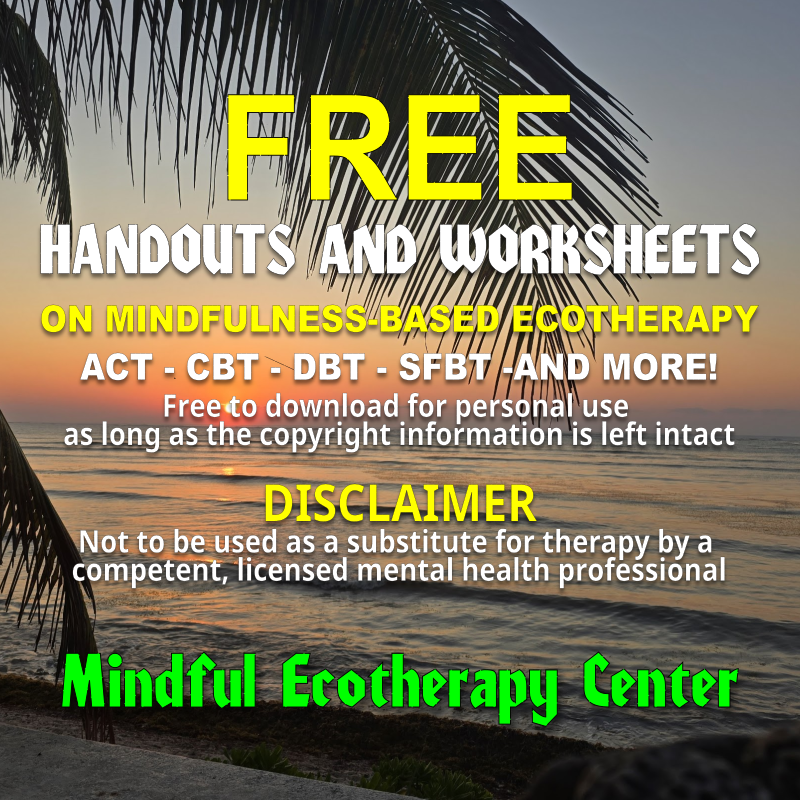
At the Mindful Ecotherapy Center, the CBT Worksheets provided on this page are offered freely for personal, educational, and clinical use. You are welcome to download, print, and use them in your own practice or therapeutic work as long as the original copyright notice remains intact. These materials are intended to support accessibility and learning, while respecting the intellectual work behind their development.
Mindfulness and Ecotherapy Integration
While traditional CBT focuses on cognition and behavior, the Mindful Ecotherapy approach also encourages awareness of your connection to the natural world. When you practice grounding techniques outdoors or reflect on thought patterns in natural settings, you may find it easier to step back from intense emotions and observe your internal experience with greater clarity.
This integration supports the idea that healing is not only internal but also relational in that they are connected to your environment, your body, and your lived experience in the world.
Why CBT Skills Matter
Learning CBT skills is not about “positive thinking” or ignoring difficult emotions. Instead, it is about developing psychological flexibility. You learn to notice thoughts without immediately believing or acting on them. This creates space for choice, which is a core component of emotional resilience.
Over time, using CBT tools such as CBT Worksheets can help you build confidence in managing stress, improving communication, and responding more effectively to life challenges.
CBT Worksheets
Cognitive Behavioral Therapy offers a practical, evidence-based framework for understanding and changing patterns that contribute to emotional distress. When combined with mindfulness and ecotherapy principles, it becomes a holistic approach that supports both mental clarity and grounded awareness. The CBT Worksheets provided below by the Mindful Ecotherapy Center are designed to help you apply these skills in a clear, structured, and accessible way.
ABCD of Cognitive Behavioral Therapy Worksheet
When our actions lead to consequences that are unpleasant for us, we may need to re-examine our beliefs and our actions and modify them so that we can get more positive outcomes. One way of doing this is with the ABCD Model of Cognitive Behavioral Therapy. The worksheet below will guide you through this process.
ABC in Nature Worksheet
This ABC in Nature Worksheet helps you to notice the connection between triggers, beliefs, and responses, practice cognitive restructuring, and integrate real-time awareness through nature observation using Mindfulness-Based Ecotherapy.
Assumptions-Perceptions-Reality Triad
This worksheet helps you explore how your assumptions about emotions and moods shape your perceptions and experiences. Reflect on your beliefs, examine how they influence your reality, and consider alternative assumptions that may lead to healthier perspectives and different outcomes.
Behavioral Activation Plan
This worksheet helps you schedule meaningful, enjoyable, or productive activities. When you are feeling depressed or unmotivated, acting often comes before feeling motivated. Small steps can help improve mood, increase energy, and create positive momentum.
CBA Questions to Consider Worksheet
Prior to filling out the Cost-Benefit Analysis Worksheet, you may wish to think about the questions on this worksheet. Your answers may help you determine how to fill out your Cost-Benefit Analysis.
When we repeatedly engage in certain behaviors, over time, we go into “automatic pilot” mode. At this point, the action may become something we don’t even think about anymore. The Cost-Benefit Analysis Pros and Cons Worksheet helps you to slow down this automatic thinking process so that you can examine it and determine where the thinking process might have “gone off the rails.”
CBA Cost-Benefit Analysis Pros and Cons Worksheet
A pros and cons cost-benefit analysis worksheet is filled out by first writing the decision you’re considering at the top. Then you list the advantages (pros/benefits) on one side and the disadvantages (cons/costs) on the other, including practical, emotional, and long-term factors. If the worksheet includes it, you can also separate short-term from long-term effects. Some versions let you assign weights or scores to each item to show importance rather than just counting items. You then review the overall balance, focusing less on quantity and more on which side better aligns with your values, goals, and likely outcomes.
Cognitive Distortions Checklist
This worksheet helps you identify common thinking errors such as all-or-nothing thinking, catastrophizing, mind reading, and overgeneralization. The goal is awareness. Once you can name the distortion, it becomes easier to challenge it.
Core Beliefs Worksheet
Core beliefs are usually formed early in life and can operate beneath conscious awareness, influencing how you interpret experiences, relate to others, and view yourself. This worksheet can help you identify a core belief, examine the evidence supporting and contradicting it, and consider whether that belief is accurate, helpful, or based on outdated experiences. By bringing these deeply held assumptions into awareness, you may take an important step toward understanding the connection between your beliefs, thoughts, emotions, and behaviors.
Evidence For and Against Worksheet
This worksheet is designed to help you evaluate the accuracy of distressing thoughts by separating factual evidence from interpretations and assumptions. By listing what supports a thought alongside what contradicts it, you create a clearer picture of the situation and reduce the tendency to rely on emotional reasoning or cognitive distortions.
The process encourages you to step back from automatic conclusions and consider a more balanced perspective grounded in evidence. As you compare both sides, you can revise the original thought into something more realistic and helpful, which often reduces emotional intensity and supports more adaptive decision-making moving forward.
Thought Record Worksheet
The Thought Record Worksheet is a Cognitive Behavioral Therapy (CBT) tool designed to help you identify and evaluate automatic thoughts that contribute to emotional distress. To use it, begin by describing a situation that triggered a strong emotional reaction, then record the emotions and automatic thoughts you experienced. Next, examine the evidence that supports and contradicts those thoughts, and develop a more balanced, realistic perspective. Finally, re-rate your emotions and reflect on what you learned. Regular use of this worksheet can help you challenge unhelpful thinking patterns and build greater cognitive flexibility and emotional resilience.
References
Beck, J. S. (2011). Cognitive behavior therapy: Basics and beyond (2nd ed.). Guilford Press.
Hofmann, S. G., Asnaani, A., Vonk, I. J. J., Sawyer, A. T., & Fang, A. (2012). The efficacy of cognitive behavioral therapy: A review of meta-analyses. Cognitive Therapy and Research, 36(5), 427–440. https://doi.org/10.1007/s10608-012-9476-1
The Mindful Ecotherapy Center on YouTube
Subscribe to the Mindful Ecotherapy Center’s YouTube channel to bring peace, presence, and healing into your daily life. Our videos guide you through mindfulness-based ecotherapy practices, including forest bathing, tree planting rituals, nature meditations, and reflective exercises for grief, stress, and emotional well-being.
Whether you’re seeking to reconnect with the natural world, cultivate inner calm, or find restorative tools for personal growth, our content offers practical guidance, inspiration, and community support. Join us to explore the transformative power of nature and mindfulness, and start your journey toward balance, resilience, and deeper connection today!
Share Your Thoughts!
What do you think? Share your thoughts in the comments below! And don’t forget to subscribe to our newsletter!