
Posted on Leave a comment

Love Bombing and Healing Through Mindfulness-Based Ecotherapy

love bombing

The term “love bombing” has become increasingly common in discussions about unhealthy relationships, emotional aggression, and manipulation. At first glance, love bombing may appear romantic, passionate, or even ideal. The attention can feel intoxicating. Someone may shower you with compliments, gifts, affection, constant texting, and promises about the future very early in a relationship. They may tell you that you are their soulmate within days or weeks. They may insist that they have “never felt this way before.”

In healthy relationships, affection develops gradually alongside trust, mutual respect, and emotional safety. Love bombing, however, often creates emotional intensity before true intimacy has had time to form. The goal may be conscious or unconscious, but the result is frequently the same: emotional dependency, confusion, and a weakening of personal boundaries.

At the Mindful Ecotherapy Center, we recognize that recovering from emotionally manipulative relationships requires more than intellectual understanding. Healing also involves reconnecting with your body, emotions, intuition, and relationship with the natural world. Mindfulness-based ecotherapy can provide grounding, clarity, and emotional restoration for individuals recovering from the effects of love bombing and other emotionally aggressive dynamics.

What Is Love Bombing?

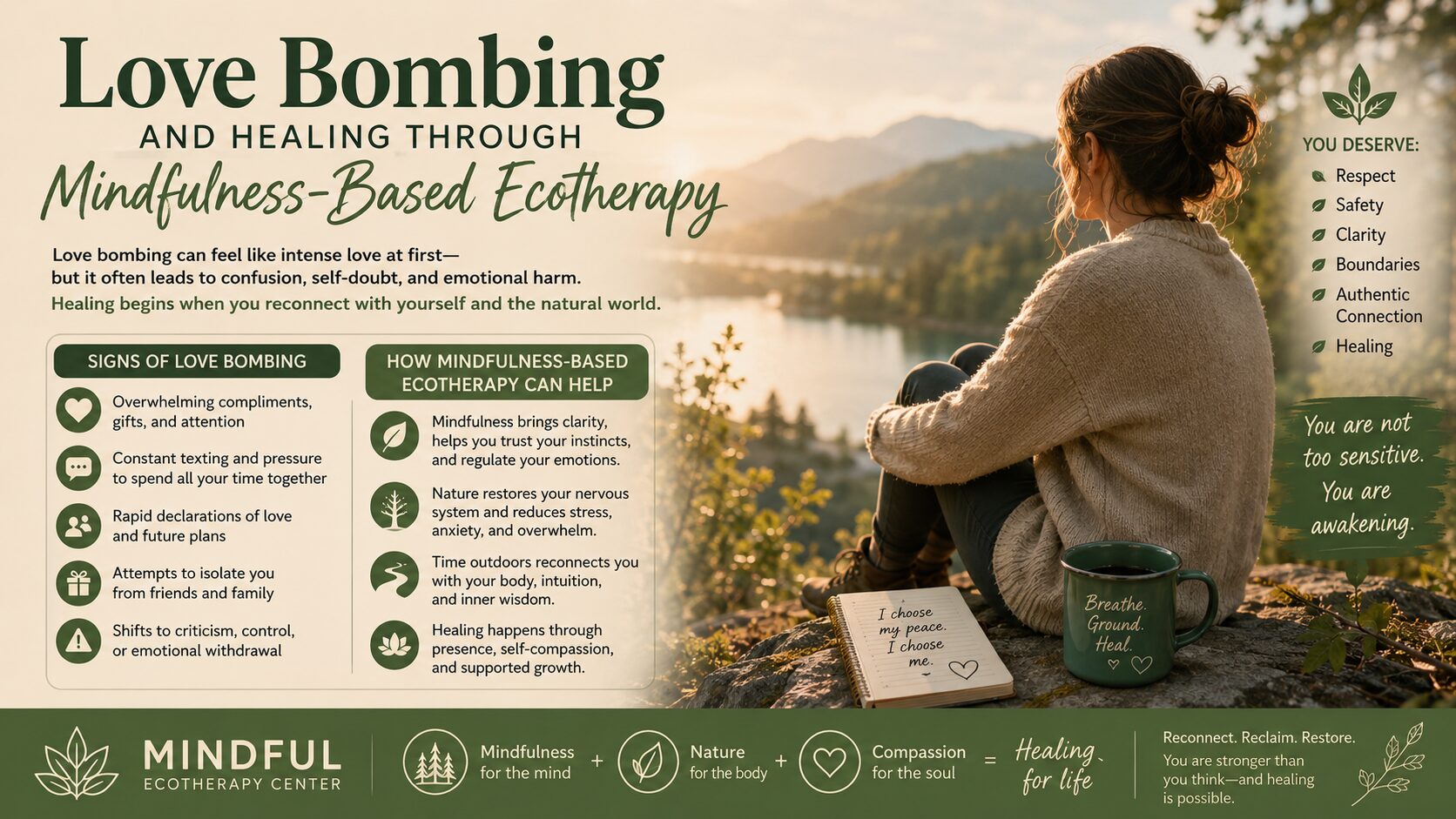
Love bombing is a pattern of overwhelming affection and attention that can be used to gain influence or emotional control over another person quickly. While not every intense romance is unhealthy, love bombing tends to move at an unusually fast pace and often involves pressure to commit emotionally before trust has been established.

Some common signs of love bombing include excessive compliments, nonstop communication, pressure to spend all your time together, grand declarations of love very early on, expensive gifts, and attempts to isolate you from friends or family. In many cases, the attention feels so validating that it becomes difficult to notice red flags.

The problem often emerges when the intense affection begins to change. The same person who once idealized you may become critical, controlling, dismissive, jealous, or emotionally volatile. You may begin questioning yourself, minimizing your own needs, or trying desperately to “get back” the loving person you first encountered.

This cycle can create a trauma bond in which intermittent affection and emotional withdrawal become psychologically addictive. Many people recovering from love bombing describe feeling emotionally disoriented, anxious, ashamed, or disconnected from themselves.

The Emotional Impact of Love Bombing

Love bombing can deeply affect your sense of self-worth and emotional stability. Because the relationship often begins with idealization, the later stages of criticism or emotional manipulation can feel especially painful and confusing.

You may begin doubting your instincts. You may replay conversations repeatedly in your mind, wondering whether you are “too sensitive” or somehow responsible for the conflict. Over time, chronic emotional stress can affect sleep, concentration, nervous system regulation, and overall mental health.

Many survivors of emotionally manipulative relationships also experience a loss of connection with the present moment. Their awareness becomes consumed by anticipating emotional reactions, avoiding conflict, or seeking validation from the other person. This is where mindfulness-based approaches can become especially helpful.

How Mindfulness Helps Restore Clarity

Mindfulness involves paying attention to present-moment experience with openness and nonjudgmental awareness. In the aftermath of love bombing, mindfulness can help you reconnect with your own internal reality instead of becoming trapped in confusion, self-doubt, or emotional reactivity.

Mindfulness practices encourage you to observe thoughts and feelings without immediately believing or reacting to them. For example, you may begin noticing patterns such as anxiety when your phone vibrates, fear of disappointing others, or the urge to ignore your own boundaries to maintain connection.

Rather than criticizing yourself for these reactions, mindfulness invites compassionate awareness. This creates space between emotional triggers and automatic responses. Over time, you can begin rebuilding trust in your own perceptions and emotional experience.

Mindfulness also strengthens emotional regulation by calming the nervous system. Simple practices such as conscious breathing, body awareness, meditation, and mindful walking can reduce stress hormones and help restore a sense of safety within yourself.

Why Ecotherapy Can Be Especially Healing

Ecotherapy combines mindfulness and psychological healing with experiences in nature. The natural world offers a grounding presence that can help counteract the emotional chaos often associated with manipulative relationships.

Nature does not pressure, manipulate, flatter, or shame. Instead, it encourages stillness, observation, rhythm, and reconnection. Time spent in forests, parks, gardens, or near water can reduce anxiety and support nervous system recovery. Research has shown that exposure to natural environments can lower stress, improve mood, and enhance emotional resilience.

For individuals recovering from love bombing, ecotherapy may include mindful hiking, nature meditation, gardening, outdoor journaling, wildlife observation, or simply sitting quietly beneath trees while reconnecting with bodily sensations and emotional awareness.

These practices help restore a sense of grounded identity. Instead of defining yourself through another person’s approval or rejection, you begin reconnecting with your own values, intuition, and inner stability.

Relearning Healthy Relationship Patterns

One of the most important aspects of healing from love bombing is learning to recognize the difference between intensity and genuine intimacy. Healthy relationships respect pacing, boundaries, individuality, and emotional reciprocity.

Mindfulness-based ecotherapy encourages slower, more conscious relationship patterns. It helps you become more aware of how your body responds to certain interactions. You may begin noticing tension, anxiety, exhaustion, or emotional confusion earlier instead of dismissing these signals.

Healing also involves practicing self-compassion. Many people blame themselves for “falling for” manipulative behavior. In reality, love bombing often targets normal human needs for connection, affection, validation, and belonging. Recovery is not about becoming emotionally closed off. It is about developing awareness, discernment, and healthier boundaries.

At the Mindful Ecotherapy Center, we believe healing happens not only through insight, but through reconnection with your body, your emotions, your community, and the living world around you. Mindfulness-based ecotherapy offers a path toward emotional clarity, grounded self-awareness, and healthier relationships rooted in authenticity rather than emotional control.

For more information, visit the Mindful Ecotherapy Center at Mindful Ecotherapy Center

Share Your Thoughts About Love Bombing!

What do you think? Share your thoughts in the comments below!


  And don’t forget to subscribe to our newsletter!
Posted on Leave a comment

Mirror Neurons: How Mindfulness-Based Ecotherapy Helps You Reset Them

mirror neurons

By Charlton Hall, MMFT, PhD
Mindful Ecotherapy Center

Mirror neurons teach us that you don’t just think your way through relationships. You absorb them. Other people’s moods, facial expressions, tone of voice, and emotional states don’t politely stop at your skin. They leak in. That’s why you flinch when someone else stubs their toe. A major reason for this lies in a fascinating piece of neuroscience known as mirror neurons.

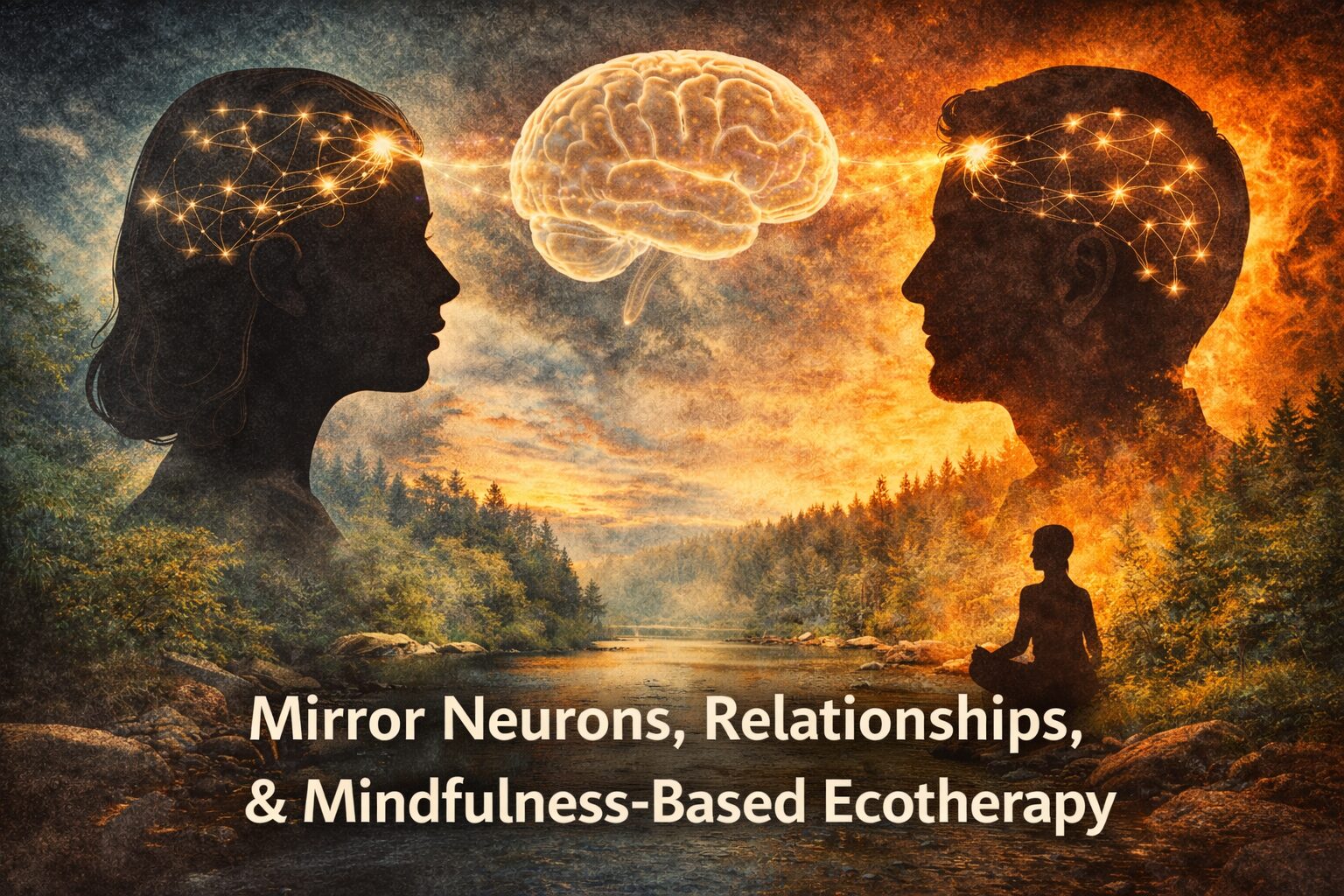
Mirror neurons are specialized brain cells that activate both when you perform an action and when you observe someone else performing that same action. In plain language, your nervous system is wired to echo the experiences of others internally. This is how empathy happens. It is also how emotional contagion, burnout, and relational distress quietly take hold.

Understanding mirror neurons helps explain why some relationships feel nourishing while others leave you depleted, irritable, or strangely unlike yourself. Mindfulness-Based Ecotherapy offers a grounded, embodied way to work with this process rather than being unknowingly run by it.

What Are Mirror Neurons and Why Do They Matter in Relationships?

Mirror neurons were first identified in the 1990s and are now understood to play a central role in empathy, social learning, attachment, and emotional attunement. When you watch someone smile, your brain partially activates the same neural circuits as if you were smiling yourself. When someone is anxious, angry, or withdrawn, your nervous system often mirrors that state before your rational mind catches up.

This process is how humans bond, cooperate, and survive socially. The problem arises when you are repeatedly exposed to dysregulated, hostile, or emotionally unavailable people without sufficient grounding or boundaries. Over time, your own baseline emotional state can shift without you realizing why.

In intimate relationships, mirror neurons help partners synchronize their emotional responses. In unhealthy dynamics, they can trap people in cycles of reactivity, resentment, or emotional exhaustion.

Mirror Neurons, Emotional Regulation, and Relationship Patterns

Mirror neurons do not operate in isolation. They interact with your stress response system, attachment history, and beliefs about safety and connection. If your nervous system is already on edge, you are more likely to absorb and amplify others’ emotional states.

This explains why:

  • Conflict often escalates faster than logic would predict
  • One person’s anxiety spreads through a room like a contagion
  • Calm, grounded people feel stabilizing to be around
  • Chronic exposure to hostility can change how you feel about yourself

Without awareness, mirror neuron activation drives automatic reactions. You snap back, shut down, over-accommodate, or emotionally withdraw. You think you are responding to the present moment, but you are often responding to your nervous system’s interpretation of another person’s internal state.

How Mindfulness Interrupts Automatic Mirroring

Mindfulness creates a pause between sensation and reaction. Instead of immediately absorbing and reflecting what someone else is feeling, you learn to notice what is happening inside you without becoming it.

Through mindfulness practice, you begin to recognize:

  • “This anxiety may not be mine”
  • “My body is reacting before my values have a say”
  • “I can observe this emotion without acting on it”

Mindfulness strengthens your capacity to stay present without being hijacked by mirror neuron activation.


Why Mindfulness-Based Ecotherapy Is Especially Effective

Mindfulness-Based Ecotherapy adds a critical missing element: the regulating power of the natural world. Human nervous systems evolved in relation to nature. Natural environments offer rhythmic, nonjudgmental sensory input that helps stabilize mirror neuron activity.

When you practice mindfulness outdoors, your nervous system receives signals of safety and continuity. Trees do not escalate conflict. Water does not demand emotional labor. Wind does not project unresolved trauma onto you.

Nature provides what many relationships cannot: steady regulation without expectation.

This allows you to:

  • Reset after emotionally intense interactions
  • Discharge absorbed stress and tension
  • Reestablish a sense of self separate from others’ moods
  • Strengthen relational boundaries without hostility

In ecotherapy-informed practice, people often report feeling more emotionally resilient, less reactive, and better able to engage in relationships from choice rather than reflex.

Mirror Neurons, Boundaries, and Emotional Health

Healthy boundaries are not walls. They are filters. Understanding mirror neurons reframes boundaries as a neurological necessity rather than a personal failing. You are not “too sensitive.” You are biologically responsive to your own needs.

Mindfulness-Based Ecotherapy supports boundary-setting by helping you:

  • Notice when emotional absorption from others is happening
  • Regulate your body before responding
  • Choose values-based actions rather than reactive ones
  • Restore balance through intentional contact with nature

Over time, this reduces resentment, emotional burnout, and the sense of losing yourself in relationships.

Working With Mirror Neurons Instead of Fighting Them

You cannot turn mirror neurons off, nor should you want to. They are the foundation of empathy, compassion, and connection. They’re what make it possible to live in community with others. The goal here is to create emotional and cognitive flexibility.

Mindfulness-Based Ecotherapy teaches you how to stay open without being overwhelmed, connected without being consumed, and compassionate without abandoning yourself. In a world saturated with emotional noise, this is not a luxury. It is a survival skill.

If your relationships feel exhausting, volatile, or emotionally confusing, the issue may not be your communication skills. It may be that your nervous system needs grounding, space, and reconnection with the living world that shaped it.

Learn more about mindfulness-based ecotherapy and our work at:
https://www.mindfulecotherapycenter.com

Subscribe for reflections, practices, and resources:
https://mindfulecotherapy.substack.com/subscribe


References

Gallese, V. (2001). The “shared manifold” hypothesis: From mirror neurons to empathy. Journal of Consciousness Studies, 8(5–7), 33–50.

Hartig, T., Mitchell, R., de Vries, S., & Frumkin, H. (2014). Nature and health. Annual Review of Public Health, 35, 207–228. https://doi.org/10.1146/annurev-publhealth-032013-182443

Iacoboni, M. (2009). Mirroring people: The science of empathy and how we connect with others. Farrar, Straus and Giroux.

Siegel, D. J. (2012). The developing mind: How relationships and the brain interact to shape who we are (2nd ed.). Guilford Press.

Ulrich, R. S., et al. (1991). Stress recovery during exposure to natural and urban environments. Journal of Environmental Psychology, 11(3), 201–230.


Share Your Thoughts About Mirror Neurons!

What do you think? Share your thoughts in the comments below!


  And don’t forget to subscribe to our newsletter!
Posted on Leave a comment

Outdoor Mindfulness Practices for Couples: Strengthening Relationships Naturally

outdoor mindfulness

By Charlton Hall, MMFT, PhD
Mindful Ecotherapy Center

Modern relationships are not failing because people do not care. They are struggling because the conditions most couples live in are relentlessly dysregulating. Chronic stress, constant digital input, economic pressure, and overstimulation wear down even strong relational bonds. Many couples report feeling disconnected, reactive, or emotionally distant, even when love and commitment are still present. One effective and underutilized way to address this disconnect is through outdoor mindfulness practices rooted in Mindfulness-Based Ecotherapy.

Outdoor mindfulness shifts couples out of environments that amplify stress and into settings that naturally support regulation, presence, and connection. Nature slows the nervous system, reduces defensive reactivity, and makes emotional attunement more accessible. When couples practice mindfulness together outdoors, they are not just relaxing. They are retraining how they relate to themselves and to each other.

Why Outdoor Mindfulness Supports Healthy Relationships

Relationships are shaped as much by physiology as by communication skills. When one or both partners are chronically stressed, the nervous system prioritizes protection over connection. This leads to misattunement, quick escalation, and repeated conflict loops. Outdoor mindfulness works because it begins with regulation, not problem-solving.

Natural environments have been shown to lower cortisol levels, reduce heart rate, and activate the parasympathetic nervous system. When partners experience these effects together, their capacity for empathy and emotional presence increases. Conversations soften. Listening improves. Reactivity decreases.

Mindfulness adds intention to this process. Rather than being distracted or task-focused outdoors, couples intentionally bring awareness to the present moment. This shared attention becomes a form of relational attunement, strengthening the sense of being together rather than merely coexisting.

Outdoor Mindfulness as a Relational Practice

In Mindfulness-Based Ecotherapy, outdoor mindfulness is not about achieving a calm state or avoiding difficult topics. It is about cultivating awareness, safety, and connection in the context of the natural world. For couples, this means learning to be present with one another without immediately trying to fix, defend, or withdraw.

Nature offers a nonjudgmental container for relational work. There is less pressure to perform or resolve everything at once. This makes outdoor mindfulness especially helpful for couples experiencing burnout, recurring conflict, or emotional distance.

Over time, these practices help couples reconnect with shared values, mutual care, and a sense of partnership grounded in lived experience rather than constant discussion.

Practical Outdoor Mindfulness Practices for Couples

One foundational outdoor mindfulness practice for couples is mindful walking. Partners walk together at a comfortable pace, paying attention to the rhythm of their steps, breath, and the surrounding environment. Conversation is optional. The focus is on shared presence rather than analysis.

Another practice involves sensory grounding. Couples sit together outdoors and take turns naming what they notice through the senses. What they hear. What they see. What they feel physically. This builds awareness and co-regulation while reinforcing emotional safety.

A third practice is nature-based reflective sharing. After a few minutes of quiet observation, each partner shares a brief reflection, such as a word, image, or feeling that arose. The other partner listens without responding or interpreting. This strengthens trust and reduces habitual defensiveness.

These practices are intentionally simple. Their effectiveness lies in consistency of application, not complexity.

Using Outdoor Mindfulness to Manage Conflict

Outdoor mindfulness practices can also support healthier conflict engagement. Nature reduces physiological arousal, making it easier to stay grounded during difficult conversations. Mindfulness helps partners notice early signs of activation, such as tension or shallow breathing, before escalation occurs.

Rather than avoiding conflict, through Mindfulness-Based Ecotherapy, couples learn to approach it with greater awareness and compassion. The natural environment reinforces perspective, reminding both partners that conflict is part of a relationship, not a sign of failure.

In therapeutic contexts, outdoor mindfulness is often used alongside communication skills and values clarification, providing a stable foundation for deeper relational work.

How Mindfulness-Based Ecotherapy Enhances Couple Connection

Mindfulness-Based Ecotherapy emphasizes the interconnectedness between people and the natural world. For couples, this perspective helps shift focus away from blame, shame, and guilt-tripping each other and toward shared experience. Partners are encouraged to see themselves as part of a larger system rather than isolated adversaries.

This approach is especially beneficial for couples dealing with stress, life transitions, or emotional fatigue. Outdoor mindfulness becomes a way to restore balance, reconnect emotionally, and cultivate resilience together.

Over time, these practices can evolve into meaningful practices that support long-term relationship health.

Strengthening Relationships Naturally

Outdoor mindfulness offers couples a grounded, accessible way to strengthen their connection. By slowing down together, engaging the senses, and practicing mindful awareness in nature, couples create space for regulation, empathy, and intimacy with each other.

At the Mindful Ecotherapy Center, outdoor mindfulness practices are integrated into therapeutic work to support relational healing in a way that is both sustainable and deeply human. Strengthening relationships does not always begin with more talking. Sometimes it begins by stepping outside together and simply paying attention.


References

Hartig, T., Mitchell, R., de Vries, S., & Frumkin, H. (2014). Nature and health. Annual Review of Public Health, 35, 207–228. https://doi.org/10.1146/annurev-publhealth-032013-182443

Kabat-Zinn, J. (2003). Mindfulness-based interventions in context: Past, present, and future. Clinical Psychology: Science and Practice, 10(2), 144–156. https://doi.org/10.1093/clipsy.bpg016

Rogers, C. R. (1961). On becoming a person: A therapist’s view of psychotherapy. Houghton Mifflin.

Ulrich, R. S., Simons, R. F., Losito, B. D., Fiorito, E., Miles, M. A., & Zelson, M. (1991). Stress recovery during exposure to natural and urban environments. Journal of Environmental Psychology, 11(3), 201–230. https://doi.org/10.1016/S0272-4944(05)80184-7


Share Your Thoughts About Outdoor Mindfulness Practices for Couples!

What do you think? Share your thoughts in the comments below!


  And don’t forget to subscribe to our newsletter!

Posted on

Why I Left the AAMFT and Joined the American Counseling Association (ACA)

aamft

Why leave the AAMFT? As a Marriage and Family Therapist (MFT), being part of a professional organization is essential to maintaining professional standards, receiving ongoing education, and accessing support resources. For years, I was a loyal member of the American Association for Marriage and Family Therapy (AAMFT). It’s a respected organization that provides a wide range of resources for therapists.

However, over time, I became increasingly frustrated with the rising membership fees and the declining value of the services and benefits offered. Today, I attempted to renew my membership. Their website crashed. I called the tech support number that I found after great difficulty. They had it well-hidden on the site. After being put on hold for over an hour I was informed that no representatives were available to accept my call, and they hung up on me. They could’ve told me that before I waited on the phone for an hour.

After much consideration, I made the decision to leave AAMFT and join the American Counseling Association (ACA) instead. Here’s why I made that change, and why I believe other therapists might want to consider the same.

AAMFT Rising Membership Fees with Fewer Benefits

One of the biggest factors that led me to leave AAMFT was the consistently increasing membership fees. Each year, it seemed that the cost of being a member rose, while the value I received in return steadily diminished. I am and have been a member of multiple professional organizations in my professional career, and none have higher membership fees with fewer benefits. When I first joined AAMFT, I appreciated the resources, networking opportunities, and professional support. But as time went on, I noticed that many of the services I once found valuable were no longer being offered—or were being offered in a more limited capacity.

While the cost of membership continued to climb, the actual benefits I received in return seemed to be shrinking. The number of workshops, seminars, and continuing education opportunities that were once included or offered at a discount became fewer and less relevant to my practice. Access to industry-specific research also became more difficult, as more AAMFT content was locked behind additional paywalls.

I felt like I was paying more for less. As a professional who prides myself on providing high-quality care to my clients and staying informed about the latest developments in marriage and family therapy, this diminishing return on investment was frustrating. It became clear that AAMFT was not meeting my needs as it once had.

AAMFT’s Lack of Relevant Resources

Over time, I also began to notice that the resources offered by AAMFT felt increasingly irrelevant to my practice. The workshops and conferences offered by the organization didn’t align with the direction I wanted my career to go in. As a therapist focusing on mindfulness-based therapy, I found that AAMFT was often slow to embrace emerging therapeutic approaches or newer methodologies in the field. Much of the research published in the AAMFT journal seemed focused on self-care for therapists rather than on patient care. While self-care is important, patient care is at least as important as therapist self-care.

Furthermore, I was increasingly frustrated by the limited scope of networking opportunities with other professionals. As an MFT, much of my work intersects with the practices of other types of counselors, social workers, and psychologists. However, AAMFT’s narrow focus on marriage and family therapy left me feeling disconnected from a broader professional community. While COVID-19 had an impact on face-to-face networking opportunities, teleconferencing remained an option. Unfortunately, it was an option that AAMFT was slow to embrace when it comes to networking with mental health professionals who are not Marriage and Family Therapists.

Why I Chose the American Counseling Association (ACA)

After years of growing dissatisfaction with the AAMFT, I began researching other organizations that could better support my practice. That’s when I discovered the American Counseling Association (ACA). The ACA provides resources for a wide variety of mental health professionals, including Licensed Professional Counselors (LPCs), Marriage and Family Therapists (LMFTs), and other types of therapists. What initially attracted me to the ACA was its inclusive approach and commitment to supporting diverse therapeutic practices.

The ACA offers a wider variety of resources and professional development opportunities that are relevant to my current practice. From advanced certifications in specialized therapeutic techniques like mindfulness and ecotherapy to discounts on continuing education courses, the ACA provides far more comprehensive and varied benefits than AAMFT has done in recent years.

Another key factor in my decision to switch was the membership fees. The ACA offers competitive pricing for its membership, and I found that the benefits far outweighed the cost. As a member, I have access to exclusive webinars, workshops, and training opportunities, many of which align directly with the areas I want to grow in, such as mindfulness-based counseling and ecotherapy.

Networking and Professional Community

One of the most valuable aspects of joining the ACA is the opportunity to network with a wider range of mental health professionals. The ACA’s emphasis on a holistic view of therapy allows me to interact with counselors who specialize in everything from trauma-informed therapy to addiction counseling, and many other areas that complement my own expertise. This diversity of perspectives helps me grow as a therapist and expand my understanding of the various therapeutic methods that work for clients.

Moreover, the ACA offers several state chapters and interest networks that allow me to connect with local professionals who share similar interests or practice areas. This has helped me build meaningful relationships and expand my referral network, which was something I was struggling to achieve through AAMFT.

Final Thoughts

Leaving the American Association for Marriage and Family Therapists (AAMFT) was not an easy decision, as I’ve always respected the work the organization has done for our profession. However, as time passed, I realized that the increasing membership fees and the diminishing value of their services no longer aligned with my professional goals, and AAMFT leadership has been slow to respond if they bothered to respond at all. By joining the American Counseling Association (ACA), I’ve found a more inclusive, relevant, and supportive community for my work as a therapist.

If you’re an MFT or counselor considering which professional organization best suits your needs, I strongly encourage you to look into the ACA. With its comprehensive resources, professional development opportunities, and more affordable membership fees, it has been a game-changer for my practice.

The right professional organization can make all the difference in your career and for your patients/clients. For me, the ACA has become the resource I was searching for.


Share Your Thoughts on the AAMFT!

Are you a current member of the AAMFT? Have you been in the past? What’s your experience been? Share your thoughts in the comments below!