
Posted on Leave a comment

Love Bombing and Healing Through Mindfulness-Based Ecotherapy

love bombing

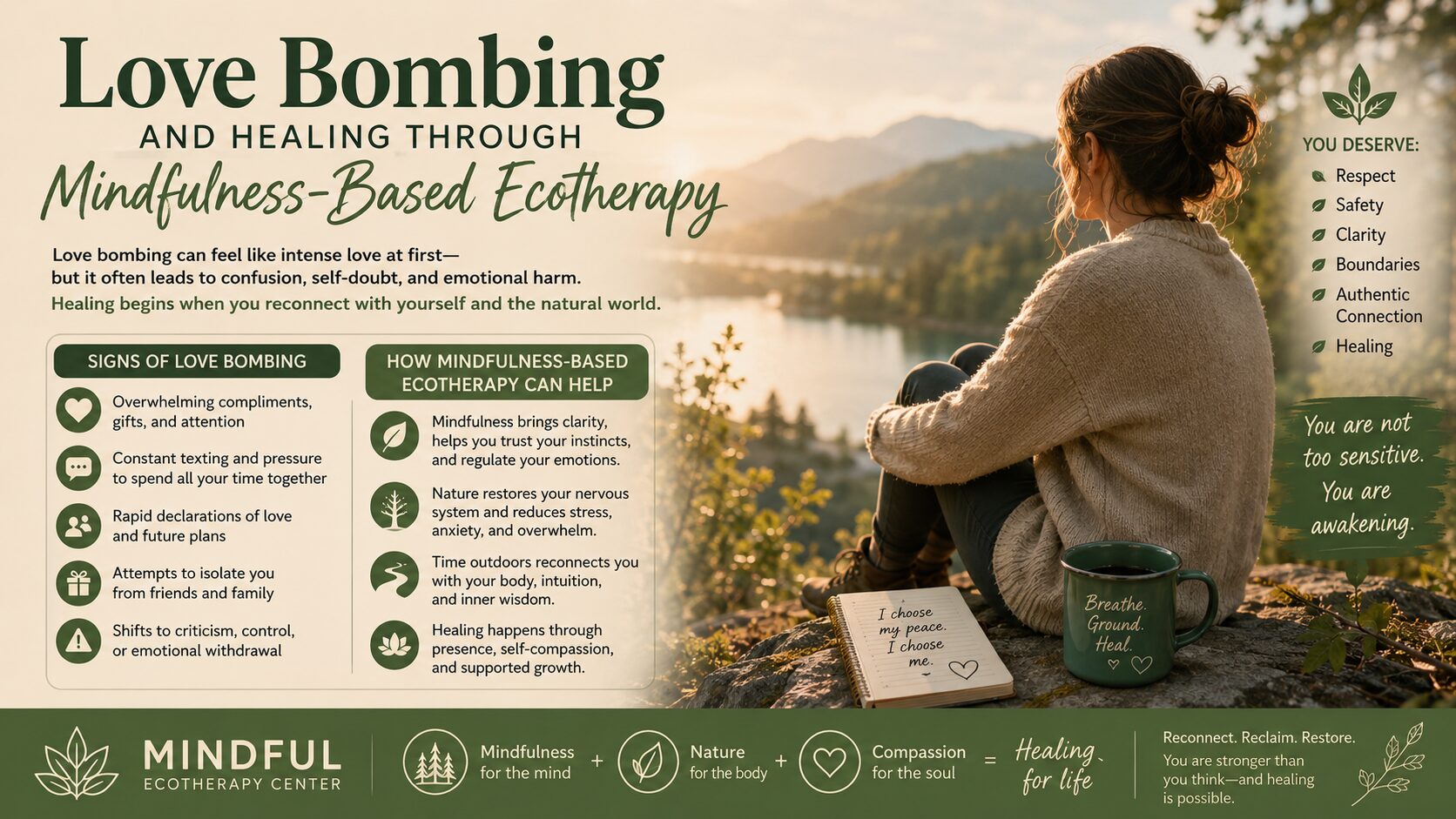
The term “love bombing” has become increasingly common in discussions about unhealthy relationships, emotional aggression, and manipulation. At first glance, love bombing may appear romantic, passionate, or even ideal. The attention can feel intoxicating. Someone may shower you with compliments, gifts, affection, constant texting, and promises about the future very early in a relationship. They may tell you that you are their soulmate within days or weeks. They may insist that they have “never felt this way before.”

In healthy relationships, affection develops gradually alongside trust, mutual respect, and emotional safety. Love bombing, however, often creates emotional intensity before true intimacy has had time to form. The goal may be conscious or unconscious, but the result is frequently the same: emotional dependency, confusion, and a weakening of personal boundaries.

At the Mindful Ecotherapy Center, we recognize that recovering from emotionally manipulative relationships requires more than intellectual understanding. Healing also involves reconnecting with your body, emotions, intuition, and relationship with the natural world. Mindfulness-based ecotherapy can provide grounding, clarity, and emotional restoration for individuals recovering from the effects of love bombing and other emotionally aggressive dynamics.

What Is Love Bombing?

Love bombing is a pattern of overwhelming affection and attention that can be used to gain influence or emotional control over another person quickly. While not every intense romance is unhealthy, love bombing tends to move at an unusually fast pace and often involves pressure to commit emotionally before trust has been established.

Some common signs of love bombing include excessive compliments, nonstop communication, pressure to spend all your time together, grand declarations of love very early on, expensive gifts, and attempts to isolate you from friends or family. In many cases, the attention feels so validating that it becomes difficult to notice red flags.

The problem often emerges when the intense affection begins to change. The same person who once idealized you may become critical, controlling, dismissive, jealous, or emotionally volatile. You may begin questioning yourself, minimizing your own needs, or trying desperately to “get back” the loving person you first encountered.

This cycle can create a trauma bond in which intermittent affection and emotional withdrawal become psychologically addictive. Many people recovering from love bombing describe feeling emotionally disoriented, anxious, ashamed, or disconnected from themselves.

The Emotional Impact of Love Bombing

Love bombing can deeply affect your sense of self-worth and emotional stability. Because the relationship often begins with idealization, the later stages of criticism or emotional manipulation can feel especially painful and confusing.

You may begin doubting your instincts. You may replay conversations repeatedly in your mind, wondering whether you are “too sensitive” or somehow responsible for the conflict. Over time, chronic emotional stress can affect sleep, concentration, nervous system regulation, and overall mental health.

Many survivors of emotionally manipulative relationships also experience a loss of connection with the present moment. Their awareness becomes consumed by anticipating emotional reactions, avoiding conflict, or seeking validation from the other person. This is where mindfulness-based approaches can become especially helpful.

How Mindfulness Helps Restore Clarity

Mindfulness involves paying attention to present-moment experience with openness and nonjudgmental awareness. In the aftermath of love bombing, mindfulness can help you reconnect with your own internal reality instead of becoming trapped in confusion, self-doubt, or emotional reactivity.

Mindfulness practices encourage you to observe thoughts and feelings without immediately believing or reacting to them. For example, you may begin noticing patterns such as anxiety when your phone vibrates, fear of disappointing others, or the urge to ignore your own boundaries to maintain connection.

Rather than criticizing yourself for these reactions, mindfulness invites compassionate awareness. This creates space between emotional triggers and automatic responses. Over time, you can begin rebuilding trust in your own perceptions and emotional experience.

Mindfulness also strengthens emotional regulation by calming the nervous system. Simple practices such as conscious breathing, body awareness, meditation, and mindful walking can reduce stress hormones and help restore a sense of safety within yourself.

Why Ecotherapy Can Be Especially Healing

Ecotherapy combines mindfulness and psychological healing with experiences in nature. The natural world offers a grounding presence that can help counteract the emotional chaos often associated with manipulative relationships.

Nature does not pressure, manipulate, flatter, or shame. Instead, it encourages stillness, observation, rhythm, and reconnection. Time spent in forests, parks, gardens, or near water can reduce anxiety and support nervous system recovery. Research has shown that exposure to natural environments can lower stress, improve mood, and enhance emotional resilience.

For individuals recovering from love bombing, ecotherapy may include mindful hiking, nature meditation, gardening, outdoor journaling, wildlife observation, or simply sitting quietly beneath trees while reconnecting with bodily sensations and emotional awareness.

These practices help restore a sense of grounded identity. Instead of defining yourself through another person’s approval or rejection, you begin reconnecting with your own values, intuition, and inner stability.

Relearning Healthy Relationship Patterns

One of the most important aspects of healing from love bombing is learning to recognize the difference between intensity and genuine intimacy. Healthy relationships respect pacing, boundaries, individuality, and emotional reciprocity.

Mindfulness-based ecotherapy encourages slower, more conscious relationship patterns. It helps you become more aware of how your body responds to certain interactions. You may begin noticing tension, anxiety, exhaustion, or emotional confusion earlier instead of dismissing these signals.

Healing also involves practicing self-compassion. Many people blame themselves for “falling for” manipulative behavior. In reality, love bombing often targets normal human needs for connection, affection, validation, and belonging. Recovery is not about becoming emotionally closed off. It is about developing awareness, discernment, and healthier boundaries.

At the Mindful Ecotherapy Center, we believe healing happens not only through insight, but through reconnection with your body, your emotions, your community, and the living world around you. Mindfulness-based ecotherapy offers a path toward emotional clarity, grounded self-awareness, and healthier relationships rooted in authenticity rather than emotional control.

For more information, visit the Mindful Ecotherapy Center at Mindful Ecotherapy Center

Share Your Thoughts About Love Bombing!

What do you think? Share your thoughts in the comments below!


  And don’t forget to subscribe to our newsletter!
Posted on

The Trust Seesaw

the trust seesaw

If you’ve ever watched children at the playground on a seesaw, you know that it takes two people to play. If one gets off, the other cannot play. The expression, “tottering on the brink,” comes from the older name for a seesaw. It was called a ‘teeter-totter.’ If you’ve ever been left dangling in the air and watching the person on the other end prepare to suddenly leap off and send you crashing, then you know exactly what that expression means!

Relationships are like seesaws. It takes two to play. If one person gets off, the other can’t play. There are many kinds of seesaw in relationships. One variety that often comes up when emotional aggression is an issue, is the ‘trust seesaw.’ Trust is a seesaw with two parts. The first part is a person hiding the truth or refusing to communicate. The second part is a person who has created an environment where it’s not safe to tell the truth or to safely communicate about emotional issues

If you react badly every time you hear the truth, don’t expect to hear the truth too often. While deception is a violation of trust, what often gets overlooked is the fact that the reason people resort to deception and sometimes to outright lying is that the other person in the relationship has made it clear that it is not safe to tell the truth.

This vicious cycle is self-reinforcing. The more one person hides the truth, the more the other person reacts badly when the truth finally comes out. The more a person reacts badly upon hearing the truth, the less likely the other person is to feel comfortable telling the truth the next time. The longer this pattern continues, the more likely it is to result in emotional cutoffs where neither side is capable of communicating about emotional issues without resorting to emotional aggression.

Getting off the Trust Seesaw

How do we end this vicious cycle? There are two ways to get off the trust seesaw. The first is that the person who is being deceptive or not communicating the truth can start being truthful. The second is that the person who usually reacts badly to hearing the truth can create a safe environment for truthful communications so that the other person feels comfortable telling the truth.

The difficulty in getting off the trust seesaw is that if one person gets off suddenly, the other is left ‘tottering on the brink.’ Unless both people agree to get off the seesaw, it’s going to be difficult to successfully navigate this territory without one or both parties resorting to some form of emotional aggression.

The best way to avoid this is to agree to communicate openly and honestly about trust while agreeing that there will be no negative repercussions for being honest. Getting off the trust seesaw and fostering mindful communication requires a combination of self-awareness, empathy, and effective communication skills. Here are some strategies to help you navigate this process:

  • Start by reflecting on your own communication patterns and behaviors. Identify any habits that may contribute to the trust seesaw.
  • Practice active listening by giving your full attention to the speaker. This involves making eye contact, nodding, and providing verbal cues to show that you are engaged in the conversation.
  • Put yourself in the other person’s shoes. Understand their perspective, emotions, and concerns. Empathy helps build trust by showing that you value and understand their feelings.
  • Be transparent and honest in your communication. Avoid hiding information or misleading others, as this can erode trust.
  • Before speaking, take a moment to consider the impact of your words. Be mindful of your tone, body language, and choice of words to ensure that your message is clear and respectful.
  • Clearly articulate your thoughts and feelings. Use “I” statements to express your own perspective without blaming or accusing others.
  • Learn to manage your emotions during difficult conversations. Take a break if needed to prevent saying things in the heat of the moment that may damage trust.
  • Clearly define and communicate your boundaries. Establishing healthy boundaries is crucial for building and maintaining trust.
  • If you make a mistake or unintentionally hurt someone, apologize sincerely and take responsibility for your actions. Work towards repairing the trust by demonstrating positive changes in your behavior.
  • Consistency in your actions and words is key to building and maintaining trust. Ensure that your behavior aligns with your words over time.
  • Encourage open communication by seeking feedback from others. This shows that you value their opinions and are open to improvement.
  • Engage in mindfulness practices, such as meditation or deep breathing exercises, to cultivate self-awareness and emotional regulation.

Remember, building trust is a gradual process, and it requires ongoing effort and commitment. By incorporating these strategies into your communication style, you can contribute to a more mindful and trustful relationship.

Posted on

Internal Validation vs. External Validation

Internal vs. external validation emotional aggression

`“If it’s never our fault, we can’t take responsibility for it. If we can’t take responsibility for it, we’ll always be its victim.”`

-Richard Bach, author

Internal Validation is the art of validating ourselves. We all like to be validated. It’s why we have relationships in the first place. We enter relationships so that others can support us emotionally. This can become a problem if we come to expect that others are responsible for validating us. Emotional aggression happens when we try to force others to validate us.

While others can choose to validate us by acting in emotionally supportive ways, we can also choose to validate ourselves. If others are validating us, then that validation is external because it is coming from someone besides ourselves. If, however, we are able to meet our own emotional needs, we are internally validated. It’s nice to have both, but there may be times when others cannot satisfy our emotional needs. In those times, it helps to be able to meet those needs ourselves.

The only healthy way to be emotionally validated by others is when others are willingly granting us such validation and support. If we attempt to force such support from others, we are acting from emotional aggression.

If we engage in fault-finding in an attempt to seek validation, we are projecting blame. Projecting blame is emotional aggression, because we are abdicating responsibility for our own emotional validation by attempting to blame, shame, or guilt others into emotionally supporting us against their will.

If you’ve ever been on the receiving end of a guilt-trip, you know that it is not a pleasant experience. If you’ve ever been the victim of a guilt-trip, ask yourself, “Is trying to make me feel guilty more likely or less likely to make me emotionally validate you?”

Now turn that around and put the shoe on the other foot. If you’re projecting blame onto your partner by trying to shame them or guilt them into doing what you want, do you think that such behavior is more likely or less likely to get the results you want?

If others are not meeting your emotional needs, and you are seeking external validation by behaving in emotionally aggressive ways in an attempt to get them to submit to your desires, do you really think you’re going to get the results you want? If the other person was doing it to you, would you be willing to respond in the way that they wanted?

Internal Validation is Loving Yourself

One way to avoid the tendency to engage in emotional aggression is to learn the art of internal validation. To be internally validated is to accept responsibility for your own emotional needs. The way to do this is to learn to love yourself.

Sometimes we get caught up in the idea that loving ourselves is somehow selfish or egotistical. But think about that for a moment. If you don’t love yourself, is it really fair of you to expect anybody else to love you? Not only that, but if you don’t love yourself, and you’re in a relationship with someone who loves you, eventually you might find yourself thinking along these lines, either consciously or unconsciously:

“I don’t really love myself, yet this person loves me. If I don’t love myself, yet this person says they love me, then there must be something wrong with him/her! How could a ‘normal’ person love someone like me, when I can’t even love me?”

If you don’t really love yourself, then you can’t really expect others how to love you in the way you’d like to be loved.

To learn to love yourself, first ask yourself, “Who am I, really?” Be as honest as possible when answering this question. In future weeks there will be an exercise to recognize some self-defeating beliefs and replace them with self-affirming beliefs.

For now, think about ways you can learn to love yourself and be happy in your own skin. It might help to talk these things over with your partner or with a friend or family member. A good way to start is to find out what others like about you.

If you feel uncomfortable asking others what they like about you, you could get the ball rolling by making a list of things you like about others, and sharing it with them. I’m willing to bet that they’d be likely to return the favor.

The more you are willing to do so, the more you’ll be able to self-validate as well.

Posted on

Emotional Aggression and Gaslighting

emotional aggression and gaslighting

One of the concepts we frequently talk about in Mindfulness-Based Ecotherapy is emotional aggression.

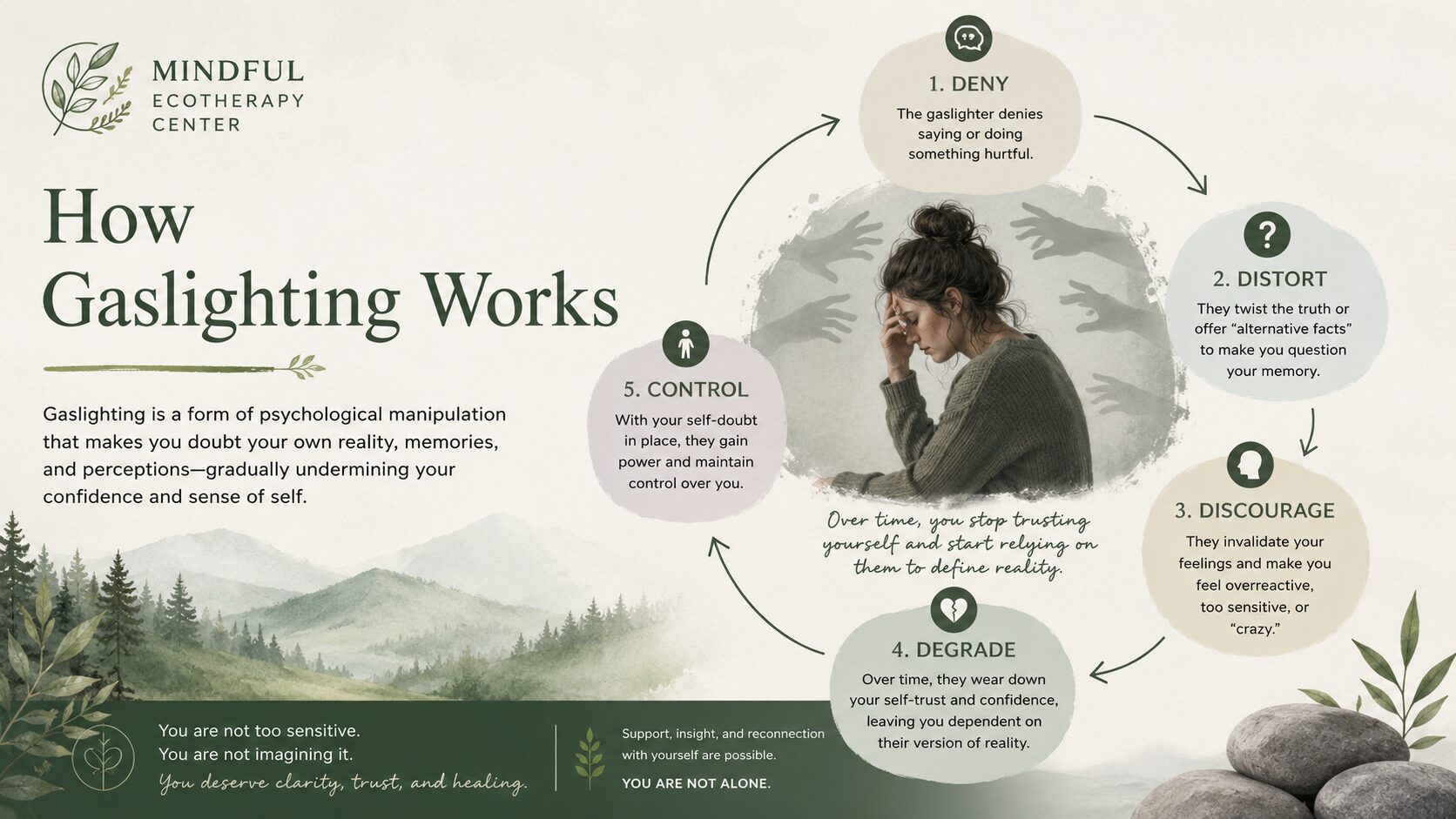
Emotional aggression and gaslighting usually go hand-in-hand. Gaslighting is used to perpetuate a perpetrator’s emotional aggression.

What is Emotional Aggression?

Emotional aggression is the aggressive use of our own emotional states in an attempt to manipulate or control others, or in an attempt to make others responsible for our moods.

If I hold others responsible for my emotional state, I am being emotionally aggressive. Likewise, if I attempt to control the emotional state of others against their will, I am being emotionally aggressive. The Emotional Aggression Questionnaire allows you to assess whether you are prone to acting in emotionally aggressive ways. Some statements emotionally aggressive people might make include:

“I won’t be happy until you do _ for me.”
“It’s your fault that I feel this way.”
“You made me feel

“You just need to stop feeling this way.”
“We’d get along just fine if you’d do things my way.”
“You have no right to be angry at me.”

People who are being emotionally aggressive usually rely on gaslighting to manipulate others with their emotions.

What is Gaslighting?

People who have been gaslit often feel anxious or depressed. Victims of gaslighting can develop mental health problems, including substance abuse issues and even thoughts of suicide. For this reason, it is important to recognize what emotional aggression is and to be familiar with its dynamics when working with patients and clients.

Some of the signs of gaslighting include:

emotional aggression and gaslighting
  • Doubting that your feelings and your reality are accurate or valid
  • Feeling that you’re just being too sensitive
  • Believing that you have no right to feel the way you do
  • Questioning your own judgment and choices
  • Questioning your own perceptions
  • Being afraid to speak up because it might cause conflict with someone who is being emotionally aggressive
  • Emotional cutoffs – shutting down in conversations about emotions because you don’t feel heard or valued
  • Feeling vulnerable and insecure
  • Feeling you’re always “walking on eggshells” when dealing with a person who is being emotionally aggressive
  • Feeling isolated and powerless
  • Doubting your own sense of self-worth and instead believing what an emotionally aggressive person is telling you about yourself
  • Being disappointed in yourself and who you have become – this is especially true if you fear disappointing an emotionally aggressive person
  • Feeling confused most of the time when talking to an emotionally aggressive person
  • You’re always “waiting for the other shoe to drop,” expecting something bad to happen all the time
  • You feel like you are never good enough, and you’re always apologizing
  • You second-guess yourself and find it hard to make decisions
  • You assume others are disappointed in you and never seem to be able to give yourself the benefit of the doubt
  • You wonder what’s wrong with you
  • You eventually give up on making your own choices and instead leave the decision-making to the emotionally aggressive person

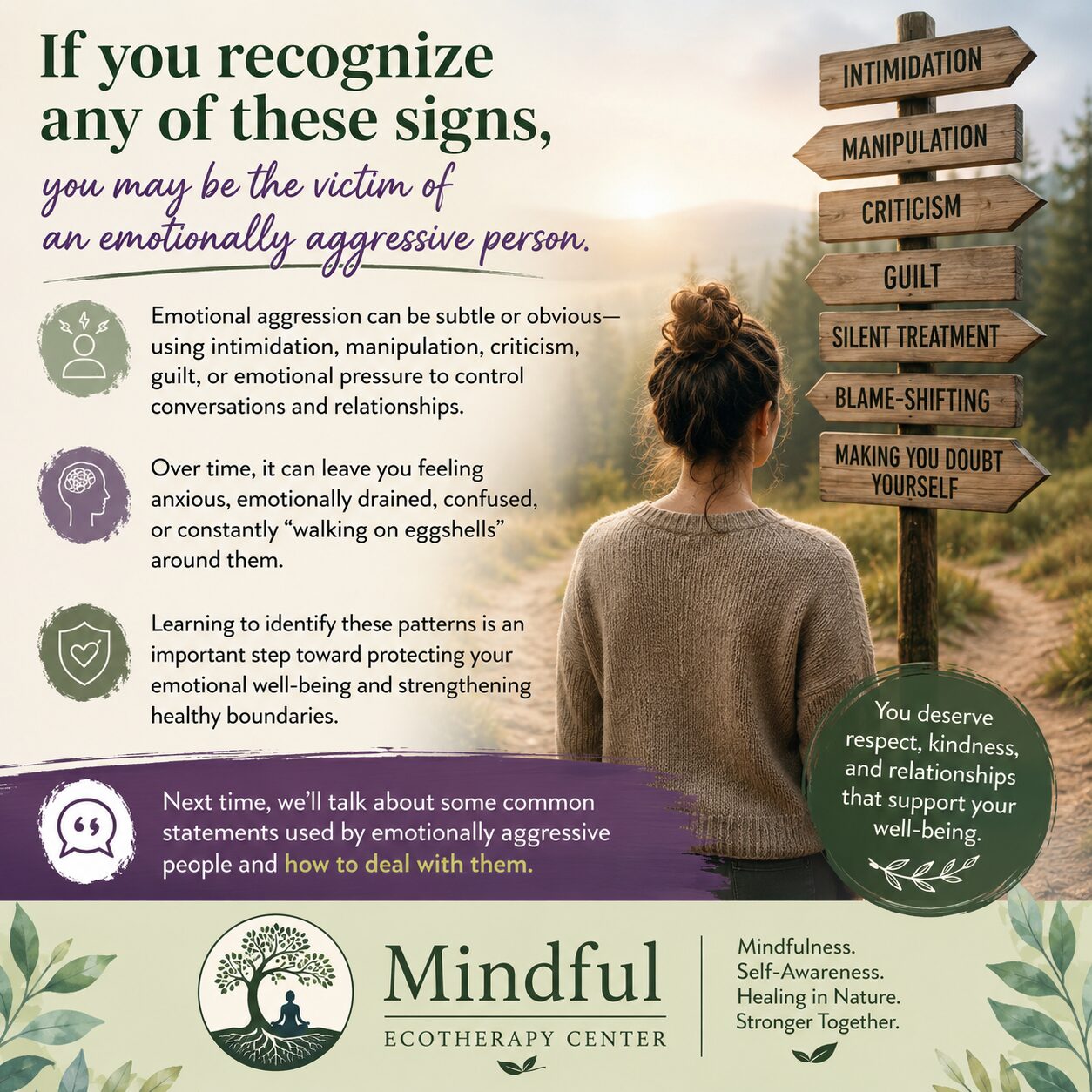
If you recognize any of these signs, you may be dealing with an emotionally aggressive person who uses intimidation, manipulation, criticism, guilt, or emotional pressure to control conversations and relationships. Over time, this behavior can leave you feeling anxious, emotionally drained, confused, or constantly “walking on eggshells” around them.

Emotional Aggression and Gaslighting

Emotional aggression is not always loud or obvious. Sometimes it appears through sarcasm, passive-aggressive comments, silent treatment, blame-shifting, or repeated attempts to make you doubt your own feelings and perceptions. Learning to identify these patterns is an important step toward protecting your emotional well-being and strengthening healthy boundaries.

At the Mindful Ecotherapy Center, we believe mindfulness, self-awareness, and supportive relationships can help you reconnect with your inner sense of safety and confidence. Next time, we’ll explore some of the most common statements emotionally aggressive people use and discuss healthy, grounded ways you can respond to them.


Grampian Women’s Aid: Coercive Control: 10 Signs It’s Gaslighting
http://www.grampian-womens-aid.com/newsevents/gaslighting-10-signs


Share Your Thoughts About Emotional Aggression and Gaslighting!

What do you think? Share your thoughts in the comments below!


  And don’t forget to subscribe to our newsletter!