
Posted on Leave a comment

Understanding the Phases of Love Bombing

phases of love bombing

The phrase “love bombing” has become increasingly common in discussions about unhealthy relationships, emotional manipulation, and coercive control. At first, love bombing may seem exciting, romantic, or even magical. The attention can feel overwhelming in a positive way. Someone may shower you with compliments, gifts, constant messages, affection, and promises about the future very early in the relationship. They may describe you as their soulmate within days or weeks of meeting.

However, beneath the intensity, love bombing is often less about authentic connection and more about gaining emotional influence and control. Understanding the phases of love bombing can help people recognize unhealthy patterns before they become emotionally damaging.

At the Mindful Ecotherapy Center, we believe mindfulness and nature-based healing practices can help you recover from emotionally manipulative relationships by restoring clarity, self-awareness, and emotional balance.

What Are the Phases of Love Bombing?

Mental health professionals often describe the phases of love bombing as a repeating emotional cycle involving idealization, devaluation, and discard. These stages can create confusion and emotional dependency, especially when the person being targeted mistakes emotional intensity for genuine intimacy.

Phase One: Idealization

The first of the phases of love bombing is known as idealization. This is the “honeymoon” stage where the person doing the love bombing showers the other person with attention, admiration, and affection.

During this phase, everything may feel almost too good to be true. The individual may constantly text or call, insist that they have never met anyone like you, or talk about marriage and long-term commitment almost immediately. Lavish gifts, extravagant dates, and dramatic emotional declarations are common.

While affection itself is not unhealthy, the pace of love bombing is often unusually fast. Instead of allowing trust and intimacy to develop naturally over time, the relationship becomes emotionally intense almost overnight.

Many people describe feeling swept off their feet during this phase. Unfortunately, the emotional intensity can make it difficult to notice red flags such as boundary violations, possessiveness, or pressure for rapid commitment.

Phase Two: Devaluation

The second of the phases of love bombing is devaluation. This is where the emotional dynamic begins to shift.

The same person who once idealized you may suddenly become critical, emotionally distant, controlling, or unpredictable. Compliments may turn into criticism. Affection may become conditional. You may feel as though you are constantly trying to regain the warmth and approval that existed at the beginning of the relationship.

This stage often creates emotional confusion because the contrast between idealization and criticism can be dramatic. One day you may feel adored, while the next you feel ignored, blamed, or emotionally manipulated.

Devaluation frequently includes guilt-tripping, passive aggression, jealousy, emotional withdrawal, or attempts to control your time and attention. If you try to establish boundaries or ask for space, the person may react with anger, sadness, or accusations of betrayal.

Over time, many individuals begin doubting themselves during this phase. They may wonder if they are “too sensitive” or somehow responsible for the tension in the relationship.

Phase Three: Discard

The final of the phases of love bombing is discard. In this stage, the relationship may abruptly end once the person feels they have gained enough control or no longer benefits emotionally from the connection.

Some people may suddenly ghost the relationship, while others may alternate between leaving and returning to maintain emotional influence. This can leave the other person feeling devastated, confused, and emotionally destabilized.

Because the relationship began with such intense affection, the discard phase can feel psychologically shocking. Many people become trapped trying to understand how someone who once seemed deeply devoted could become so emotionally detached.

Healthy Interest Versus Love Bombing

One reason the phases of love bombing can be difficult to recognize is that healthy attraction can also involve excitement and emotional enthusiasm. The difference usually lies in pacing, boundaries, and consistency.

Healthy relationships develop gradually. Trust, affection, and commitment deepen over time through shared experiences and mutual respect. Healthy partners respect your need for space, friendships, personal identity, and emotional boundaries.

Love bombing, by contrast, often feels rushed and emotionally consuming. The affection may seem overwhelming rather than grounding. In healthy relationships, affection remains relatively stable. In manipulative relationships, affection is often withdrawn once emotional dependency develops.

How Mindfulness-Based Ecotherapy Can Help

Recovering from emotionally manipulative relationships often requires reconnecting with your own intuition, emotions, and bodily awareness. Mindfulness-based ecotherapy combines mindfulness practices with the healing effects of nature to support emotional recovery.

Nature can help calm the nervous system and reduce emotional overwhelm. Mindful walking, outdoor meditation, journaling in natural settings, gardening, and spending time near water or forests can help restore emotional clarity and inner stability.

Mindfulness also helps individuals become more aware of emotional patterns and red flags without immediately reacting out of fear or confusion. Over time, this awareness can strengthen healthy boundaries and self-trust.

Healing from the phases of love bombing involves learning that genuine love does not require emotional pressure, manipulation, or control. Healthy relationships allow space for authenticity, respect, emotional safety, and mutual growth.

For more information, visit the Mindful Ecotherapy Center at Mindful Ecotherapy Center


Share Your Thoughts About the Phases of Love Bombing!

What do you think? Share your thoughts in the comments below!


  And don’t forget to subscribe to our newsletter!

Posted on

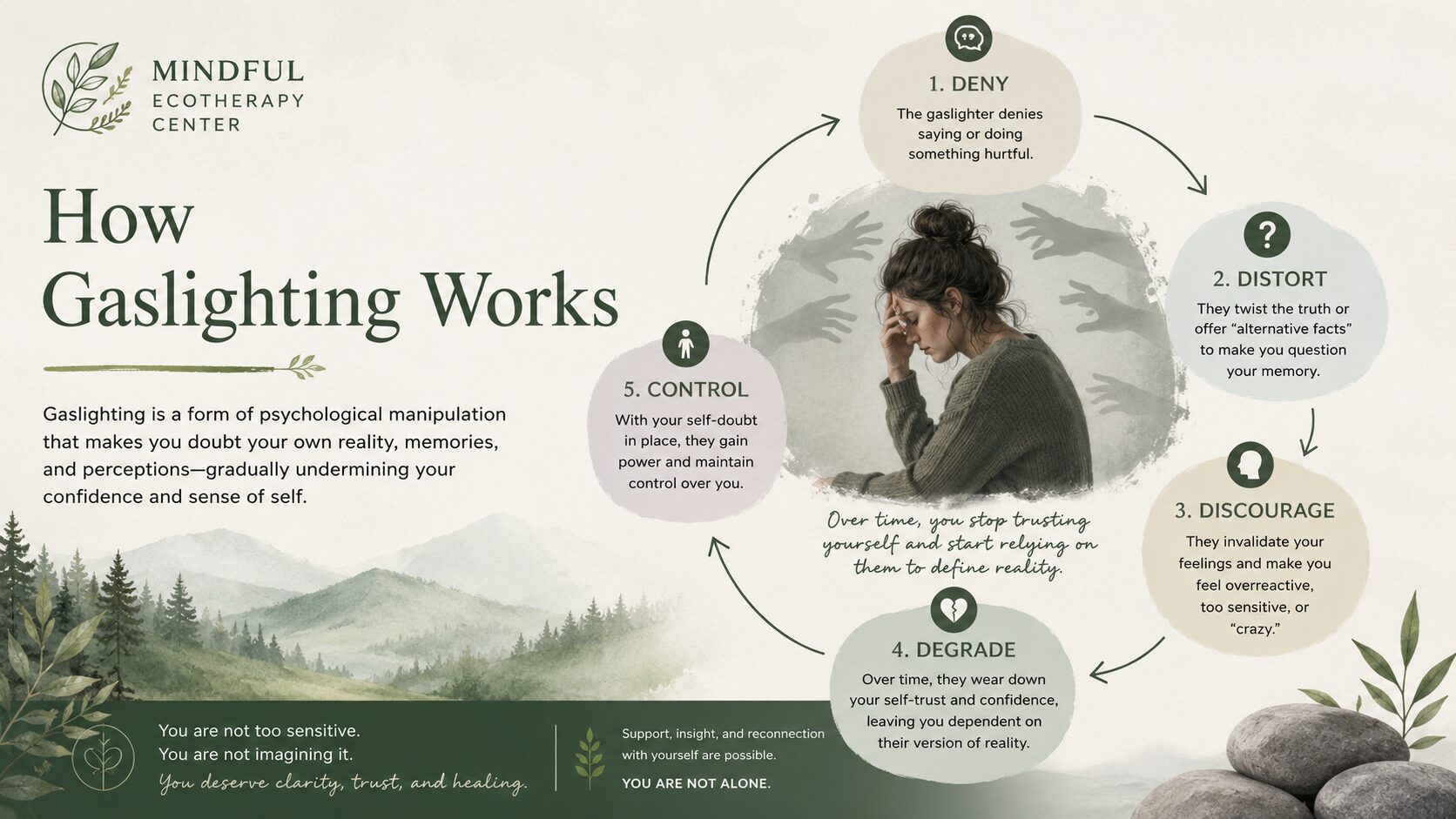
How Gaslighting Works: Characteristics of Manipulation

how gaslighting works

Last week, we talked about what emotional aggression is and how emotionally aggressive people often use gaslighting to achieve their goals. Today, we’re going to talk about how gaslighting works. We’ll also discuss some common statements used by gaslighters who are being emotionally aggressive.

Origins of the Term “Gaslighting”

The term “gaslighting” comes from the 1938 play, Gaslight. This was made into a film in 1944. The premise of the movie is that a husband is trying to convince his wife she is insane so he can gain control of her assets. He leads her to believe she’s stealing things without realizing it and hearing noises that aren’t really there. Because of his manipulations, she begins questioning her sense of reality. The term “gaslight” comes from the fact that the husband goes into the attic at night to turn the gas lights on and off in hopes of making his wife question what she’s seeing. In other words, he’s trying to make her doubt her sense of reality.

When someone is being emotionally aggressive, the goal is to make you question your own sense of reality and to instead rely only on what they’re telling you your reality should be. Gaslighting confuses the victims, making them question their own judgment, sense of self-worth, ability to recall the past, and eventually their own sanity.

Characteristics of Gaslighting

Here are some of the techniques emotionally aggressive gaslighters use:

Lying to You

People who engage in emotional aggression by gaslighting are habitual liars, and they’re usually so good at it that eventually you start to believe them. They eventually make you start second-guessing yourself. They say things like, “You’re making things up,” “That never happened,” or “You’re crazy.”

Discrediting You

Gaslighters like to try to turn others against you or to convince you that others are against you even when they aren’t. They will use those near and dear to you to accomplish their objectives. They will only tell you the negative things others say about you, and if others aren’t really saying negative things about you the emotionally aggressive person will invent things. Comments a gaslighter might make to discredit you would be things like, “Your family agrees with me…you’re crazy,” or “The kids think you’re being ridiculous.”

Distracting You

Emotionally aggressive people love to distract. This usually takes the form of “whataboutism” in which, whenever you bring up a problem, they say something like, “Oh yeah, well what about this problem instead?” This sometimes takes the form of “You do it too!” Regardless of whether or not you do it too, it doesn’t address the initial question of the gaslighter’s behavior.

Minimizing Your Thoughts and Feelings

One way that a gaslighter will use emotional aggression is to use your own emotional states against you. They might say things like, “Calm down,” “You’re overreacting,” or “Why are you so sensitive?” The goal here is to minimize how you’re feeling or what you’re thinking while trying to force you to be responsible for their emotional state instead.

Shifting Blame

Blame-shifting and blame-storming are other common gaslighting tactics. Every time you try to have a discussion with an emotional aggressor, they twist everything into making it your fault so that you feel you are to blame. Whenever you try to discuss how their behavior towards you makes you feel, they say things like, “We’d get along just fine if you’d see things my way,” or “If you acted right I wouldn’t have to treat you the way I do.”

Denying Wrongdoing

Emotional aggressors are notorious for denying that they did anything wrong. They make poor choices and then refuse to take responsibility for them, preferring to blame others. Denying the feelings of others in this manner can leave their victims feeling unseen, unheard, and unloved. Over longer periods of time victims develop “learned helplessness,” which is a state of giving up and losing hope that things will change. Gaslighters might deny wrongdoing by saying things like, “I never said that,” or “You’re just overreacting” or “Stop imagining things.”

Using Compassionate Words as Weapons

Emotional aggressors are very good at mixing lies with the truth to keep you off-balance. Sometimes they’ll through in positive reinforcement just to confuse you. They know that keeping you off-balance makes you easier to control. They might say something like, “You know how much I love you. I would never hurt you on purpose,” or “I only criticize you because I love you and want you to get better.” The most abusive form of this is when domestic violence offenders say things like, “I only hit you because I love you.”

Rewriting History

Gaslighters and emotional aggressors love to change the details of events to their favor. If your partner shoved you against the wall, and then you bring it up later, they might say something like, “What really happened is that you stumbled and I tried to catch you.”

The Goal: Making You Doubt Reality

All of these tactics are used by gaslighters to make you lose your own sense of reality. Emotional aggressors try to control others so they don’t have to learn how to control themselves. If you have a partner or a loved one who is trying to make you responsible for their emotional states, or who is trying to tell you what you should feel and should not feel, you’re probably a victim of gaslighting.

In the coming weeks, we’ll be talking about how to address some of these issues. We’ll also be focusing on how people who use emotional aggression and gaslighting as their primary coping mechanisms can learn less maladaptive behaviors.


What Is Gaslighting and Signs It May Be Happening to You, Very Well Mind
By Sherri Gordon Updated on April 12, 2023


Share Your Thoughts About Gaslighting!

What do you think? Share your thoughts in the comments below!


  And don’t forget to subscribe to our newsletter!

Posted on

Emotional Aggression and Gaslighting

emotional aggression and gaslighting

One of the concepts we frequently talk about in Mindfulness-Based Ecotherapy is emotional aggression.

Emotional aggression and gaslighting usually go hand-in-hand. Gaslighting is used to perpetuate a perpetrator’s emotional aggression.

What is Emotional Aggression?

Emotional aggression is the aggressive use of our own emotional states in an attempt to manipulate or control others, or in an attempt to make others responsible for our moods.

If I hold others responsible for my emotional state, I am being emotionally aggressive. Likewise, if I attempt to control the emotional state of others against their will, I am being emotionally aggressive. The Emotional Aggression Questionnaire allows you to assess whether you are prone to acting in emotionally aggressive ways. Some statements emotionally aggressive people might make include:

“I won’t be happy until you do _ for me.”
“It’s your fault that I feel this way.”
“You made me feel

“You just need to stop feeling this way.”
“We’d get along just fine if you’d do things my way.”
“You have no right to be angry at me.”

People who are being emotionally aggressive usually rely on gaslighting to manipulate others with their emotions.

What is Gaslighting?

People who have been gaslit often feel anxious or depressed. Victims of gaslighting can develop mental health problems, including substance abuse issues and even thoughts of suicide. For this reason, it is important to recognize what emotional aggression is and to be familiar with its dynamics when working with patients and clients.

Some of the signs of gaslighting include:

emotional aggression and gaslighting
  • Doubting that your feelings and your reality are accurate or valid
  • Feeling that you’re just being too sensitive
  • Believing that you have no right to feel the way you do
  • Questioning your own judgment and choices
  • Questioning your own perceptions
  • Being afraid to speak up because it might cause conflict with someone who is being emotionally aggressive
  • Emotional cutoffs – shutting down in conversations about emotions because you don’t feel heard or valued
  • Feeling vulnerable and insecure
  • Feeling you’re always “walking on eggshells” when dealing with a person who is being emotionally aggressive
  • Feeling isolated and powerless
  • Doubting your own sense of self-worth and instead believing what an emotionally aggressive person is telling you about yourself
  • Being disappointed in yourself and who you have become – this is especially true if you fear disappointing an emotionally aggressive person
  • Feeling confused most of the time when talking to an emotionally aggressive person
  • You’re always “waiting for the other shoe to drop,” expecting something bad to happen all the time
  • You feel like you are never good enough, and you’re always apologizing
  • You second-guess yourself and find it hard to make decisions
  • You assume others are disappointed in you and never seem to be able to give yourself the benefit of the doubt
  • You wonder what’s wrong with you
  • You eventually give up on making your own choices and instead leave the decision-making to the emotionally aggressive person

If you recognize any of these signs, you may be dealing with an emotionally aggressive person who uses intimidation, manipulation, criticism, guilt, or emotional pressure to control conversations and relationships. Over time, this behavior can leave you feeling anxious, emotionally drained, confused, or constantly “walking on eggshells” around them.

Emotional Aggression and Gaslighting

Emotional aggression is not always loud or obvious. Sometimes it appears through sarcasm, passive-aggressive comments, silent treatment, blame-shifting, or repeated attempts to make you doubt your own feelings and perceptions. Learning to identify these patterns is an important step toward protecting your emotional well-being and strengthening healthy boundaries.

At the Mindful Ecotherapy Center, we believe mindfulness, self-awareness, and supportive relationships can help you reconnect with your inner sense of safety and confidence. Next time, we’ll explore some of the most common statements emotionally aggressive people use and discuss healthy, grounded ways you can respond to them.


Grampian Women’s Aid: Coercive Control: 10 Signs It’s Gaslighting
http://www.grampian-womens-aid.com/newsevents/gaslighting-10-signs


Share Your Thoughts About Emotional Aggression and Gaslighting!

What do you think? Share your thoughts in the comments below!


  And don’t forget to subscribe to our newsletter!