
Posted on

Radical Acceptance: A Positive Path Out of Emotional Struggle

radical acceptance

Radical acceptance is one of the most powerful and misunderstood skills in Mindfulness-Based Ecotherapy. You are often taught, implicitly or explicitly, that uncomfortable emotions must be fixed, suppressed, or eliminated. Radical acceptance offers a different and far more effective approach. It teaches you that you can experience emotions and thoughts fully without engaging in behavioral cycles that lead to negative consequences. You learn that pain is part of being human, but suffering is often optional.

The Mindfulness-Based Ecotherapy skill of radical acceptance teaches you that you are not your thoughts and you are not your emotions. Thoughts and feelings are not commands, identities, or truths. They are temporary processes of the brain, shaped by learning, memory, trauma, biology, and context. When you fuse with them, believing they define who you are or dictate what you must do, you lose flexibility. When you relate to them with awareness and acceptance, you regain choice.

Radical Acceptance and the Shift From Reaction to Response

Radical acceptance does not mean liking what is happening, approving of harm, or giving up on change. It means clearly acknowledging reality as it is in this moment, without adding layers of resistance. When you fight reality internally, your nervous system remains activated, keeping you locked in cycles of anxiety, anger, shame, or avoidance. Research consistently shows that experiential avoidance, the attempt to escape unwanted internal experiences, is strongly linked to psychological distress and maladaptive behavior (Hayes et al., 2020).

When you practice radical acceptance, you stop arguing with what already exists. You allow thoughts to arise and pass. You allow emotions to move through the body. This creates space between what you feel and what you do. Instead of reacting automatically, you respond intentionally. This skill is foundational in mindfulness-based and acceptance-based therapies, including Acceptance and Commitment Therapy and Dialectical Behavior Therapy, both of which emphasize acceptance as a pathway to psychological flexibility (Linehan, 2020; Hayes et al., 2020).

You Are Not Your Thoughts or Emotions

One of the most liberating aspects of radical acceptance is learning to defuse from internal experiences. A thought like “I am failing” is no longer treated as a fact. An emotion like fear is no longer treated as a threat that must be eliminated. Instead, thoughts are seen as mental events and emotions as physiological and psychological processes. Neuroscience research supports this perspective, showing that emotional experiences are dynamic brain-body states that change when they are observed with nonjudgmental awareness rather than suppressed or amplified (Dahl et al., 2020).

This shift matters because behavior follows relationship, not content. When you believe your thoughts unquestioningly, you act as if they are instructions. When you accept their presence without attachment, you gain the freedom to choose actions aligned with your values rather than your impulses.

Radical Acceptance in Mindfulness-Based Ecotherapy

In Mindfulness-Based Ecotherapy, radical acceptance is practiced not only internally but also in relationship with the natural world. Nature offers constant demonstrations of acceptance without resignation. A river does not resist obstacles; it moves around them. A forest does not judge decay; it integrates it into renewal. When you practice radical acceptance outdoors, your body often understands the lesson before your mind catches up.

Ecotherapy supports radical acceptance by engaging your senses and grounding you in the present moment. Sitting with discomfort while noticing birdsong or the rhythm of waves can regulate the nervous system, making acceptance more accessible. Research since 2020 shows that nature-based mindfulness practices reduce rumination and emotional reactivity while increasing psychological flexibility and self-regulation (Schutte & Malouff, 2021; Passmore & Howell, 2020).

Acceptance Is the Doorway to Change

Paradoxically, radical acceptance is what allows meaningful change to occur. When you stop wasting energy fighting internal experiences, that energy becomes available for skillful action. You can feel anger without acting aggressively. You can feel anxiety without avoiding life. You can feel sadness without collapsing into hopelessness. Acceptance creates stability. Stability creates choice.

At the Mindful Ecotherapy Center, radical acceptance is taught as a lived practice,. You learn to notice when resistance shows up in your body, your thoughts, and your behaviors. You learn to soften your grip. Over time, you experience a quiet but profound shift. Life becomes less about controlling what you feel and more about living fully, even when feelings are difficult.

To explore how radical acceptance and other Mindfulness-Based Ecotherapy skills can support your well-being, visit www.mindfulecotherapycenter.com


References

Dahl, C. J., Wilson-Mendenhall, C. D., & Davidson, R. J. (2020). The plasticity of well-being: A training-based framework for the cultivation of human flourishing. Proceedings of the National Academy of Sciences, 117(51), 32197–32206. https://doi.org/10.1073/pnas.2014859117

Hayes, S. C., Strosahl, K. D., & Wilson, K. G. (2020). Acceptance and commitment therapy: The process and practice of mindful change (2nd ed.). Guilford Press.

Linehan, M. M. (2020). DBT skills training manual (2nd ed.). Guilford Press.

Passmore, H. A., & Howell, A. J. (2020). Nature involvement increases hedonic and eudaimonic well-being: A two-week experimental study. Ecopsychology, 12(1), 1–11. https://doi.org/10.1089/eco.2019.0025

Schutte, N. S., & Malouff, J. M. (2021). Mindfulness and connectedness to nature: A meta-analytic investigation. Personality and Individual Differences, 179, 110984. https://doi.org/10.1016/j.paid.2021.110984


Share Your Thoughts About Radical Acceptance!

What do you think? Share your thoughts in the comments below!


  And don’t forget to subscribe to our newsletter!
Posted on

How Gaslighting Works: Characteristics of Manipulation

how gaslighting works

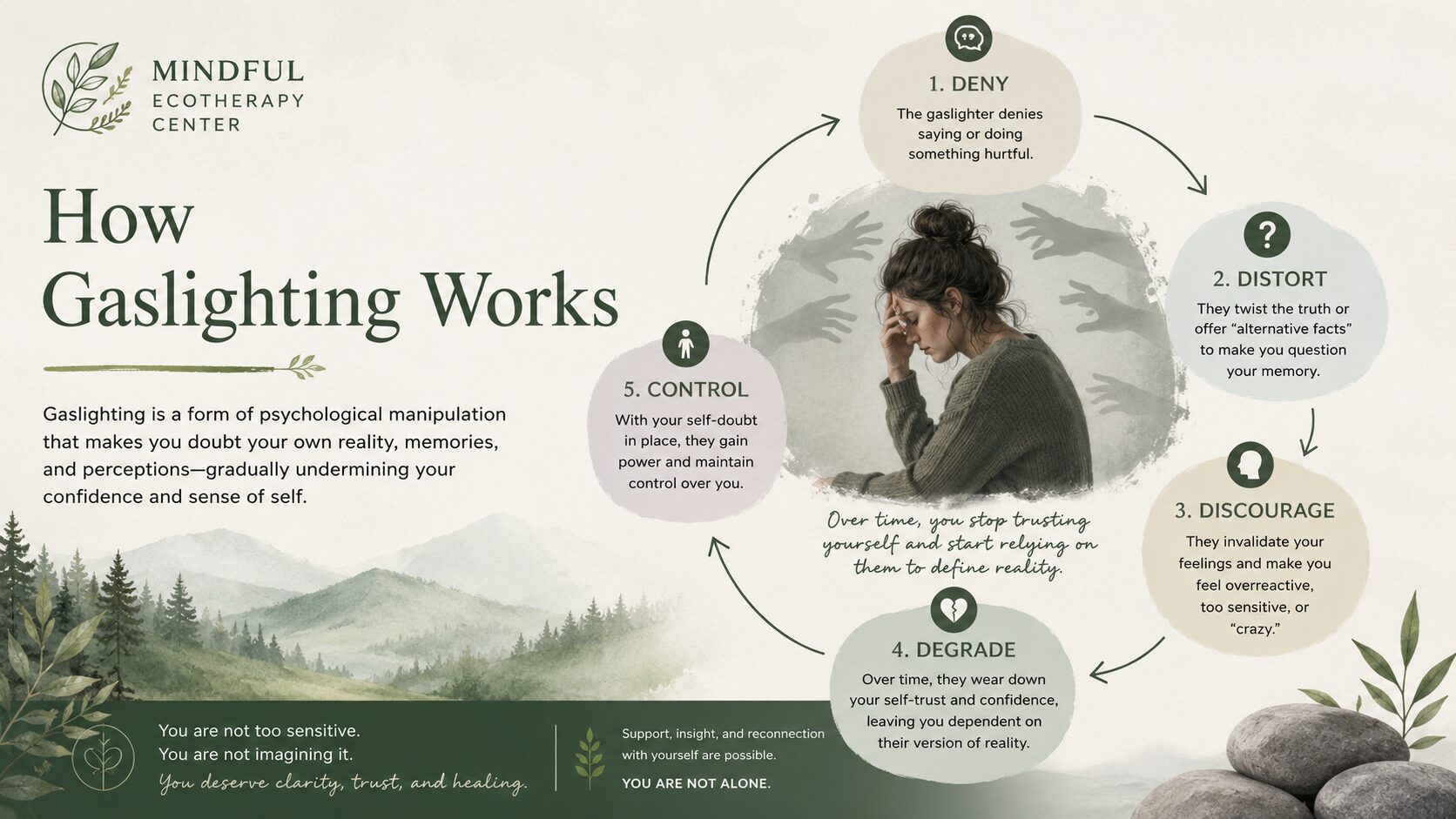
Last week, we talked about what emotional aggression is and how emotionally aggressive people often use gaslighting to achieve their goals. Today, we’re going to talk about how gaslighting works. We’ll also discuss some common statements used by gaslighters who are being emotionally aggressive.

Origins of the Term “Gaslighting”

The term “gaslighting” comes from the 1938 play, Gaslight. This was made into a film in 1944. The premise of the movie is that a husband is trying to convince his wife she is insane so he can gain control of her assets. He leads her to believe she’s stealing things without realizing it and hearing noises that aren’t really there. Because of his manipulations, she begins questioning her sense of reality. The term “gaslight” comes from the fact that the husband goes into the attic at night to turn the gas lights on and off in hopes of making his wife question what she’s seeing. In other words, he’s trying to make her doubt her sense of reality.

When someone is being emotionally aggressive, the goal is to make you question your own sense of reality and to instead rely only on what they’re telling you your reality should be. Gaslighting confuses the victims, making them question their own judgment, sense of self-worth, ability to recall the past, and eventually their own sanity.

Characteristics of Gaslighting

Here are some of the techniques emotionally aggressive gaslighters use:

Lying to You

People who engage in emotional aggression by gaslighting are habitual liars, and they’re usually so good at it that eventually you start to believe them. They eventually make you start second-guessing yourself. They say things like, “You’re making things up,” “That never happened,” or “You’re crazy.”

Discrediting You

Gaslighters like to try to turn others against you or to convince you that others are against you even when they aren’t. They will use those near and dear to you to accomplish their objectives. They will only tell you the negative things others say about you, and if others aren’t really saying negative things about you the emotionally aggressive person will invent things. Comments a gaslighter might make to discredit you would be things like, “Your family agrees with me…you’re crazy,” or “The kids think you’re being ridiculous.”

Distracting You

Emotionally aggressive people love to distract. This usually takes the form of “whataboutism” in which, whenever you bring up a problem, they say something like, “Oh yeah, well what about this problem instead?” This sometimes takes the form of “You do it too!” Regardless of whether or not you do it too, it doesn’t address the initial question of the gaslighter’s behavior.

Minimizing Your Thoughts and Feelings

One way that a gaslighter will use emotional aggression is to use your own emotional states against you. They might say things like, “Calm down,” “You’re overreacting,” or “Why are you so sensitive?” The goal here is to minimize how you’re feeling or what you’re thinking while trying to force you to be responsible for their emotional state instead.

Shifting Blame

Blame-shifting and blame-storming are other common gaslighting tactics. Every time you try to have a discussion with an emotional aggressor, they twist everything into making it your fault so that you feel you are to blame. Whenever you try to discuss how their behavior towards you makes you feel, they say things like, “We’d get along just fine if you’d see things my way,” or “If you acted right I wouldn’t have to treat you the way I do.”

Denying Wrongdoing

Emotional aggressors are notorious for denying that they did anything wrong. They make poor choices and then refuse to take responsibility for them, preferring to blame others. Denying the feelings of others in this manner can leave their victims feeling unseen, unheard, and unloved. Over longer periods of time victims develop “learned helplessness,” which is a state of giving up and losing hope that things will change. Gaslighters might deny wrongdoing by saying things like, “I never said that,” or “You’re just overreacting” or “Stop imagining things.”

Using Compassionate Words as Weapons

Emotional aggressors are very good at mixing lies with the truth to keep you off-balance. Sometimes they’ll through in positive reinforcement just to confuse you. They know that keeping you off-balance makes you easier to control. They might say something like, “You know how much I love you. I would never hurt you on purpose,” or “I only criticize you because I love you and want you to get better.” The most abusive form of this is when domestic violence offenders say things like, “I only hit you because I love you.”

Rewriting History

Gaslighters and emotional aggressors love to change the details of events to their favor. If your partner shoved you against the wall, and then you bring it up later, they might say something like, “What really happened is that you stumbled and I tried to catch you.”

The Goal: Making You Doubt Reality

All of these tactics are used by gaslighters to make you lose your own sense of reality. Emotional aggressors try to control others so they don’t have to learn how to control themselves. If you have a partner or a loved one who is trying to make you responsible for their emotional states, or who is trying to tell you what you should feel and should not feel, you’re probably a victim of gaslighting.

In the coming weeks, we’ll be talking about how to address some of these issues. We’ll also be focusing on how people who use emotional aggression and gaslighting as their primary coping mechanisms can learn less maladaptive behaviors.


What Is Gaslighting and Signs It May Be Happening to You, Very Well Mind
By Sherri Gordon Updated on April 12, 2023


Share Your Thoughts About Gaslighting!

What do you think? Share your thoughts in the comments below!


  And don’t forget to subscribe to our newsletter!