
Posted on Leave a comment

Outdoor Mindfulness Practices for Couples: Strengthening Relationships Naturally

outdoor mindfulness

By Charlton Hall, MMFT, PhD
Mindful Ecotherapy Center

Modern relationships are not failing because people do not care. They are struggling because the conditions most couples live in are relentlessly dysregulating. Chronic stress, constant digital input, economic pressure, and overstimulation wear down even strong relational bonds. Many couples report feeling disconnected, reactive, or emotionally distant, even when love and commitment are still present. One effective and underutilized way to address this disconnect is through outdoor mindfulness practices rooted in Mindfulness-Based Ecotherapy.

Outdoor mindfulness shifts couples out of environments that amplify stress and into settings that naturally support regulation, presence, and connection. Nature slows the nervous system, reduces defensive reactivity, and makes emotional attunement more accessible. When couples practice mindfulness together outdoors, they are not just relaxing. They are retraining how they relate to themselves and to each other.

Why Outdoor Mindfulness Supports Healthy Relationships

Relationships are shaped as much by physiology as by communication skills. When one or both partners are chronically stressed, the nervous system prioritizes protection over connection. This leads to misattunement, quick escalation, and repeated conflict loops. Outdoor mindfulness works because it begins with regulation, not problem-solving.

Natural environments have been shown to lower cortisol levels, reduce heart rate, and activate the parasympathetic nervous system. When partners experience these effects together, their capacity for empathy and emotional presence increases. Conversations soften. Listening improves. Reactivity decreases.

Mindfulness adds intention to this process. Rather than being distracted or task-focused outdoors, couples intentionally bring awareness to the present moment. This shared attention becomes a form of relational attunement, strengthening the sense of being together rather than merely coexisting.

Outdoor Mindfulness as a Relational Practice

In Mindfulness-Based Ecotherapy, outdoor mindfulness is not about achieving a calm state or avoiding difficult topics. It is about cultivating awareness, safety, and connection in the context of the natural world. For couples, this means learning to be present with one another without immediately trying to fix, defend, or withdraw.

Nature offers a nonjudgmental container for relational work. There is less pressure to perform or resolve everything at once. This makes outdoor mindfulness especially helpful for couples experiencing burnout, recurring conflict, or emotional distance.

Over time, these practices help couples reconnect with shared values, mutual care, and a sense of partnership grounded in lived experience rather than constant discussion.

Practical Outdoor Mindfulness Practices for Couples

One foundational outdoor mindfulness practice for couples is mindful walking. Partners walk together at a comfortable pace, paying attention to the rhythm of their steps, breath, and the surrounding environment. Conversation is optional. The focus is on shared presence rather than analysis.

Another practice involves sensory grounding. Couples sit together outdoors and take turns naming what they notice through the senses. What they hear. What they see. What they feel physically. This builds awareness and co-regulation while reinforcing emotional safety.

A third practice is nature-based reflective sharing. After a few minutes of quiet observation, each partner shares a brief reflection, such as a word, image, or feeling that arose. The other partner listens without responding or interpreting. This strengthens trust and reduces habitual defensiveness.

These practices are intentionally simple. Their effectiveness lies in consistency of application, not complexity.

Using Outdoor Mindfulness to Manage Conflict

Outdoor mindfulness practices can also support healthier conflict engagement. Nature reduces physiological arousal, making it easier to stay grounded during difficult conversations. Mindfulness helps partners notice early signs of activation, such as tension or shallow breathing, before escalation occurs.

Rather than avoiding conflict, through Mindfulness-Based Ecotherapy, couples learn to approach it with greater awareness and compassion. The natural environment reinforces perspective, reminding both partners that conflict is part of a relationship, not a sign of failure.

In therapeutic contexts, outdoor mindfulness is often used alongside communication skills and values clarification, providing a stable foundation for deeper relational work.

How Mindfulness-Based Ecotherapy Enhances Couple Connection

Mindfulness-Based Ecotherapy emphasizes the interconnectedness between people and the natural world. For couples, this perspective helps shift focus away from blame, shame, and guilt-tripping each other and toward shared experience. Partners are encouraged to see themselves as part of a larger system rather than isolated adversaries.

This approach is especially beneficial for couples dealing with stress, life transitions, or emotional fatigue. Outdoor mindfulness becomes a way to restore balance, reconnect emotionally, and cultivate resilience together.

Over time, these practices can evolve into meaningful practices that support long-term relationship health.

Strengthening Relationships Naturally

Outdoor mindfulness offers couples a grounded, accessible way to strengthen their connection. By slowing down together, engaging the senses, and practicing mindful awareness in nature, couples create space for regulation, empathy, and intimacy with each other.

At the Mindful Ecotherapy Center, outdoor mindfulness practices are integrated into therapeutic work to support relational healing in a way that is both sustainable and deeply human. Strengthening relationships does not always begin with more talking. Sometimes it begins by stepping outside together and simply paying attention.


References

Hartig, T., Mitchell, R., de Vries, S., & Frumkin, H. (2014). Nature and health. Annual Review of Public Health, 35, 207–228. https://doi.org/10.1146/annurev-publhealth-032013-182443

Kabat-Zinn, J. (2003). Mindfulness-based interventions in context: Past, present, and future. Clinical Psychology: Science and Practice, 10(2), 144–156. https://doi.org/10.1093/clipsy.bpg016

Rogers, C. R. (1961). On becoming a person: A therapist’s view of psychotherapy. Houghton Mifflin.

Ulrich, R. S., Simons, R. F., Losito, B. D., Fiorito, E., Miles, M. A., & Zelson, M. (1991). Stress recovery during exposure to natural and urban environments. Journal of Environmental Psychology, 11(3), 201–230. https://doi.org/10.1016/S0272-4944(05)80184-7


Share Your Thoughts About Outdoor Mindfulness Practices for Couples!

What do you think? Share your thoughts in the comments below!


  And don’t forget to subscribe to our newsletter!

Posted on

The Trust Seesaw

the trust seesaw

If you’ve ever watched children at the playground on a seesaw, you know that it takes two people to play. If one gets off, the other cannot play. The expression, “tottering on the brink,” comes from the older name for a seesaw. It was called a ‘teeter-totter.’ If you’ve ever been left dangling in the air and watching the person on the other end prepare to suddenly leap off and send you crashing, then you know exactly what that expression means!

Relationships are like seesaws. It takes two to play. If one person gets off, the other can’t play. There are many kinds of seesaw in relationships. One variety that often comes up when emotional aggression is an issue, is the ‘trust seesaw.’ Trust is a seesaw with two parts. The first part is a person hiding the truth or refusing to communicate. The second part is a person who has created an environment where it’s not safe to tell the truth or to safely communicate about emotional issues

If you react badly every time you hear the truth, don’t expect to hear the truth too often. While deception is a violation of trust, what often gets overlooked is the fact that the reason people resort to deception and sometimes to outright lying is that the other person in the relationship has made it clear that it is not safe to tell the truth.

This vicious cycle is self-reinforcing. The more one person hides the truth, the more the other person reacts badly when the truth finally comes out. The more a person reacts badly upon hearing the truth, the less likely the other person is to feel comfortable telling the truth the next time. The longer this pattern continues, the more likely it is to result in emotional cutoffs where neither side is capable of communicating about emotional issues without resorting to emotional aggression.

Getting off the Trust Seesaw

How do we end this vicious cycle? There are two ways to get off the trust seesaw. The first is that the person who is being deceptive or not communicating the truth can start being truthful. The second is that the person who usually reacts badly to hearing the truth can create a safe environment for truthful communications so that the other person feels comfortable telling the truth.

The difficulty in getting off the trust seesaw is that if one person gets off suddenly, the other is left ‘tottering on the brink.’ Unless both people agree to get off the seesaw, it’s going to be difficult to successfully navigate this territory without one or both parties resorting to some form of emotional aggression.

The best way to avoid this is to agree to communicate openly and honestly about trust while agreeing that there will be no negative repercussions for being honest. Getting off the trust seesaw and fostering mindful communication requires a combination of self-awareness, empathy, and effective communication skills. Here are some strategies to help you navigate this process:

  • Start by reflecting on your own communication patterns and behaviors. Identify any habits that may contribute to the trust seesaw.
  • Practice active listening by giving your full attention to the speaker. This involves making eye contact, nodding, and providing verbal cues to show that you are engaged in the conversation.
  • Put yourself in the other person’s shoes. Understand their perspective, emotions, and concerns. Empathy helps build trust by showing that you value and understand their feelings.
  • Be transparent and honest in your communication. Avoid hiding information or misleading others, as this can erode trust.
  • Before speaking, take a moment to consider the impact of your words. Be mindful of your tone, body language, and choice of words to ensure that your message is clear and respectful.
  • Clearly articulate your thoughts and feelings. Use “I” statements to express your own perspective without blaming or accusing others.
  • Learn to manage your emotions during difficult conversations. Take a break if needed to prevent saying things in the heat of the moment that may damage trust.
  • Clearly define and communicate your boundaries. Establishing healthy boundaries is crucial for building and maintaining trust.
  • If you make a mistake or unintentionally hurt someone, apologize sincerely and take responsibility for your actions. Work towards repairing the trust by demonstrating positive changes in your behavior.
  • Consistency in your actions and words is key to building and maintaining trust. Ensure that your behavior aligns with your words over time.
  • Encourage open communication by seeking feedback from others. This shows that you value their opinions and are open to improvement.
  • Engage in mindfulness practices, such as meditation or deep breathing exercises, to cultivate self-awareness and emotional regulation.

Remember, building trust is a gradual process, and it requires ongoing effort and commitment. By incorporating these strategies into your communication style, you can contribute to a more mindful and trustful relationship.

Posted on

Validating vs. Condoning

Validating vs. Condoning Young Woman Old Woman Optical Illusion

One of the skills of mindful communication is Validating vs. Condoning.

Look at the picture above and describe what you see.

Did you see an old lady, or a young lady? If you saw both, which did you see first?

Now assume your partner saw the old lady in the picture, and you saw the young lady. Which of you would be ‘right’ and which of you would be ‘wrong’?

Obviously, neither is ‘right’ or ‘wrong.’ You’re both just looking at the same picture and coming to different conclusions. Suppose you can readily see the old lady, but have a hard time seeing the young lady. Further suppose your partner can readily see the young lady, but has a hard time seeing he old lady. Even though you’re not seeing the same thing your partner sees, would you be able to readily agree that your partner sees it?

Validation works in this way. You can validate your partner’s way of seeing the picture without having to agree with what your partner is seeing. Now let’s apply this to the concept of feelings.

Validating vs. Condoning…What’s the Difference?

How many times have you told yourself not to feel angry, or to cheer up, or to “snap out” of a depression?

How successful were you at changing your feelings? We’re sometimes conditioned to believe that certain feelings are ‘bad’ or ‘unacceptable’ while other feelings are okay. But the truth is that there is no such thing as a ‘bad’ or ‘unacceptable’ feeling. Feelings are feelings. They exist. You cannot help the way you feel about a thing or a situation.

Often when we tell ourselves or others to “snap out of it” or to try to repress certain feelings, what we really mean is to repress certain behaviors. While there are no wrong or problematic feelings, the behavior that comes after the feeling may cause problems. For example, simply feeling anger is perfectly okay. Just being with the anger in the moment is entirely different than feeling anger and then acting upon it in negative and destructive ways.

Validating vs. Condoning: Understanding doesn’t Mean Allowing

If you or your partner is feeling angry, that’s okay. But if you or your partner choose to act on that anger by saying or doing hurtful things, that’s not okay. Both you and your partner have a right to feel what you feel. You just don’t have the right to act on those feelings in negative or destructive ways…especially when others are involved.

If your partner is experiencing negative emotions like anger, sadness, or depression, you can validate their feelings without having to understand and agree with those feelings. You can do this by saying things like, “I understand you’re mad right now. I may not understand why you’re mad right now, but I respect your right to be entitled to your own feelings.”

Notice that this does not mean that you have to validate, condone, or even tolerate bad or negative behaviors. You are simply validating the feelings, and not necessarily the behaviors that come after the feelings.

You and your partner can choose when and how to respond to those feelings and act upon them. You may also choose not to act upon them at all, but to simply acknowledge their presence and sit with them quietly, knowing that they will eventually subside.

When you learn to do this you will be able to validate each other’s feelings without condoning any emotional aggression those feelings might generate.

Posted on

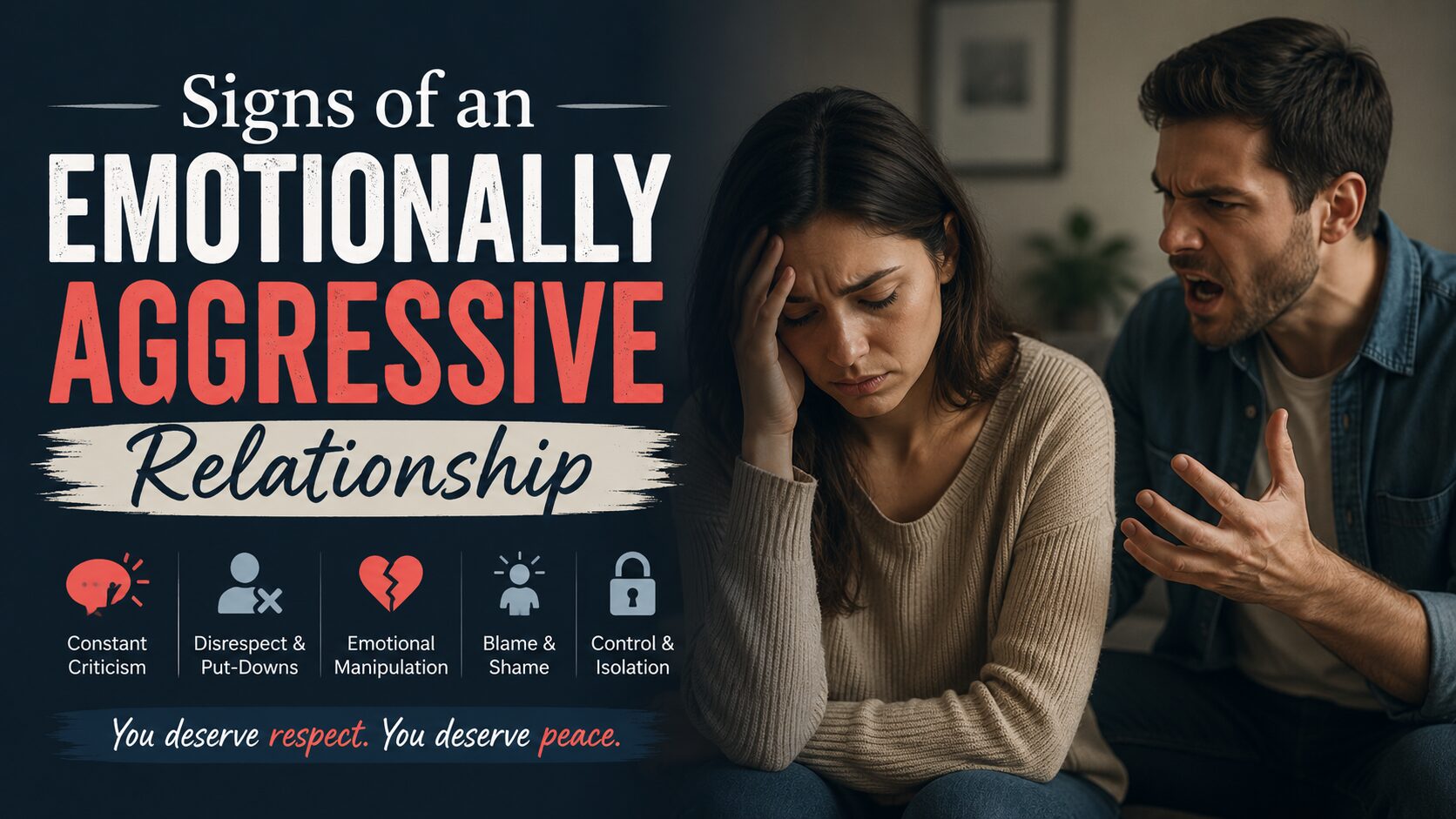
45 Signs of an Emotionally Aggressive Relationship

EMOTIONALLY AGGRESSIVE

Emotional aggression is the aggressive use of our own emotional states in an attempt to manipulate or control others, or in an attempt to make others responsible for our moods. If I hold others responsible for my emotional state, I am being emotionally aggressive. Likewise, if I attempt to control the emotional states of others against their will, I am being emotionally aggressive.

If you have beliefs that are leading you to react in ways that are emotionally aggressive, you may choose to challenge those beliefs so that you may replace them with new beliefs that do not lead to emotionally aggressive consequences.

One of the tenets of mindfulness is the realization that we are not our thoughts, and we are not our feelings. Thoughts and feelings are simply processes of the mind. We can choose to pay attention to those processes, or we can choose to ignore them.

Here’s a way to demonstrate that you are not your thoughts. Suppose I tell you that for the next ten minutes, you are to avoid having any thoughts. Now, further suppose that you attempt to avoid having any thoughts for ten minutes. About two or three minutes into this exercise, you catch yourself having a thought.

When you realize that you had a thought, what part of you is it that recognized that you had a thought? It couldn’t be your thoughts, because the thoughts are what you recognized. So that means that there is another part of you that is independent from your thoughts. This part of you is what practitioners of mindfulness call your True Self. The True Self is what recognizes that you were having a thought. The True Self is independent of your thoughts.

Emotionally Aggressive Behavior and the True Self

emotionally aggressive

Your True Self is who you would be if you could ‘get out of your own way’ and live the life you were meant to live. Your True Self is who you are when you strip away all the masks that you put on in day-to-day life and get down to the business of being who you were meant to be.

Think for a moment about your own True Self. Suppose you could be anyone you wanted to be. Who would you choose to be? What things are keeping you from living in your True Self? When you act in an emotionally aggressive manner, are you being your True Self?

One way to tell if a belief is keeping you from being the person you were meant to be is to consider the consequences of that belief. Most emotional aggression comes from the belief that we can change the behavior of other people. In fact, the very definition of emotional aggression is: “Using our own emotional states in an attempt to control the behavior of others.” Emotional aggression occurs when others refuse to live up to our expectations of how we believe they should behave and what they should feel.

One of the marks of an addiction to emotional processes is the belief that we can and should tell others how to feel and what to think. If we have such beliefs, and if people fail to meet our expectations, the result can be emotional aggression. That is to say that we get frustrated that others in our lives resist our attempts to control their behavior, and we may react by becoming angry, sad, or frustrated.

Because these beliefs are often embedded in processes that have become automatic, it may sometimes be difficult to identify those beliefs. The questions below may help you to identify some of these beliefs and patterns of behavior.

The first five questions are for your partner (if you have one). If your partner is willing to answer these questions, have him or her do so. If your partner is not willing, try to answer those questions as well as you can, based on what you think your partner would say.

The rest of the questions are for you to answer. Be as honest with yourself as you can in answering.

Signs of an Emotionally Aggressive Relationship

Does your partner:

  • Feel afraid of you much of the time?
  • Avoid certain topics out of fear of upsetting you?
  • Feel that they can’t do anything right for you?
  • Feel emotionally numb or helpless?
  • Feel trapped or imprisoned?

Do you:

  • Humiliate, criticize, or yell at your partner?
  • Use abusive language
  • Ignore your partner’s answers
  • Mock or call your partner names
  • Yell, swear, interrupt, or change the subject by turning blame back onto your partner?
  • Become emotionally aggressive towards your partner?
  • Twist your partner’s words?
  • Tell your partner what to think and how to feel?
  • Put your partner down in front of other people?
  • Say bad things about your partner’s friends and family?
  • Treat your partner so badly that your partner is embarrassed for your friends or family to see?
  • Ignore or put down your partner’s opinions or accomplishments?
  • Blame your partner for your own abusive behavior?
  • Make light of your own behavior and not take your partner’s concerns about it seriously?
  • Deny that the emotional aggression happened?
  • Shift responsibility for your behavior, or say that your partner caused it?
  • See your partner as property or a sex object, rather than as a person?
  • Have a bad and unpredictable temper?
  • Hurt your partner, or threaten to hurt or kill your partner?
  • Hit, slap, kick, choke, push, punch, beat, or restrain your partner to keep them from leaving?
  • Destroy furniture, punch holes in the walls, or damage your partner’s possessions?
  • Use the children or other family members against your partner?
  • Lock your partner out of the house?
  • Threaten to take your partner’s children away or harm them?
  • Threaten to harm other family members or family pets?
  • Threaten to commit self-harm, up to and including suicide, if your partner leaves?
  • Force your partner to have sex against their will?
  • Destroy your partner’s belongings?
  • Use blaming, shaming, or guilt-tripping to control your partner?
  • Act excessively jealous and possessive?
  • Control where your partner goes or what your partner does?
  • Keep your partner from seeing their friends or family?
  • Make rules that it is impossible for your partner to keep?
  • Punish your partner for not keeping these impossible rules?
  • Force your partner into decisions they may not be ready to make?
  • Always insist on being right?
  • Refuse to ‘agree to disagree’?
  • Follow your partner to see what they’re doing and where they’re going?
  • Refuse to leave when asked?
  • Limit your partner’s access to money, the phone, or the car for anything other than budgetary reasons?
  • Withhold money as a means of control?
  • Refuse to let your partner work, or interfere with your partner’s job?
  • Show up at your partner’s job to cause trouble?
  • Constantly check up on your partner?
  • Go through your partner’s emails, cell phone records, text messages, or other communications?

If you checked more than five items on the list above, you may have difficulties managing emotionally aggressive behavior towards yourself and towards others.

Share Your Thoughts About Signs of Emotional Aggression!

What do you think? Share your thoughts in the comments below!


  And don’t forget to subscribe to our newsletter!

Posted on

Emotional Aggression and Gaslighting

emotional aggression and gaslighting

One of the concepts we frequently talk about in Mindfulness-Based Ecotherapy is emotional aggression.

Emotional aggression and gaslighting usually go hand-in-hand. Gaslighting is used to perpetuate a perpetrator’s emotional aggression.

What is Emotional Aggression?

Emotional aggression is the aggressive use of our own emotional states in an attempt to manipulate or control others, or in an attempt to make others responsible for our moods.

If I hold others responsible for my emotional state, I am being emotionally aggressive. Likewise, if I attempt to control the emotional state of others against their will, I am being emotionally aggressive. The Emotional Aggression Questionnaire allows you to assess whether you are prone to acting in emotionally aggressive ways. Some statements emotionally aggressive people might make include:

“I won’t be happy until you do _ for me.”
“It’s your fault that I feel this way.”
“You made me feel

“You just need to stop feeling this way.”
“We’d get along just fine if you’d do things my way.”
“You have no right to be angry at me.”

People who are being emotionally aggressive usually rely on gaslighting to manipulate others with their emotions.

What is Gaslighting?

People who have been gaslit often feel anxious or depressed. Victims of gaslighting can develop mental health problems, including substance abuse issues and even thoughts of suicide. For this reason, it is important to recognize what emotional aggression is and to be familiar with its dynamics when working with patients and clients.

Some of the signs of gaslighting include:

emotional aggression and gaslighting
  • Doubting that your feelings and your reality are accurate or valid
  • Feeling that you’re just being too sensitive
  • Believing that you have no right to feel the way you do
  • Questioning your own judgment and choices
  • Questioning your own perceptions
  • Being afraid to speak up because it might cause conflict with someone who is being emotionally aggressive
  • Emotional cutoffs – shutting down in conversations about emotions because you don’t feel heard or valued
  • Feeling vulnerable and insecure
  • Feeling you’re always “walking on eggshells” when dealing with a person who is being emotionally aggressive
  • Feeling isolated and powerless
  • Doubting your own sense of self-worth and instead believing what an emotionally aggressive person is telling you about yourself
  • Being disappointed in yourself and who you have become – this is especially true if you fear disappointing an emotionally aggressive person
  • Feeling confused most of the time when talking to an emotionally aggressive person
  • You’re always “waiting for the other shoe to drop,” expecting something bad to happen all the time
  • You feel like you are never good enough, and you’re always apologizing
  • You second-guess yourself and find it hard to make decisions
  • You assume others are disappointed in you and never seem to be able to give yourself the benefit of the doubt
  • You wonder what’s wrong with you
  • You eventually give up on making your own choices and instead leave the decision-making to the emotionally aggressive person

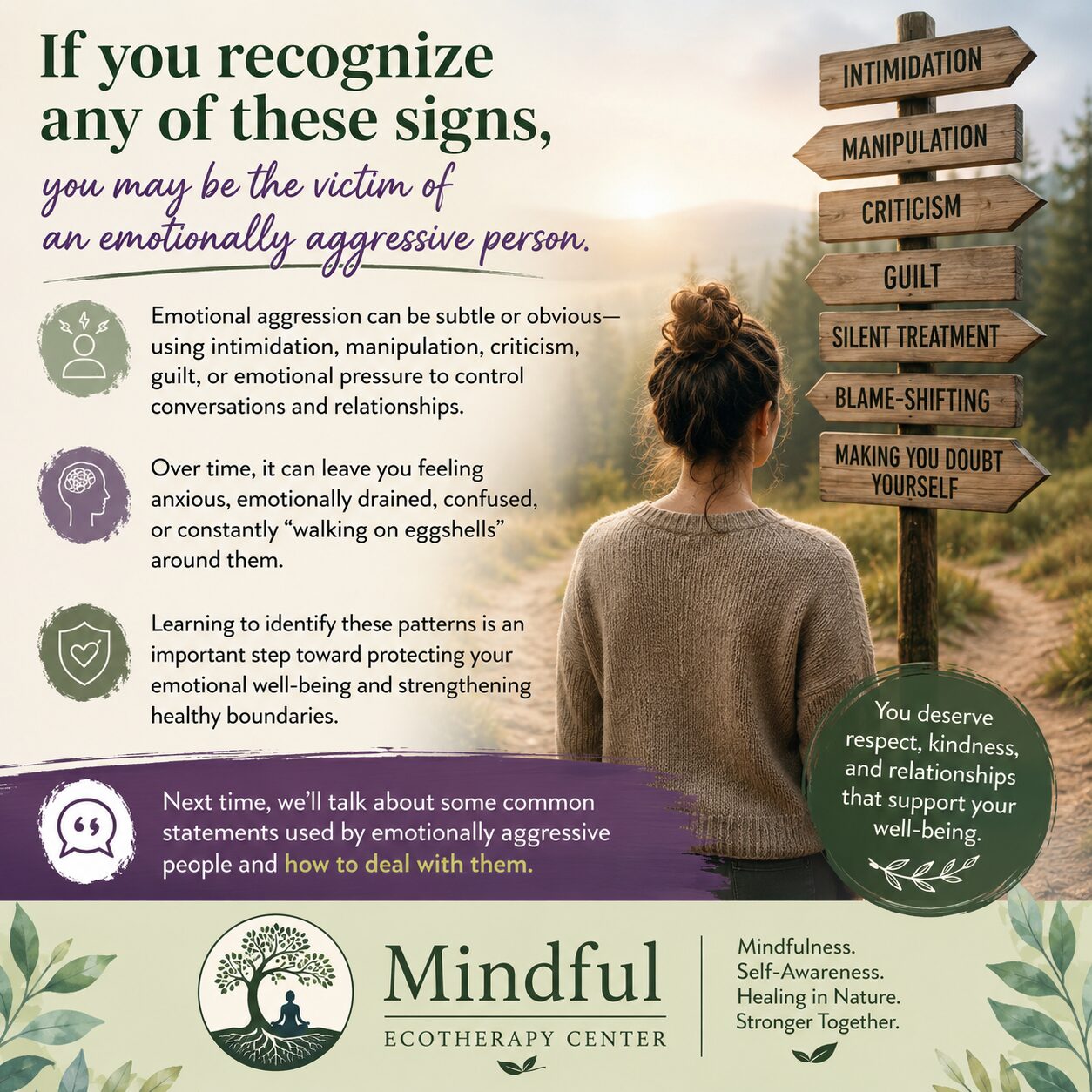
If you recognize any of these signs, you may be dealing with an emotionally aggressive person who uses intimidation, manipulation, criticism, guilt, or emotional pressure to control conversations and relationships. Over time, this behavior can leave you feeling anxious, emotionally drained, confused, or constantly “walking on eggshells” around them.

Emotional Aggression and Gaslighting

Emotional aggression is not always loud or obvious. Sometimes it appears through sarcasm, passive-aggressive comments, silent treatment, blame-shifting, or repeated attempts to make you doubt your own feelings and perceptions. Learning to identify these patterns is an important step toward protecting your emotional well-being and strengthening healthy boundaries.

At the Mindful Ecotherapy Center, we believe mindfulness, self-awareness, and supportive relationships can help you reconnect with your inner sense of safety and confidence. Next time, we’ll explore some of the most common statements emotionally aggressive people use and discuss healthy, grounded ways you can respond to them.


Grampian Women’s Aid: Coercive Control: 10 Signs It’s Gaslighting
http://www.grampian-womens-aid.com/newsevents/gaslighting-10-signs


Share Your Thoughts About Emotional Aggression and Gaslighting!

What do you think? Share your thoughts in the comments below!


  And don’t forget to subscribe to our newsletter!