Posted on

The Monomyth

letting go The Monomyth: An ecospiritual shaman's journey

The Monomyth was the creation of Joseph Campbell, who was an American mythologist best known for his works and lectures in comparative mythology and comparative religion. His personal philosophy is often summarized in the phrase, “Follow your bliss.”

One of his areas of study was the archetypal nature of world mythologies. He noted that myths from around the world followed a pattern. Campbell conceptualized this pattern, calling it the monomyth. The monomyth is the archetypal mythological journey of discovery. The monomyth is often referred to as the Hero’s Journey. Elements of this journey show up in sacred texts of most religions. It is the journey of Moses, of Jesus, of Krishna, of Mohammed, of the Buddha, of King Arthur, and even of Luke Skywalker. George Lucas relied heavily on the works of Joseph Campbell when crafting the original Star Wars saga.

The template for the monomyth, along with an explanation of the phases, is outlined below. There are three major phases, with steps for each phase. The three major phases are: Departure, Initiation, and Return.

As you read the descriptions below, see if you can identify where you might be in your own ecospiritual path.

Phase One of the Monomyth: Departure

In the Departure phase, the hero leaves the familiar on a journey of self-awareness that will ultimately make or break him. The Departure phase is about a way of doing things differently than they have been done in the past. It is an awakening to the world of wider possibilities. For an ecospiritual seeker, it means challenging your own accepted notions of what spirituality means. It means going against the dogma and finding your own individual path. It means trusting yourself and your own supernatural aid enough to take that step.

The Call to Adventure
The Call to Adventure is the catalyst that sets the Hero’s Journey in motion. It could be an inner need to change one’s circumstances, or it could be an external event that triggers the journey. For Buddha, it was the inner desire to seek enlightenment. For Luke Skywalker, the Empire forced his hand. In either case, the hero recognizes that something fundamental has changed, and he/she can never go back to the way things were.

Refusal of the Call
Change is scary. The comforting thing about the familiar is its familiarity; we know what to expect. This can even be true if the familiar situation is grim. Such a sentiment is often expressed in the phrase, “Better the devil you know than the devil you don’t know.”
The familiar, however uncomfortable it may be, is at least familiar. When faced with change, there is an element of the unknown that must be reckoned with. No matter how bad things are, the thought that they could potentially get worse always hovers in the back of our minds. By making a change, chance has entered the equation. What may you expect to happen when walking into uncharted territory? Things might get better, but they might get worse as well. Because of this doubt and uncertainty about where the path may lead, many people refuse the call to adventure.

Supernatural Aid
Sometimes when we get stuck in our refusal, we need a little push to get going again. When this happens, the universe tends to align the stars in such a way that we have to act. If we choose not to walk through the open door out of fear or uncertainty, the universe begins to close all other doors one by one until we have no choice but to walk through the open door before us.
This supernatural aid doesn’t have to come from some deity. Sometimes it is just as simple as a moment of inspiration or a flash of insight. Whatever it is, it sets our feet on the path in spite of our reluctance to embrace the journey.

The Crossing of the First Threshold
As Bilbo Baggins says, “It’s a dangerous business, going out your door. You step into the road, and if you don’t keep your feet, there is no knowing where you might be swept off to.”

For every journey there is a first step. The Crossing of the First Threshold is that first step. The significance of that first step is that it indicates a commitment to the journey. The reluctance and refusal are over, and the intention has been set. Once your intention has been determined, and you announce your intention to the Universe, there is no going back.

Belly of the Whale
To learn new ways of being, we must first cast off our assumptions about the way things work. Our assumptions create our perceptions, and our perceptions create our reality. If we’re journeying to new realities, our perceptions and assumptions have to be discarded. This can be an especially difficult task since many of our assumptions and perceptions are involved in our own sense of identity. If we cast them off, we lose who we are. But to become someone new, we must lose who we are. Percival had to cast off his armor before he could receive the Holy Grail. Since he was a knight, this meant casting off all outward appearances of his former identity in order to discover something new.

Jonah spent three days in the Belly of the Whale after his Refusal of the Call. This was Jonah’s casting off of his former identity so that he could step into his new role as a spiritual leader. This time in the whale’s belly is a time of reflection and of challenging preconceived notions before initiation into a wider world.


Phase Two of the Monomyth: Initiation

In the Initiation phase, the hero must “die to herself.” Many religious and shamanic rituals involve a symbolic death and rebirth to a new way of being. Initiation is an emptying of your cup so that it may be refilled with new knowledge. For a spiritual seeker, Initiation means being open to new experiences and being willing to experiment with new ways of being.

The Road of Trials
“The word ‘ashes’ contains in it a dark feeling for death; ashes when put on the face whiten it as death does…some men around thirty-five or forty will begin to experience ashes privately, without ritual, even without old men. They begin to notice how many of their dreams have turned to ashes.”

–Robert Bly, Iron John: A Book about Men

The Road of Trials begins with what Robert Bly calls “Time in the Ashes,” or “Ashes Time.” Sometimes things get worse before they get better. The Greek katabasis literally means “to go down” or “to descend.” Katabasis is the idea that it is always darkest before the dawn. As the spiritual seeker’s old identity is stripped away in the Belly of the Whale, there is nothing yet with which to replace it. To a spiritual seeker, this katabasis may feel like the end of the world. Sometimes it manifests as a sense that one’s entire life has been meaningless up until this point. Author Richard Bach, in his bestseller Jonathan Livingston Seagull, describes this feeling best: “I gave my life to become the person I am right now. Was it worth it?”

The Meeting with the Goddess

“For she is the incarnation of the promise of perfection, the soul’s assurance that, at the conclusion of the exile in a world of organized inadequacies, the bliss that once was known will be known again…”

– Joseph Campbell, The Hero’s Journey

The Goddess here isn’t necessarily an actual divine entity, although she can be. Since the heroes in most of the myths Campbell studied were heterosexual males, the Meeting with the Goddess represents the ideal partner. Since we’re talking about a spiritual and metaphorical level here, the Meeting with the Goddess symbolizes the idea of completeness and perfection. After having our former identities stripped away in the Belly of the Whale, and after our Initiation in the Road of Trials, the Goddess appears to us in ideal form with the promise of what could be, if we persevere. The Goddess represents perfect love. It is a love that is truly unconditional; a love that applies not only to others, bur to self as well.

Woman as Temptress
Again, the gender bias of referring to the Temptress as a woman is a by-product of centuries of male heroes in mythology. The Temptress can just as easily be a Tempter, as when Lucifer tempted Jesus with all the wealth of the world if he would give up his seeker’s journey.

Whichever sex you choose to picture the Tempter/Temptress, its purpose is to entice you with the easy way out. The Temptress manifests in shortcuts, laziness, and leaving things half-done. The lesson of the Temptress is that if we cheat by taking a shortcut on the road to enlightenment, we are ultimately only cheating ourselves.
The Temptress will test your integrity and character, but there is a purpose in this trial. By testing your character, the Temptress gives you an opportunity to display your honor. True honor is how we act when nobody is watching, and the Temptress gives us the opportunity to practice that honor. She will attempt to sway us from the path and try to prevent us from owning the darker parts of ourselves. If this happens, we will fail to achieve Atonement with the Father.

Atonement with the Father
The poet Robert Bly, in Iron John, talks about the son receiving an injury from the father. Often it is this injury that sets the son off on a journey of self-discovery in the first place. In primal cultures this injury is sometimes ritualized. In some African cultures, the father knocks out one of the son’s teeth in a rite of passage ritual. In some Native American cultures, the son receives some other form of injury, as in the ritual tearing of the pectoral muscles practiced during the Sun Dance of the Lakotas. This dark aspect of fatherhood is reflected in the idea of the Shadow from Jungian psychology (more on this later). The psychoanalyst Carl Jung believed that all human beings have the potential for all behaviors. The most moral among us have the potential to become serial killers, and the most immoral among us have the potential to redeem themselves. Since, according to Jung, all humans have the potential for all behaviors, the behaviors we choose not to express are suppressed. The part of the psyche in which these behaviors are repressed is what Jung called the Shadow. The behaviors we choose to express, the mask we wear in our daily lives, is what Jung called the Persona.

The Atonement with the Father is the integration of the Shadow with the Persona. Although the Shadow is where our dark, evil impulses lie, it is also where our creativity lies. Without it, we can have no imagination. So Atonement is literally “at-ONE-ment,” meaning that the Shadow and the Persona become one. This does not mean that we consciously choose to act on those evil impulses. It means that by acknowledging their existence in the first place, we can move towards mastering them. When they are mastered, we can achieve apotheosis.

Apotheosis
This word, Greek in origin, means, “To deify,” or to “become godlike.” According to Joseph Campbell, apotheosis is, “The pattern of the divine state to which the human hero attains who has gone beyond the last terrors of ignorance.”
Apotheosis is the ability to rise above the chess board and recognize that one has been a pawn in the game. By seeing the whole board, we gain a new perspective. It is a shift in perspective; the solving of the puzzle of existence. Once the hero has achieved apotheosis, he can never go back to the way things were before. Apotheosis is the gaining of a godlike wisdom. Adam has eaten the apple, and gained the godlike knowledge of good and evil.

The Ultimate Boon
The Ultimate Boon is the treasure at the end of the journey. It is the Holy Grail; the elixir of life; the reason for the journey in the first place. For a spiritual seeker, the Ultimate Boon may be the gifts of wisdom and enlightenment.

Phase Three of the Monomyth: Return

In the Return Phase, the hero has gained wisdom about the nature of reality and consciousness and is now faced with the challenge of returning to the world to teach those who are willing to listen. It is the process of coming home with the Holy Grail. It is the act of bringing the Ten Commandments down off the mountaintop. It is the act of helping others to achieve what the hero has achieved while avoiding the temptation to turn them into carbon copies of himself. For a spiritual seeker, this means applying lessons learned in the spiritual realm to daily life. It means learning to see the bigger picture and to trust the vision.

Refusal of the Return
When you have tasted the milk and honey of Paradise, why would you want to leave? When you’ve experienced perfection, it can be difficult to summon the energy to return to an imperfect world. There is also the consideration of trying to communicate your experience to others who have not had the same experience. You will lack a common frame of reference. Once your perceptions have been transformed and you learn to see things in a new way and speak a new language, it can feel like it’s impossible to communicate with those who haven’t learned the same language.

In Plato’s Cave Allegory, the Seeker learns to see beyond the illusion and into the real nature of things. In Plato’s Cave, these illusions take the form of shadows projected on a wall. The shadows are of people. The shadows are not the people; they are merely an illusion and a projection of the real people behind the shadows. In Plato’s Cave, the Seeker sees the real people behind the shadows for the first time. But when he tries to explain the concept of real people to the others in the cave, they cannot understand what he means, because they lack a common frame of reference.

A return to the “real” world of shadows after living for a time in the world of true substance can be a frustrating experience if you hope to share your newfound wisdom with others. Because of this, it is easy to refuse the return, especially if you have attained paradise along your journey.

The Magic Flight
“If the hero in his triumph wins the blessing of the goddess or the god and is then explicitly commissioned to return to the world with some elixir for the restoration of society, the final stage of his adventure is supported by all the powers of his supernatural patron. On the other hand, if the trophy has been attained against the opposition of its guardian, or if the hero’s wish to return to the world has been resented by the gods or demons, then the last stage of the mythological round becomes a lively, often comical, pursuit. This flight may be complicated by marvels of magical obstruction and evasion.”

-Joseph Campbell

Sometimes the hero can escape with the Ultimate Boon. But sometimes forces conspire to prevent the hero from returning. Even paradise can be a prison if you can’t leave when you wish to leave.

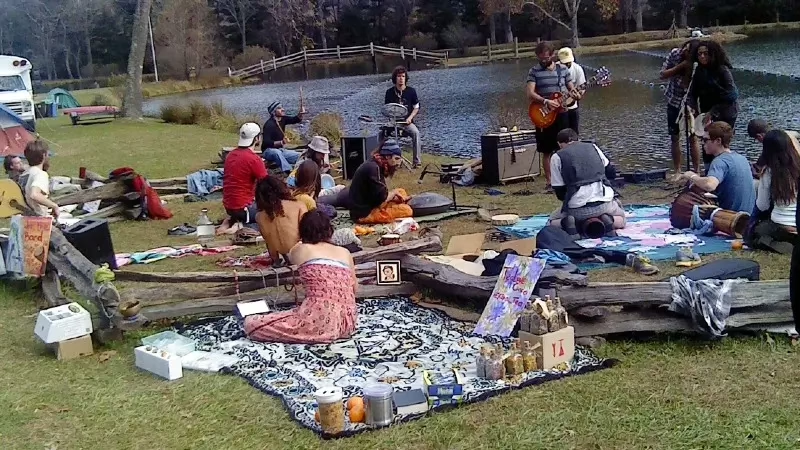
For the spiritual seeker, the Magic Flight may consist of letting go of forms of spirituality that are no longer meaningful. One warm spring day. I was at the lake with the woman I would later divorce. We were having a picnic by the lake. She’d brought along her collection of talismans and other New Age paraphernalia and was busily trying to read portents in a deck of Tarot cards. Unfortunately, she had the habit of consulting the deck for every little aspect of her life to the point that it was almost an obsessive-compulsive disorder. It’s fine to see portents from time to time, but she couldn’t seem to see anything else.

As we sat there, she dealing out her Tarot and obsessing over it, a cardinal appeared on a tree branch just above our heads. Seeing an opportunity for another omen, she looked up at the bird and said, “Hi, do you have a message for me?”

The bird, in response, cocked her head sideways and dumped a prodigious load right onto her head.
I laughed, looked at her and said, “There’s your message.”

Spirituality is only good when it isn’t taken too seriously. This is the ultimate lesson of ecospirituality. If you find yourself in a space where the tools have become more important than the message, then you may be in need of a Magic Flight.

Rescue from Without
As the end of the path draws nigh, the hero may be exhausted and spent from the journey. If you have cast off the weary world, you are probably in no hurry to return to it. If this is the case, then the world may have to come and get you. For a spiritual seeker, this rescue from without may come from a friend or a family member who needs the wisdom you have gained from your journey.

The Crossing of the Return Threshold
The Return Threshold is the doorway that lies between the spiritual world and the “real” world. In order to cross the return threshold, the spiritual seeker must complete three tasks. First, she must retain all the wisdom she gained on the quest so that she may share it with others. Next, she must find a way to integrate that wisdom into a human life without pain or regret. Finally, she must find a way to share that wisdom with the rest of the world in such a way that they receive it with welcome. This last task is especially important, as we humans tend to make martyrs out of messiahs. This is another powerful way that coyote magic may be used. Sometimes people have to be “tricked” into enlightenment to bypass their preconceived notions of what is and what should be.

Master of Two Worlds
Once your basic needs of food, clothing, shelter and love have been satisfied, how much do you truly need? We often confuse our wants with our needs. The Master of Two Worlds has learned to reconcile these dualities. Such a Master has found a balance between the spiritual world and the material world. This seeker has also found a balance between his Shadow and his Persona; his light half and his dark half. Such a person has moved beyond seeing the world in black-and-white terms, and can see the gray areas, where most of life happens.

Georg Wilhelm Friedrich Hegel’s famous philosophical device, commonly known as the Hegelian Dialectic, is a triad consisting of thesis, antithesis, and synthesis, where the thesis is an idea, the antithesis is the idea’s opposite, and the synthesis is the blending of the two. For example, if the material world is the thesis, and the spiritual world is the antithesis, then a synthesis of the two would be finding a way to live spiritually in the material world. The Master of Two Worlds has achieved this synthesis.

Freedom to Live
Once you’ve conquered your fear of death, what else can stand in your way? If the soul is the only thing in the Universe that is truly indestructible, then death is just another way of being. Even if you are atheist or agnostic, and have no belief in an afterlife, this is still true from the point of view of your own consciousness. If this life is all you will ever know, and there is no afterlife, then it is impossible to ever be conscious of your own death; therefore there is no way you could ever know that you have died. How can you be conscious of your own death, if death is the end to consciousness? So from the perspective of your own consciousness, you are immortal for all practical purposes. When you die, your Universe ceases to exist, and you are no longer the Center. With this knowledge of death comes the Freedom to Live. Soul musician Ray Charles said, “Live every day like it’s going to be your last, because one of these days you’ll be right.”

Freedom to Live means that you have mastered death.

A ecospiritual seeker can use this monomyth template as a road map for following the way of the ecospiritual shaman, or any other spiritual path. As you look over the phases and steps above, you can probably readily identify where you are on the journey. You can also identify what lies ahead, and get some idea of what skills and tools you will need to meet those upcoming challenges. In the weeks that follow we will go into more depth about what some of those challenges might be and how to overcome them.

The rest is up to you!

Posted on

NOW AVAILABLE! Ecospirituality Group Facilitator Certification Program Bundle

Ecospirituality Workbook Cover Photo Ecospirituality Group Facilitator Certification Program

CLICK HERE TO PURCHASE THIS BUNDLE AT A SAVINGS OF OVER 20%!

GET AN ADDITIONAL $50 OFF DURING THE MONTH OF JUNE!

Regular price:

$299.99

For June, 2024 this bundle will be

$249.99!


What is the Ecospirituality Group Program?

This Ecospirituality Group Facilitator Certification Program teaches you to be an  Ecospirituality Program facilitator. The Ecospirituality Group Program is a 12-week nature-based spiritual self-improvement program. Each session meets outdoors for about 90 minutes and is guided by a trained Ecospirituality Facilitator. The word “spiritual” comes from the Latin spiritus, which means, “breath.” Originally, that which was spiritual was simply that which was breathtaking. From this perspective a spiritual experience is an awe-inspiring experience. People of all religions…or none…can experience such awe-inspiring events. You can be spiritual without being religious. Spirituality doesn’t rely on a set system of teachings or dogmas. Spirituality is the joy of being present in the moment and experiencing the awe and wonder of living. When a seeker of the ecospiritual path has completed such a journey, they will become an ecospiritual shaman. An ecospiritual shaman is a practitioner who integrates spiritual and shamanic traditions with a deep ecological consciousness, emphasizing a sacred connection between humans and the natural world. Such a person has become fully integrated within themselves and is able to live in their True Self as the person they were born to be.  

Program Description

This program certifies you to be a facilitator for the Ecospirituality Group Program developed by the Mindful Ecotherapy Center, LLC. The Ecospirituality Program is a 12-week nature-based spiritual self-improvement group program. Each group meets outdoors for about 90 minutes and is guided by a trained Ecospirituality Facilitator. There is a companion workbook for the program that is available for purchase here. A FREE copy of this workbook in pdf format is included in the course documents section of the Ecospirituality Group Facilitator Course included in this bundle. This workbook was designed to accompany the 12-week program. Each course of the program includes ecotherapy and mindfulness activities and worksheets. There are also optional activities for each course of the program. This program bundle includes all of the three courses required to be a Certified Ecospirituality Group Facilitator. The courses in this program are:

There are no other fees or purchases required to complete certification. Once you have completed all three courses, email chuck@mindfulectherapy.com. When your completion of all three courses with passing grades has been verified, you will be emailed a Certificate of Completion in pdf format indicating that you are a Certified Ecospirituality Group Facilitator. You will also be eligible for a FREE listing in our Directory.


Privacy Policy | Refund and Returns Policy | Terms and Conditions


Meet Your Instructor 

Charlton Hall, MMFT, PhD is a former Marriage and Family Therapy Supervisor and a former Registered Play Therapy Supervisor (now retired from both those roles).

In 2008 he was awarded a two-year post-graduate fellowship through the Westgate Training and Consultation Network to study mindfulness and ecotherapy. His chosen specialty demographic at that time was Borderline Personality Disorder.

Dr. Hall has been providing training seminars on mindfulness and ecotherapy since 2007 when he founded what would become the Mindful Ecotherapy Center, LLC, and has been an advocate for education in ecotherapy and mindfulness throughout his professional career, serving on the South Carolina Association for Marriage and Family Therapy’s Board of Directors as Chair of Continuing Education from 2012 to 2014.

He served as the Chair of Behavioral Health for ReGenesis Health Care from 2014 to 2016 and trained all the medical staff in suicide risk assessment and prevention during his employment at that agency.

Dr. Hall is also a trained SMART Recovery Facilitator and served as a Volunteer Advisor in South Carolina for several years.

Dr. Hall’s area of research and interest is using Mindfulness and Ecotherapy to facilitate acceptance and change strategies within a family systemic framework, and he has presented research at several conferences and seminars on this and other topics.

Click here for instructor contact information

Course materials for all three courses in this online home study package are evidence-based, with clearly defined learning objectives, references and citations, and post-course evaluations. Upon request a copy of this information and a course description containing objectives, course description, references and citations will be given to you for your local licensing board.

All of our courses and webinars contain course objectives, references, and citations as a part of the course materials; however, it is your responsibility to check with your local licensure board for suitability for continuing education credit.

No warranty is expressed or implied as to approval or suitability for continuing education credit regarding jurisdictions outside of the United States or its territories.

If a participant or potential participant would like to express a concern about his/her experience with the Mindful Ecotherapy Center, NBCC ACEP #7022, he/she may call or e-mail at (864) 384-2388 or chuck@mindfulecotherapy.com. Emails generally get faster responses.

You may also use the contact form below.

Although we do not guarantee a particular outcome, the individual can expect us to consider the complaint, make any necessary decisions and respond within 24 to 48 hours.

Privacy Policy | Terms and Conditions | Refund and Return Policy


Contact MEC | Help with Courses | My Account | Student Forum


Posted on

Call of the Coyote

the first threshold Coyote call of the coyote

The Call of the Coyote is a path to ecospirituality. Last week we talked about the emerging “dark green religion.” What is ecospirituality, and what does it have to do with a dark green religion?

The original meaning of the word “spiritual” comes from the Latin spiritus, which means, “to breathe.” So originally, that which was spiritual was simply that which was breathtaking. A spiritual experience is an awe-inspiring experience. Such inspiring events can be had by people of all religions, or of none. You can be spiritual without being religious.
In my personal experience, those breathtaking moments most often occur when I have made some sort of connection. It could be a connection with nature, or with others, or with my own inner self. Such a connection opens up a channel of communication, or perhaps communion. Such a connection allows me to feel that I am a part of everything, and everything is a part of me.

In this ecospirituality workbook and the accompanying program, we will be exploring the possibility of making such connections through the eyes of Coyote.

Coyote’s motto could well be, “If I weren’t crazy, I’d go insane.”

Many Native American tribes consider Coyote to be the Trickster, the one who teaches by becoming a mirror. Coyote’s tricks and jokes reflect our own folly and stubbornness back to us until we realize what is happening and learn from it, if we are fortunate enough to realize what is going on. Coyote will continue to hold a mirror up to us until we learn to see our true selves, or until we become so angry and frustrated that we lose sight of our spiritual paths.

The Way of the Coyote teaches us that wisdom is the twin of foolishness. In an insane world, the sane man must appear insane. When following the Way of the Coyote we learn to see our own foolishness in the antics of others, and we learn from their mistakes. Likewise, when we follow coyote medicine, we show others their own foolishness by our own antics. If Coyote is your teacher, he will frustrate you, anger you, and make you furious. But if you can learn to see through the rage and frustration to the lessons beneath, Coyote can teach you much.

Coyote’s Archetypal Energy

Coyote teaches through humor and the ability to laugh at life’s absurdities and ironies. The Way of the Coyote is to strip away the masks we all wear so that we may get to the truth underneath. Coyote teaches us to cast aside all the fronts that we put on for others and for ourselves.

Coyote’s humor also teaches us that what we do to others, we ultimately do to ourselves. He teaches us that we reap what we sow, so if we use Coyote medicine on our friends and family, we shouldn’t be surprised or offended if they do the same to us.

Coyote energy is reflected in the phrase, “Simplicity is perfection.” He teaches us to learn to distinguish what we need from what we want. Coyote won’t give us everything we want, but he will lead us to everything we need.

The Call of the Coyote stirs up something primitive and passionate in our souls, and reminds us to return to the place of the beginning; that childlike sense of wonder and fascination with the beauty of the world.

Coyote is a survivor, and is able to adapt to new situations by learning to bend and flow with skill and cunning. The Way of the Coyote is to understand that all things are sacred, yet nothing is sacred. If you have any sacred cows in our life, coyote will be sure to devour them. It has been said that, “insanity is doing the same thing in the same way and expecting things to turn out differently.”

Another way to put this is that if what you’re doing isn’t working, then doing more of it isn’t going to work either. In fact, it may make things worse. So when we begin to walk the Way of the Coyote, we may find ourselves lost in the unfamiliar. Some of the things Coyote may ask us to do will seem strange, even weird. But that’s okay. If it didn’t feel weird, we’d probably already be doing it. If we stay on the path of the comfortable and the familiar, we are in danger of doing the same things in the same ways and getting the same results we’ve always gotten. If, however, we have the courage to step forth and try something different, we may find that our world will change for the better.

But setting about doing things differently can be a scary experience. We often fear the unknown, and Coyote loves to take us into the mysterious. That is the art of the Trickster. It is also the reason Coyote can often be frustrating. She asks us to leave our comfort zone.

If you have heard the Call of the Coyote, learn to look for things you may have been avoiding or refusing to acknowledge in your own life. This sometimes manifests in strange ways. Look at what you criticize the most in others, and see if you yourself have those same characteristics. For example, if you find yourself constantly judging others for their anger, could it be that you have a problem with anger yourself? If you are constantly demanding that other people be more forgiving, could there be someone in your own life that you need to beg for forgiveness? If you are constantly telling others to be more tolerant and loving, could it be that you may need to learn to be more tolerant and loving as well?

A danger to Coyote medicine is that Coyotes tend to spend all of their energy caring for others. Coyotes would do well to remember to take some time and energy for themselves as well. Another pitfall of coyote medicine is that those who don’t understand Coyote’s ways are often angered or alienated by the mirror because they don’t wish to acknowledge what it shows them about themselves. Sometimes the Way of the Coyote can be a lonely way because of this. If you have heard the Call of the Coyote, it could also mean that you need to look into your own mirror and see if there is something about yourself that you have been afraid to acknowledge. By refusing to acknowledge it, you give it power over you. But acknowledging our weaknesses and shortcomings is the first step to conquering them.

If Coyote has chosen you, look closely at ways you may have been giving energy to foolishness. This is especially true in relationships, since we often fool ourselves in relationships, and refuse to see what is plain to everyone else. As they say, “Love is blind.” Remember that Coyote’s ultimate goal is not to anger or frustrate, but to teach. In order for Coyote to teach, we have to be willing to learn. It helps to remember that sometimes the best lessons are also the most painful lessons. If Coyote is causing you pain, it is not out of malice, but out of love. It is so that you may grow on your own path.

To answer the Call of the Coyote is to be a strong protector of family, relationships, and connections. Coyotes often mate for life, and will fiercely defend mate and cubs. If Coyote is your ally, family is probably very important to you. Coyotes will often adopt cubs who have become parentless. They realize that family is not always a matter of blood, but of spirit, so for those of us who follow the Way, Coyote medicine is concerned with our spiritual families. To follow the Way of the Coyote is to realize that members of the same spiritual family rarely grow up under the same roof. It is also to realize that our family need not be restricted to our two-legged brothers and sisters, but it can include our four-legged brothers and sisters as well, and ultimately all of nature.

Sometimes Coyotes go to extremes to defend the family. In such a case the Coyote medicine has become too strong. Coyotes are fiercely loyal to their own, sometimes to the point that they may even alienate those whom they are trying to protect. In such a case, the coyote spirit is overprotective to the point of becoming overbearing. When this happens, Coyote needs to learn to let go.

The Way of the Coyote is about achieving balance. A dark green religion is also about achieving balance. All life on Mother Earth is in danger largely because of the greed of human beings. If we continue our pursuit of trinkets and baubles, always wanting more and never satisfied with what we have, we will eventually destroy everything. A life of rampant materialism is a life out of balance. Things can never fill the void inside. Only true spiritual wisdom can fill that void. The Call of the Coyote is about finding a balance between the material and the spiritual so that we cease to destroy our Earth Mother and each other. It is about learning to distinguish between our wants and our needs.

The only true necessities in life are food, clothing, shelter and love. Once those needs are met, anything else is a luxury. Material possessions are a poor substitute for love and spirit. When we learn this lesson completely, we will be embracing a dark green religion and learning to walk the Way of the Coyote. When we learn to share this knowledge with our fellow travelers along the way, we will have fulfilled our destinies as spiritual seekers. We will have achieved the ultimate in ecospirituality.

The upcoming Ecospirituality Group Program, due to be released on June 1, 2024, is a synopsis of what it means to answer the Call of the Coyote. It is a seeker’s journey of self-discovery. If you choose to purchase the upcoming Ecospirituality Group Program, it is my wish that, as with everything else in life, you take what is useful and discard the rest.

Posted on

Dark Green Religion

Plant A Dark Green Religion - Treebeard

“Empirical studies have begun to demonstrate that many people in advanced industrial cultures resonate deeply with what could be called nature spirituality or nature religion. Some of these people view the world as full of spiritual intelligences with whom one can be in relationship (an animistic perception), while others among them perceive the earth to be alive or even divine (a more pantheistic belief).”

–Bron Taylor, Dark Green Religion

As the human race has become increasingly urbanized, we have come to spend less and less time in natural settings. Many of us now live in cities. Even so, we still hear the calls of nature. The wildness cries out to something in our blood. Although the Industrial Revolution has forced us into an urban way of living, we were creatures of the wilderness for millennia before that. Evolution has hardwired our brains for the woods.

Bron Taylor is a professor of religion and nature, environmental ethics, and environmental studies, at the University of Florida. He coined the term “dark green religion” and is the author of a book by that name. According to his book, a dark green religion is one that has a set of beliefs and practices characterized by a central conviction that “nature is sacred, has intrinsic value, and is therefore due reverent care.”

The central theme of Taylor’s book is that the people involved in ecological awareness and the green movement display many of the characteristics usually associated with a religious or spiritual movement. Both are characterized by deeply-held beliefs about the nature of reality and our relationship with it. Both have ethical systems of behavior, and “prophets” who outline and discuss these ethical standards. Taylor cites Henry David Thoreau’s Walden and Rachel Carson’s Silent Spring as examples of “sacred texts” used by this Dark Green Religion.

Taylor differentiates between green religion and dark green religion. To him, traditional world religions that have added ecological practices into their worship services and holiday observations are green religions, but not dark green religions. So if you go to a church that recycles, or a temple that has a carpooling club, or a mosque that uses LED lighting, you may be partaking of green religion without becoming involved in a dark green religion. According to Taylor, the “dark green” part of dark green religion refers to what Arne Naess called deep ecology.

Dark Green Religion and Deep Ecology

Arne Naess was a Norwegian philosopher and founder of the Deep Ecology movement. He cited Rachel Carson’s book Silent Spring as instrumental in his development of the philosophy of deep ecology, which states that humans are not privileged above other living things and that all living things should be treated with equal respect and ethical consideration. Naess believed that all things have an equal right to thrive and to survive. This is similar to the Gaia Hypothesis.

Although NASA scientist James Lovelock is credited with creating the Gaia hypothesis, which says that the Earth herself is a living thing, and we are all a part of the much larger organism that is Gaia, the Earth, Native Americans had such a concept for thousands of years before Lovelock came along. The Oglala Medicine Man and Shaman, Black Elk, once said, “The first peace, which is the most important, is that which comes within the souls of people when they realize their relationship, their oneness with the universe and all its powers, and when they realize at the center of the universe dwells the Great Spirit, and that its center is really everywhere, it is within each of us.”

The scientists have discovered what the Native Americans knew all along: That the Earth is a living organism and that we are all a part of the web of life. We are all connected. This idea of the interconnectedness of all things is what Naess meant by “deep ecology,” and deep ecology pursued with a reverent and sacred attitude is what Taylor means by a “dark green religion.” A tenet of this dark green religion is that if we are all connected, then what we do to the web of life, we do to ourselves as well. If we poison the water, then we drink the water, we take the poison into ourselves. If we pollute the food with pesticides, then eat the food, we take the pesticides into our own bodies. If we pollute the air, then breathe in the air, we take our own pollutants into our lungs. If we fatten our beef animals with hormones, then eat the beef, we take the hormones into ourselves. If we poison the minds and souls of our neighbors with hatred, anger, and bitterness, then interact with those neighbors in negative ways, we take the hatred, anger and bitterness into ourselves as well.

The deep ecology of a dark green religion teaches us to be one with nature. This is true even if we are agnostic or atheist. We don’t have to believe in supernatural beings in order to realize that nature is something larger and more transcendent than ourselves. The divinity in a dark green religion is nature herself. This is true whether or not we choose to personify nature as a separate supernatural and divine entity. We are all interdependent, and a dark green religion teaches us that if we cannot live in a sustainable, ecological way, then the human race will have no future. This planet has limited resources, and we don’t have anywhere else to go. Eventually everything will run out, and when this happens, how will we survive? The only way that the human race can survive is to embrace a way of life that honors all life on the planet. Such a way of life is what Taylor means by a dark green religion.

Posted on

Memories: Making the Pieces Fit

memories

There are many types of memory. Let’s talk about two of them: Implicit Memory and Narrative Memory. Implicit memories are memories about specific events. What did you have for breakfast this morning? What outfit did you wear yesterday? Which people did you talk to today? The answers to these questions are implicit memories.

Narrative memories are memories that try to make sense of our various experiences on a day-to-day basis. Narrative memories integrate our implicit memories into a coherent whole. While implicit memories are the ‘what,’ narrative memories are the ‘why.’ Suppose I don’t usually eat eggs for breakfast, but today I decided to have scrambled eggs. The memory of having scrambled eggs is an implicit memory that answers the question, “What did I have for breakfast?” Further suppose that I was having breakfast with a friend who knew my eating habits, and my friend commented that I don’t usually eat eggs. If I search my own mind for a reason why I chose eggs for breakfast on this particular day, the reason I come up with will be the ‘why’ of narrative memory.

Our lives are made up of implicit memories of our daily events. In order to make sense of our lives, we link these events together in a narrative that gives our lives meaning. These stories that we create about our life experiences are our narrative memories. We all write our own autobiographies every day of our lives. This process of autobiography writing is our narrative memory fitting the pieces of our implicit memories together like a jigsaw puzzle.

Integrating Memories

For most of us, most of the time, our stories make sense and everything runs smoothly. But sometimes we get a bunch of implicit memories that we just can’t seem to fit into our own narratives. It’s as if, while working this jigsaw puzzle, we somehow grabbed a handful of pieces from another box. When this happens, we have to ‘change the picture’ of our life stories to incorporate these new puzzle pieces. This process of fitting the new pieces into the puzzle is called integration.

If we are able to successfully integrate all of these implicit memories, then there’s no problem. If we have difficulty making some of the pieces fit, it usually means that we’d have to change our worldview and re-write our own narrative in order to fit those pieces into the puzzle. This can be a frustrating experience. Sometimes that frustration manifests in emotional aggression.

Living a life of consistency means finding a way to make all of the pieces fit without getting frustrated or without having to act out in emotionally aggressive ways. By learning to integrate our True Selves into the story of our lives, we fit all of our implicit memories into a new narrative memory that creates this new paradigm. When all of these pieces have fit together, we are living at the core of our True Selves.

Posted on

Mindful Walking

mindful walking the coyote walk

Mindful Walking utilizes mindfulness and ecopsychology as emotional regulation skills. This is especially true if you are able to do this exercise outdoors. Mindful walking may be used to de-fuse potential emotional aggression. If you feel that one of your triggers has been activated, and you can take a break, go outside and do a little mindful walking!

The goal of a mindful walking exercise is to increase self-awareness by focusing on the sensations your body experiences while walking. Your brain takes in about 2 billion bytes of information per second. Of all this information being taken in, you are usually only conscious of about 4000 bytes of this information. This Mindful Walking exercise helps you to learn to become more consciously aware by learning to focus on only one thing at a time. By being present in the moment, we learn to let go of worries about the past, and anxieties about the future.

It is preferable to do this exercise outdoors if possible, but if necessary you may also do the exercise indoors. You may wish to make a recording of it for your mp3 player so that you may take it with you while you walk, or you can watch the video below to get a good idea of the process. the video below is for the Coyote Walk Meditation, a type of mindful walking that we use in our Ecospirituality Program.

Mindful Walking Instructions

Read over the instructions below, then try it on your own:

  • Start by standing with your feet about shoulder width apart, with your weight evenly distributed. Your hands should hang loosely and freely by your side. Gaze at the ground about five or six feet in front of you. Don’t focus your eyes on anything…just allow your eyes to relax.
  • Center yourself before beginning to walk by taking a few deep breaths before beginning to walk. Don’t begin to walk until your attention and intention are focused on the moment. Shift from Doing Mode to Being Mode.
  • When you are ready, slowly lift your right leg in preparation for taking the first step.
  • As you step, focus on feeling every muscle in your leg. Note what each muscle is doing as you move. Don’t hurry the step. Just allow yourself to experience all the sensations that your leg is giving to you. Step forward until your right foot makes contact with the ground. Notice how your foot makes contact with the surface.
  • Did your heel touch first, or was it your toes?
  • Did you feel the pressure of contact first with the inside edge of your foot, or with the outside edge?
  • Now as you begin to bring your left foot forward for another step, notice how the weight changes on your right foot. Is it changing from heel to toe, or the other way around? Where do your feet feel the pressure? Can you feel the pressure move across your right foot as you make the next step?
  • Now as you bring your left foot forward to make contact with the ground, repeat the procedure. Note how the pressure and weight change over your left foot and leg as you prepare to make another step with your right foot.
  • Continue on, walking in the same manner, paying attention only to the way your body moves as you continue to walk. Focus only on the sensations your body continues to give you.
  • At times you may find yourself becoming distracted. If you notice a fragrance on the breeze, or if an animal crosses your path, or if you hear a bird singing, your mind may wander from the sensations of walking. If this happens, simply stop walking until your attention returns to you.
  • Sometimes the distractions are not in the environment, but in your mind. If thoughts and feelings take your mind off of the walking, then once again, stop walking until your mind returns to focusing only on the walking.
  • Remember that the goal of this exercise is to practice paying attention to only one thing at a time, and one thing only. If you feel tempted to begin thinking about the past or the future, stop walking until your thoughts and feelings return only to the sensations of the walking.
  • As you continue to practice Mindful Walking as part of your daily routine, your mind will become more calm and relaxed. Mindful walking is something that you can practice at any time during the day whenever you need a quick break from doing.
  • As you continue to practice focusing on only one thing at a time, you we gain more control over your own thoughts and feelings. You will become less prone to periods of overwhelming emotions and thoughts. You will also learn to experience the joy and the happiness within you.
  • Continue your walk, directing your attention only to the sensations of your walking. As you come to an end to this mindful walking meditation, slowly take your last step, and come to a stop, resting comfortably where you stand.
  • End the meditation by taking a few deep breaths and expanding your awareness to the environment around you. You may wish to do a mindful meditation during your mindful walking exercise as well.

Use the Mindful Walking meditation whenever you have the opportunity to take a quick break; especially if you find yourself experiencing anxiety or depression. Strong emotions can lead to emotional aggression, and you can de-fuse such ruminating cycles by shifting from Doing Mode into Being Mode. Mindful Walking helps you to do this by taking energy out of the thinking cycle and shifting it into the sensing cycle.

Posted on

Emotional Regulation

Emotional Regulation

Successful mood management comes from successful emotional regulation. Emotional regulation means recognizing patterns of emotional aggression and stopping the cycle of emotional aggression before it starts. This means becoming aware of and attuned to your own cycles of emotions.

Before you can become attuned to your own cycles of emotional behavior, you must first be able to identify your emotions.

Society often teaches us that there are acceptable emotions to display in public, and unacceptable emotions to display in public. Those emotions that we feel safe displaying are our secondary emotions. In situations where people tend to become emotionally aggressive, there are underlying emotions driving these secondary emotions.

These underlying emotions, called primary emotions, are emotions that we do not feel safe displaying or discussing in public. If we suppress these primary emotions for long enough, it is possible that we may eventually forget what these emotions are and what they feel like. When this happens, the first step to emotional regulation is to identify these lost emotions.

By using the mindful skills of observing and describing, you can distract yourself from drowning in unpleasant emotions by simply identifying the emotions and describing their characteristics to yourself. As you step outside of the stream of feeling by distracting yourself with the process of observing and describing, it may help to name these emotions to yourself.

For example, if you’re feeling angry, repeat to yourself, “That’s anger.” As you begin to ponder this emotional state, trace it back to its origin. Are there any primary emotions driving the anger? Could it be that you are angry because you fear losing someone or something? Are you angry because of a fear of being inadequate in some area of your life? Are you angry because you are frustrated at a personal failure? The feeling behind the secondary emotion is the primary emotion.

Ruminating Cycles and Emotional Regulation

As you use your skills of observing and describing, you will not only be distracting yourself from fully experiencing the negative aspects of the mood. You will also be exploring the primary roots of the secondary emotion being experienced. As you observe and describe your emotional states to yourself, you become more emotionally aware of their origins. The more aware you are about the origins of those emotions, the more you are able to choose which emotions to give your full attention, and which emotions to let go.

A ruminating cycle is a cycle of thought or emotion. There are positive ruminating cycles and negative ruminating cycles. Such cycles consist of the self-talk we engage in as we go about our daily business.

Let’s look at a couple of scenarios involving ruminating cycles. These cycles are from Joe and Jim. Joe’s negative ruminating cycle might look like this:

“My wife just frowned at me. I wonder what she’s upset about?”
“What have I done wrong this time?”
“Can’t I ever do anything right?”
“Why is it so hard to please her?”
“Maybe I should just divorce her and get it over with. She’s never happy.”
“I’ll show her! I’ll give her the silent treatment!”

Jim’s positive ruminating cycle might look like this:

“My wife just frowned. I wonder if she’s upset?”
“Maybe she’s just having a bad day.”
“I wonder if there’s anything I can do to help?”
“I’m happy that she trusts me enough to share her innermost feelings with me!”

Joe’s negative ruminating cycle assumes that his wife’s frown was personal in that Joe believes that his wife was frowning at him. Jim, on the other hand, simply noted that his wife had frowned, without assuming that the frown was directed at him personally. Joe also assumed that his wife’s frown was indicative of a pervasive problem: That Joe cannot ever do anything to please his wife. Jim, on the other hand, recognized that this was just one incident, and not a pervasive problem. His response to his wife’s frown was, “Maybe she’s just having a bad day.”

Finally, Joe’s ruminating cycle assumes a permanent problem: That Joe can’t “ever do anything right,” while Jim doesn’t see it as a permanent problem. He’s even willing to try to change the situation by wondering if there is anything he can do to help his wife.

Try this: The next time you find yourself in a ruminating cycle, whether it is a positive cycle or a negative cycle, begin talking out loud. Verbalize your thought and feeling patterns by observing and describing them. Look for any permanent, personal or pervasive patterns of thinking and feeling.

Be on the lookout for all-or-nothing thinking. You can usually identify such patterns of thought by looking for words like always and never. The good news about thoughts like, “Things have always been this way,” and “Things are never going to change,” is that you only need one example to disprove them. If Joe has ever done a single thing to please his wife, then he cannot say, “I can never do anything to please her.”

If Joe can find just one example of where things have gone well, then he can’t say, “I always do the wrong thing.” He might do the wrong thing 99,999 times, but if there’s even one case in which he did the right thing, then he is not justified in saying, “I always do the wrong thing.”

If Joe can think of a single time when he was able to do the right thing, then it means that it is possible to do the right thing. If it is possible to do the right thing once, it is possible to do the right thing again. All that remains is figuring out what made it possible, and repeating the conditions that made it possible.

The key point to remember about ruminating cycles is that they are self-reinforcing. Emotions like to hang around once they’ve shown up. Research has shown that once a ruminating cycle of emotional aggression gets started, we tend to act, think, and feel in ways that perpetuate the cycle. We’re conditioned to believe that when we have strong emotions, we must immediately act upon them.

Mindfulness-Based Ecotherapy teaches us that we do not have to act on those emotions, and we don’t have to dwell on them. We can simply observe and describe those emotions without feeling the need to react or respond.

It may help to remember that there is no such thing as a ‘good’ or ‘bad’ feeling. What may be considered ‘good’ or ‘bad’ is the behavior that comes after the feeling. So the problem is in the behavior, not the feeling itself. One of the behaviors that can be labeled as ‘good’ or ‘bad,’ or ‘positive’ or ‘negative,’ is the ruminating cycle itself.

It works in this way: You have a negative feeling (anger, hostility, sadness, etc.). You then activate a ruminating cycle by continuing to dwell on the feeling. As you continue to dwell on the feeling, the negative emotion feeds off of the ruminating cycle and the emotion causes you to become more and more emotionally aroused, until you act out with emotional aggression.

You can change this behavior in this way: When you note a negative emotion, simply observe it and describe it, while recognizing that you do not have to dwell on it. The feeling itself is not ‘good’ or ‘bad.’ It simply is. You can decide not to give it power over you by disengaging from the ruminating cycle. In doing so, you don’t feed the negative emotion, and it eventually subsides.

When you have mastered this, you will be well on the way to managing your moods.

Posted on

Learning to be Mindful: The Fisherman and His Son

fisherman and his son

The Fisherman and His Son is a parable that illustrates how to be mindfully intentional. It’s been said that the definition of insanity is “Doing the same thing in the same way and expecting different results.” In other words, if what you’re doing isn’t working, doing more of the same isn’t likely to work either. It may be time to do something different.

Mindfulness is a way to do something different.

When we commit to change, it sometimes feels strange at first. If you think about it, this only makes sense because if it didn’t feel weird, you’d probably already be doing it. Sometimes you have to think outside the box to get the change you want. This parable illustrates the concept of being open to trying something new, even if it feels strange at first.

The Fisherman and His Son: A Mindful Parable

A fisherman and his son were at sea, going about the daily tasks of catching enough fish to make their living. It was a beautiful spring day, and they were both enjoying the ocean. They were having a particularly good day. They had caught many fish, and they were ready to turn for home and make their way back to the shore when the fisherman noticed a tiny leak at the bow of the boat. The boat was slowly filling up with water. While the leak wasn’t a big one, they both realized that the boat would be full of water before they could row back to shore.

The father and son began to panic as they thought of the prospect of losing not only their boat, but the fine catch they had made that day. In his panic, the father suddenly seized upon an idea. He grabbed the oar and punched a hole in the side of the boat.

The son thought his fisherman father had gone mad. “What are you doing?” the son shouted.

The father replied, “I’m punching a hole in the bottom of the boat so the water can flow out!”

They both watched in horror as more water rushed into the boat the father had made. Seeing that his idea had not succeeded, but had only made things worse, the father began to furiously punch even more holes in the bottom of the boat.

The son, upon seeing this, yelled at his father, “Will you please stop it? Can’t you see you are only making things worse?”

But the fisherman said, “No, my idea will work! I just didn’t have enough holes in the boat! If I keep punching holes in the boat, the water will eventually flow out!”

The son watched helplessly as the father, in a frenzy, continued to batter more holes into the hull of the boat. Finally, the boat overflowed, sinking to the bottom of the sea and taking the catch of the day with it. The father and son had to swim to shore.

Upon arriving at the shore, totally exhausted, they both realized that they had not only lost a fine catch, but they had also lost their means of making a living. With the boat gone, they could no longer be fishermen. With great sadness, they turned to make their way home, wondering about what they’d do to survive in the future.

To think about

What solutions to problems have you been trying that only make the problem worse? How could you make it better instead? If what you’re doing isn’t working, could it be time to try something different?


Share Your Thoughts About The Fisherman and His Son!

What do you think? Share your thoughts in the comments below!


  And don’t forget to subscribe to our newsletter!

Posted on

What is Ecotherapy?

ecotherapy
Ecotherapy

For most of its existence, homo sapiens has lived in harmony with nature as hunter/gatherers. Such a lifestyle requires a vast knowledge of the seasons, and of the patterns and habits of wildlife, and of plants and herbs and their healing powers. Industrialization and urbanization are fairly recent phenomena on an evolutionary scale. We still carry the genetic memory of our ancestors who lived in untamed nature. Our brains are wired for the outdoors and nature. A growing body of research demonstrates that not only do we feel better when we make time for nature, but it is also actually a requirement for good physical and mental health!

Ecopsychology and Ecotherapy

The field of ecopsychology studies how humans interact with nature. Ecopsychology is a philosophy combining elements of psychology and ecology. It is the philosophy that mental health is contingent upon the health of the environment. Humankind and the environment are part of an interrelated system. We are not separate from nature. We are a part of nature.

ecotherapy

Ecopsychology suggests that there is a synergistic relation between planetary and personal well-being; that the needs of the one are relevant to the needs of the other. In short, what we do to the environment, we do to ourselves. Ecotherapy is the practical application of this knowledge. In ecotherapy, nature is the “therapist.” In practicing the techniques of ecotherapy, we allow the healing power of nature to work its magic on us. Hölzel et al (2011) demonstrated that meditative states of mindfulness stimulate neural growth in the cerebral cortex in the areas of the brain responsible for emotional regulation, good judgment, insight, and impulse control. Nature experiences have been demonstrated in several studies to produce meditative states (fascination, relaxation, and mindfulness).

Ecotherapy: Natural Experiences with Nature

Experiences in and with nature, or natural experiences, are ways in which we consciously choose to allow nature to work its healing magic on us. Some types of natural experiences include:

Facilitated Wilderness Experiences

In these types of experiences, a trained facilitator takes you into the woods for an adventure. These events can be anything from a wilderness experience in ecotherapy led by a therapist or counselor to a hunting trip led by a wilderness guide. Kuo & Taylor (2004) demonstrated that therapy and other activities conducted in outdoor settings reduced symptoms of Attention-Deficit Hyperactivity Disorder. Whittington (2006) found that wilderness skills training gave adolescent girls increased self-esteem and self-confidence and helped to shatter gender stereotypes.

Animal-Assisted Therapy

Animal therapy in the form of contact with pets and/or wild or domesticated animals enhances self-actualization and can lessen symptoms of depression. Antonioli & Reveley (2005) found that simply swimming with dolphins can greatly reduce symptoms of depression. Other studies have shown that owning pets, or even just watching fish in an aquarium, can greatly reduce stress. Equine Therapy uses horses to facilitate mental and physical well-being. There are many other ways that animals can help us lead happier lives, as any pet owner can tell you!

Therapeutic Gardens

Sempik & Spurgeon (2006) demonstrated that therapeutic gardening reduces stress and lessens symptoms of depression. Blair (2009) discovered that gardening can be used as a means of helping school children to enhance self-sufficiency, social identity, meaning, and self-integration. There’s just something very healing about planting something and nurturing it as you watch it grow.

Vacations

Berto (2014) discovered that outdoor activities reduce stress and restore energy. If you’ve ever had to miss a vacation, you’re probably painfully aware of the regenerative power of taking a week or so off to spend time in nature. Cole (2012) found that you don’t need a facilitator or guide to enjoy health and well-being benefits from the use of wilderness areas. There’s a reason we’re attracted to beaches and national parks!

Architecture Incorporating Natural Spaces

Nature can be incorporated into the home environment through the use of plants, an aquarium, or even recorded nature sounds. Alvarsson et al (2010) studied the positive mental health effects of listening to nature sounds.

Outdoor Classrooms

Dennis, Wells & Bishop (2014) revealed that outdoor classrooms enhanced many critical factors of the educational experience, including: Enhanced retention, better focus, more attention to detail, less hyperactivity, more relaxation, increased confidence and self-esteem, and better cognitive functioning

Why Mindfulness-Based Ecotherapy?

Mindfulness-based ecotherapy (MBE) enhances traditional ecotherapy by combining the restorative benefits of nature with the self-regulation and awareness skills cultivated through mindfulness practices. Ecotherapy alone has been shown to reduce stress, improve mood, and increase feelings of connectedness to the natural environment (Berto, 2014).

By integrating mindfulness, participants are encouraged to attend fully to present-moment sensory experiences within natural settings, which can deepen emotional processing, reduce rumination, and amplify psychological restoration (Kabat-Zinn, 2003). This combination strengthens the therapeutic impact, particularly for individuals prone to anxiety or depression, by not only providing exposure to nature but also fostering intentional engagement with it. Mindfulness enhances attentional control, allowing participants to notice subtle natural cues, reflect without judgment, and cultivate a sense of grounded presence, thereby making ecotherapy sessions more effective and transformative (Berto, 2014; Kabat-Zinn, 2003).


References

Alvarsson JJ, Wiens S, Nilsson ME. Stress recovery during exposure to nature sound and environmental noise. Int J Environ Res Public Health. 2010 Mar;7(3):1036-46. doi: 10.3390/ijerph7031036. Epub 2010 Mar 11. PMID: 20617017; PMCID: PMC2872309.

Antonioli C, Reveley MA. Randomised controlled trial of animal facilitated therapy with dolphins in the treatment of depression. BMJ. 2005 Nov 26;331(7527):1231. doi: 10.1136/bmj.331.7527.1231. PMID: 16308382; PMCID: PMC1289317.

Berto, R. (2014). The role of nature in coping with psycho-physiological stress: A literature review on restorativeness. Behavioral Sciences, 4(4), 394–409. https://doi.org/10.3390/bs4040394

Blair, D. (2009). The child in the garden: An evaluative review of the benefits of school gardening. Journal of Environmental Education, 40(2), 15–38.

Cole, D. N. (2012). Wilderness visitor experiences: A selective review of 50 years of research. Park Science, 28(3), Winter 2011‑2012. https://www.fs.usda.gov/rm/pubs_other/rmrs_2012_cole_d001.pdf

Dennis, S. F., Wells, A., & Bishop, C. (2014). A post-occupancy study of nature-based outdoor classrooms in early childhood education. Children, Youth and Environments, 24(2). https://doi.org/10.7721/chilyoutenvi.24.2.0035

Fieldhouse J, Sempik J. ‘Gardening without Borders’: Reflections on the Results of a Survey of Practitioners of an ‘Unstructured’ Profession. British Journal of Occupational Therapy. 2007;70(10):449-453. doi:10.1177/030802260707001006

Hölzel BK, Carmody J, Vangel M, Congleton C, Yerramsetti SM, Gard T, Lazar SW. Mindfulness practice leads to increases in regional brain gray matter density. Psychiatry Res. 2011 Jan 30;191(1):36-43. doi: 10.1016/j.pscychresns.2010.08.006. Epub 2010 Nov 10. PMID: 21071182; PMCID: PMC3004979.

Kabat-Zinn, J. (2003). Mindfulness-based interventions in context: Past, present, and future. Clinical Psychology: Science and Practice, 10(2), 144–156. https://doi.org/10.1093/clipsy/bpg016

Taylor AF, Kuo FE. Children with attention deficits concentrate better after walk in the park. J Atten Disord. 2009 Mar;12(5):402-9. doi: 10.1177/1087054708323000. Epub 2008 Aug 25. PMID: 18725656.


Share Your Thoughts!

What do you think? What courses would you like the Mindful Ecotherapy Center to add in the future? Share your thoughts in the comments below! And don’t forget to subscribe to our newsletter!

Posted on

What is Ecotherapy?

What is Ecotherapy

What is Ecotherapy?

For most of its existence, homo sapiens has lived in harmony with nature as hunter/gatherers. Such a lifestyle requires a vast knowledge of the seasons, and of the patterns and habits of wildlife, and of plants and herbs and their healing powers. Industrialization and urbanization are fairly recent phenomena on an evolutionary scale. We still carry the genetic memory of our ancestors who lived in untamed nature. Our brains are wired for the outdoors and nature. A growing body of research demonstrates that not only do we feel better when we make time for nature, but it is also a requirement for good physical and mental health!

Ecopsychology and Ecotherapy

The field of ecopsychology studies how humans interact with nature. Ecopsychology is a philosophy combining elements of psychology and ecology. It is the philosophy that mental health is contingent upon the health of the environment. Humankind and the environment are part of an interrelated system. We are not separate from nature. We are a part of nature.

At its core, ecopsychology suggests that there is a synergistic relation between planetary and personal well-being; that the needs of the one are relevant to the needs of the other. In short, what we do to the environment, we do to ourselves. Ecotherapy is the practical application of this knowledge. In ecotherapy, nature is the “therapist.” In practicing the techniques of ecotherapy, we allow the healing power of nature to work its magic on us. Hölzel et al (2011) demonstrated that meditative states of mindfulness stimulate neural growth in the cerebral cortex in the areas of the brain responsible for emotional regulation, good judgment, insight, and impulse control. Nature experiences have been demonstrated in several studies to produce meditative states (fascination, relaxation, and mindfulness).

Ecotherapy Techniques

Experiences in and with nature, or natural experiences, are ways in which we consciously choose to allow nature to work its healing magic on us. Some types of natural experiences include:

Facilitated Wilderness Experiences

In these types of experiences, a trained facilitator takes you into the woods for an adventure. These events can be anything from a wilderness experience in ecotherapy led by a therapist or counselor, to a hunting trip led by a wilderness guide. Kuo & Taylor (2004) demonstrated that therapy and other activities conducted in outdoor settings reduced symptoms of Attention-Deficit Hyperactivity Disorder. Whittington (2006) found that wilderness skills training gave adolescent girls increased self-esteem and self-confidence and helped to shatter gender stereotypes.

Animal Assisted Therapy

Animal therapy in the form of contact with pets and/or wild or domesticated animals enhances self-actualization and can lessen symptoms of depression. Antonioli & Reveley (2005) found that simply swimming with dolphins can greatly reduce symptoms of depression. Other studies have shown that owning pets, or even just watching fish in an aquarium, can greatly reduce stress. Equine Therapy uses horses to facilitate mental and physical wellbeing. There are many other ways that animals can help us lead happier lives, as any pet owner can tell you!

Therapeutic Gardens

Sempik & Spurgeon (2006) demonstrated that therapeutic gardening reduces stress and lessens symptoms of depression. Blair (2009) discovered that gardening can be used as a means of helping school children to enhance self-sufficiency, social identity, meaning, and self-integration. There’s just something very healing about planting something and nurturing it as you watch it grow.

Vacations

Sponselee, et al (2004) discovered that outdoor activities reduce stress and restore energy. If you’ve ever had to miss a vacation, you’re probably painfully aware of the regenerative power of taking a week or so off to spend time in nature. Roggenbuck & Driver (2000) found that you don’t need a facilitator or guide to enjoy health and well-being benefits from the use of wilderness areas. There’s a reason we’re attracted to beaches and national parks!

Architecture Incorporating Natural Spaces

Nature can be incorporated into the home environment through the use of plants, an aquarium, or even recorded nature sounds. Alvarsson et al (2010) studied the positive mental health effects of listening to nature sounds.

Outdoor Classrooms

Purcell, et all in 2007 revealed that outdoor classrooms enhanced many critical factors of the educational experience, including: Enhanced retention, better focus, more attention to detail, less hyperactivity, more relaxation, increased confidence and self-esteem, and better cognitive functioning.

Ecotherapy for Mental Health

Numerous studies affirm that ecotherapy (also called nature‑based interventions) supports mental well‑being by reducing anxiety and depression and enhancing mood and cognitive function. A systematic meta‑analysis of randomized controlled trials found that outdoor nature‑based interventions were effective in improving depressive mood and lowering anxiety scores. Even brief nature exposure matters—one meta‑analytic review reports that as little as 10 minutes in natural settings can provide measurable short‑term mental health benefits for adults. Beyond individual experiences, cost‑effectiveness studies show that ecotherapy programs for mild to moderate mental health issues can be delivered more affordably than traditional treatments and may reduce healthcare usage. Collectively, this body of evidence underscores ecotherapy as a powerful, accessible complement to conventional mental health care.


Share Your Thoughts!

What do you think? Share your thoughts in the comments below! And don’t forget to subscribe to our newsletter!