Posted on

Mindfulness and Control

mindfulness and control

“He who angers you conquers you.”

-Elizabeth Kenny

Mindful Ecotherapy relies on the 7Cs of family resilience. These resilience factors help you to better weather the storms that come with life.

The second ‘C’ of the 7Cs of family resilience is “control.”

If someone has the ability to anger you, then that person just controlled you.

If you allow others to ‘make’ you feel angry, you have relinquished control over your own emotional well-being.

Similarly, anger is often the result of failed attempts to control others. By analyzing our beliefs about control, we learn to manage our moods so that control is no longer an issue.

Once there was a sculptor who was famous for his carvings of animals. Of all the animals he carved, his elephants were the most lifelike and inspiring. One day an art student came to him and asked him the secret to creating such beautiful elephants.

“The answer,” he said, “Is simple. You just get a block of marble and chip away anything that doesn’t look like an elephant.”

When difficulties arise in a relationship, it’s usually because we’ve set out to carve an elephant, but we suddenly find ourselves carving a bear or a donkey or some other animal instead. When this happens, we’ve gotten caught up in the details of living, and we have lost sight of our original goal, the elephant.

Go over your list of standard arguments with your partner, and decide for yourselves which ones will lead to a happier relationship, and which ones involve side issues (i.e., arguments that are not ‘carving the elephant.’) You may disagree with your partner over which ones are which, and that’s okay too.

Maybe your version of the elephant is slightly different from your partner’s version. Just remember that by sharing your vision of a happier relationship with your partner, you can both come to agreement on what sort of elephant you would like to carve together.

The first step is agreeing that you will focus only on those actions that lead to the end result you both want. Once you’ve agreed on that end result, you can both begin to ‘chip away’ anything that doesn’t look like the relationship you both want to share.

Remember to keep it focused on solutions. You can talk about the problem all day if you wish, but that doesn’t do anything to actually solve the problem.

If your intention is to have a happy, healthy relationship, then anything that doesn’t promote that is irrelevant. It’s just marble to be carved away. If you find yourself constantly discussing problems, and never reaching resolution, ask yourself, “What is my intention?” or perhaps, “Is this the elephant I’m trying to carve, or is it just excess marble?”

If both you and your partner have the same intention, then the rest is just details. You’re working towards a common goal, and all that remains is to resolve how you both approach the common goal.

If, on the other hand, you both have different intentions, then you both have different goals. This is the source of a lot of friction in relationships.

Always remember that you can only control your own intentions, and not your partner’s. Use your mindful communication skills to find common ground and to avoid the temptation to try to control others.

Posted on

Internal Validation vs. External Validation

Internal vs. external validation emotional aggression

`“If it’s never our fault, we can’t take responsibility for it. If we can’t take responsibility for it, we’ll always be its victim.”`

-Richard Bach, author

Internal Validation is the art of validating ourselves. We all like to be validated. It’s why we have relationships in the first place. We enter relationships so that others can support us emotionally. This can become a problem if we come to expect that others are responsible for validating us. Emotional aggression happens when we try to force others to validate us.

While others can choose to validate us by acting in emotionally supportive ways, we can also choose to validate ourselves. If others are validating us, then that validation is external because it is coming from someone besides ourselves. If, however, we are able to meet our own emotional needs, we are internally validated. It’s nice to have both, but there may be times when others cannot satisfy our emotional needs. In those times, it helps to be able to meet those needs ourselves.

The only healthy way to be emotionally validated by others is when others are willingly granting us such validation and support. If we attempt to force such support from others, we are acting from emotional aggression.

If we engage in fault-finding in an attempt to seek validation, we are projecting blame. Projecting blame is emotional aggression, because we are abdicating responsibility for our own emotional validation by attempting to blame, shame, or guilt others into emotionally supporting us against their will.

If you’ve ever been on the receiving end of a guilt-trip, you know that it is not a pleasant experience. If you’ve ever been the victim of a guilt-trip, ask yourself, “Is trying to make me feel guilty more likely or less likely to make me emotionally validate you?”

Now turn that around and put the shoe on the other foot. If you’re projecting blame onto your partner by trying to shame them or guilt them into doing what you want, do you think that such behavior is more likely or less likely to get the results you want?

If others are not meeting your emotional needs, and you are seeking external validation by behaving in emotionally aggressive ways in an attempt to get them to submit to your desires, do you really think you’re going to get the results you want? If the other person was doing it to you, would you be willing to respond in the way that they wanted?

Internal Validation is Loving Yourself

One way to avoid the tendency to engage in emotional aggression is to learn the art of internal validation. To be internally validated is to accept responsibility for your own emotional needs. The way to do this is to learn to love yourself.

Sometimes we get caught up in the idea that loving ourselves is somehow selfish or egotistical. But think about that for a moment. If you don’t love yourself, is it really fair of you to expect anybody else to love you? Not only that, but if you don’t love yourself, and you’re in a relationship with someone who loves you, eventually you might find yourself thinking along these lines, either consciously or unconsciously:

“I don’t really love myself, yet this person loves me. If I don’t love myself, yet this person says they love me, then there must be something wrong with him/her! How could a ‘normal’ person love someone like me, when I can’t even love me?”

If you don’t really love yourself, then you can’t really expect others how to love you in the way you’d like to be loved.

To learn to love yourself, first ask yourself, “Who am I, really?” Be as honest as possible when answering this question. In future weeks there will be an exercise to recognize some self-defeating beliefs and replace them with self-affirming beliefs.

For now, think about ways you can learn to love yourself and be happy in your own skin. It might help to talk these things over with your partner or with a friend or family member. A good way to start is to find out what others like about you.

If you feel uncomfortable asking others what they like about you, you could get the ball rolling by making a list of things you like about others, and sharing it with them. I’m willing to bet that they’d be likely to return the favor.

The more you are willing to do so, the more you’ll be able to self-validate as well.

Posted on

Don’t Lose Your Marbles!

bag of marbles exercise don't lose your marble

A fun way to practice mindfulness is the “Don’t Lose Your Marbles” exercise.
The purpose of this exercise is to become aware of how many times throughout the day we have negative thoughts about ourselves and our families. As we become aware of that pattern of negative thoughts, we can replace them with positive, more compassionate thoughts. Those positive thoughts lead to more positive expectations of ourselves and our families.

Don’t Lose Your Marbles Exercise

Here’s how it works:

  • Go to the toy store and buy a bag of marbles.
  • Put the marbles in your pocket or purse so that you have them with you all day.
  • Every time you catch yourself having a negative thought, take a marble out of the bag and put it in your pocket or purse, or just set it aside somewhere where it won’t get lost.
  • Every time you catch yourself having a positive thought, put a marble back into the bag.
  • At the end of the day, if your bag is empty, you’ve ‘lost all your marbles.’
  • To get the marbles back into the bag, you have to say one positive thing about yourself or your family for each marble you return to the bag. Don’t go to bed at night until all the marbles are back in the bag!
    The marbles are a physical representation of our inner thought processes. Use this exercise to help change negative self-talk habits by giving yourself a physical reminder of how often during the day you have negative thoughts.
  • Over time you can change your thought habits. The first step is recognizing that they’re there. This exercise will help you make that connection.
Posted on

Emotional Regulation

Emotional Regulation

Successful mood management comes from successful emotional regulation. Emotional regulation means recognizing patterns of emotional aggression and stopping the cycle of emotional aggression before it starts. This means becoming aware of and attuned to your own cycles of emotions.

Before you can become attuned to your own cycles of emotional behavior, you must first be able to identify your emotions.

Society often teaches us that there are acceptable emotions to display in public, and unacceptable emotions to display in public. Those emotions that we feel safe displaying are our secondary emotions. In situations where people tend to become emotionally aggressive, there are underlying emotions driving these secondary emotions.

These underlying emotions, called primary emotions, are emotions that we do not feel safe displaying or discussing in public. If we suppress these primary emotions for long enough, it is possible that we may eventually forget what these emotions are and what they feel like. When this happens, the first step to emotional regulation is to identify these lost emotions.

By using the mindful skills of observing and describing, you can distract yourself from drowning in unpleasant emotions by simply identifying the emotions and describing their characteristics to yourself. As you step outside of the stream of feeling by distracting yourself with the process of observing and describing, it may help to name these emotions to yourself.

For example, if you’re feeling angry, repeat to yourself, “That’s anger.” As you begin to ponder this emotional state, trace it back to its origin. Are there any primary emotions driving the anger? Could it be that you are angry because you fear losing someone or something? Are you angry because of a fear of being inadequate in some area of your life? Are you angry because you are frustrated at a personal failure? The feeling behind the secondary emotion is the primary emotion.

Ruminating Cycles and Emotional Regulation

As you use your skills of observing and describing, you will not only be distracting yourself from fully experiencing the negative aspects of the mood. You will also be exploring the primary roots of the secondary emotion being experienced. As you observe and describe your emotional states to yourself, you become more emotionally aware of their origins. The more aware you are about the origins of those emotions, the more you are able to choose which emotions to give your full attention, and which emotions to let go.

A ruminating cycle is a cycle of thought or emotion. There are positive ruminating cycles and negative ruminating cycles. Such cycles consist of the self-talk we engage in as we go about our daily business.

Let’s look at a couple of scenarios involving ruminating cycles. These cycles are from Joe and Jim. Joe’s negative ruminating cycle might look like this:

“My wife just frowned at me. I wonder what she’s upset about?”
“What have I done wrong this time?”
“Can’t I ever do anything right?”
“Why is it so hard to please her?”
“Maybe I should just divorce her and get it over with. She’s never happy.”
“I’ll show her! I’ll give her the silent treatment!”

Jim’s positive ruminating cycle might look like this:

“My wife just frowned. I wonder if she’s upset?”
“Maybe she’s just having a bad day.”
“I wonder if there’s anything I can do to help?”
“I’m happy that she trusts me enough to share her innermost feelings with me!”

Joe’s negative ruminating cycle assumes that his wife’s frown was personal in that Joe believes that his wife was frowning at him. Jim, on the other hand, simply noted that his wife had frowned, without assuming that the frown was directed at him personally. Joe also assumed that his wife’s frown was indicative of a pervasive problem: That Joe cannot ever do anything to please his wife. Jim, on the other hand, recognized that this was just one incident, and not a pervasive problem. His response to his wife’s frown was, “Maybe she’s just having a bad day.”

Finally, Joe’s ruminating cycle assumes a permanent problem: That Joe can’t “ever do anything right,” while Jim doesn’t see it as a permanent problem. He’s even willing to try to change the situation by wondering if there is anything he can do to help his wife.

Try this: The next time you find yourself in a ruminating cycle, whether it is a positive cycle or a negative cycle, begin talking out loud. Verbalize your thought and feeling patterns by observing and describing them. Look for any permanent, personal or pervasive patterns of thinking and feeling.

Be on the lookout for all-or-nothing thinking. You can usually identify such patterns of thought by looking for words like always and never. The good news about thoughts like, “Things have always been this way,” and “Things are never going to change,” is that you only need one example to disprove them. If Joe has ever done a single thing to please his wife, then he cannot say, “I can never do anything to please her.”

If Joe can find just one example of where things have gone well, then he can’t say, “I always do the wrong thing.” He might do the wrong thing 99,999 times, but if there’s even one case in which he did the right thing, then he is not justified in saying, “I always do the wrong thing.”

If Joe can think of a single time when he was able to do the right thing, then it means that it is possible to do the right thing. If it is possible to do the right thing once, it is possible to do the right thing again. All that remains is figuring out what made it possible, and repeating the conditions that made it possible.

The key point to remember about ruminating cycles is that they are self-reinforcing. Emotions like to hang around once they’ve shown up. Research has shown that once a ruminating cycle of emotional aggression gets started, we tend to act, think, and feel in ways that perpetuate the cycle. We’re conditioned to believe that when we have strong emotions, we must immediately act upon them.

Mindfulness-Based Ecotherapy teaches us that we do not have to act on those emotions, and we don’t have to dwell on them. We can simply observe and describe those emotions without feeling the need to react or respond.

It may help to remember that there is no such thing as a ‘good’ or ‘bad’ feeling. What may be considered ‘good’ or ‘bad’ is the behavior that comes after the feeling. So the problem is in the behavior, not the feeling itself. One of the behaviors that can be labeled as ‘good’ or ‘bad,’ or ‘positive’ or ‘negative,’ is the ruminating cycle itself.

It works in this way: You have a negative feeling (anger, hostility, sadness, etc.). You then activate a ruminating cycle by continuing to dwell on the feeling. As you continue to dwell on the feeling, the negative emotion feeds off of the ruminating cycle and the emotion causes you to become more and more emotionally aroused, until you act out with emotional aggression.

You can change this behavior in this way: When you note a negative emotion, simply observe it and describe it, while recognizing that you do not have to dwell on it. The feeling itself is not ‘good’ or ‘bad.’ It simply is. You can decide not to give it power over you by disengaging from the ruminating cycle. In doing so, you don’t feed the negative emotion, and it eventually subsides.

When you have mastered this, you will be well on the way to managing your moods.

Posted on

Being Effective

Mindfulness is the art of being effective. This simply means doing more of what works and less of what doesn’t work.

As you continue to hone your ability to focus only on one thing at a time, this skill can be extended to problem-solving. When you become mindfully aware of a problem with the idea of solving it, you have focused your intention on the solution rather than on the problem. You can talk about a problem all day, but in the end, talking about a problem does nothing to help solve it. Only by focusing your intention on solutions will the problem get solved.

In Mindfulness we speak of the power of intention. This means that we choose every act deliberately and purposefully, focusing our awareness on each task with intention. When using the power of intention, we never wander about aimlessly, driven by the winds of whim and fortune. Every act is deliberate. Every act is intentional. This is the power of intention.

Once there was a sculptor who was famous for his carvings of animals. Of all the animals he carved, his elephants were the most lifelike and inspiring. One day an art student came to him and asked him the secret to creating such beautiful elephants.

“The answer,” the artist replied, “Is simple. You just get a block of marble and chip away anything that doesn’t look like an elephant.”

When difficulties arise in life, it’s usually because we’ve set out to carve an elephant, but we suddenly find ourselves carving a bear or a donkey or some other animal instead. When this happens, we’ve gotten caught up in the details of living, and we have lost sight of our original goal, the elephant.

You may talk about the problem for as long you wish, but simply talking about the problem doesn’t do anything to actually solve the problem. If your intention is to have a happy, healthy life and happy, healthy relationships, then anything that doesn’t promote these ideals is irrelevant. It’s just marble to be carved away. If you find yourself constantly discussing problems, and never reaching resolution, ask yourself, “What is my intention?” or perhaps, “Is this the elephant I’m trying to carve, or is it just excess marble?”

Mindfulness-Based Cognitive Therapy (MBCT) was developed by Segal, Williams and Teasdale (2002) as a method of treating clinical depression and for preventing relapse. There are eight sessions in the usual MBCT intervention:

  1. Automatic pilot and mindfulness
  2. Dealing with barriers and pleasant events
  3. Mindfulness of the breath
  4. Staying present
  5. Allowing and letting be
  6. Thoughts are not facts
  7. How can I best take care of myself?
  8. Using what has been learned to deal with future moods

In the first session, students are taught how to switch from “automatic pilot mode” or habitual mode, to intentional mode. Intentional mode involves moving from a ruminative mode to a mindful mode. Rumination in this sense refers to the tendency to engage in automatic patterns of thought, feeling and experience that lead to a recurrence of depressive symptoms.

These automatic patterns are driven by memory; i.e., they are learned responses to certain stimuli. By harnessing the power of intention, the practitioner of MBCT moves from this automatic ruminative state to an intentional, purposeful mindful state. Intentionality involves metacognition (thinking about thinking). By becoming a conscious observer of these automatic states, the student learns that these automatic thought processes are simply thoughts. They are not destiny, nor or they identity. My acting intentionally to step outside of oneself and simply observe and describe these automatic thoughts and feelings, practitioners learn that they have control over these internal states.

By using the power of intention to move from Thinking Mode to Sensing Mode, the student learns to view unwanted or difficult thoughts and feelings as passing mental events, and not as permanent characteristics. If the student can intentionally “ride out the wave” of depression or anxiety, then he/she will learn that “this too shall pass.”


Williams JM, Russell I, Russell D. Mindfulness-based cognitive therapy: further issues in current evidence and future research. J Consult Clin Psychol. 2008 Jun;76(3):524-9. doi: 10.1037/0022-006X.76.3.524. PMID: 18540746; PMCID: PMC2834575.

Posted on

What is Mindfulness?

Mindfulness for Therapists


“Mindfulness is the energy of being aware and awake to the present moment. It is the continuous practice of touching life deeply in every moment of daily life. To be mindful is to be truly alive and present with those around you and with what you are doing. We bring our body and mind into harmony while we wash the dishes, drive the car or take our morning cup of tea.”

–Thich Nhat Hanh, Zen Buddhist Monk and Founder of the An Quang Buddhist Institute

Think about the things that have caused you anxiety, stress or depression in the past. Now ask yourself, “Was it the things themselves that caused the anxiety, stress and depression, or was it what I believed about those things?”

Can you think of anything that you’ve ever been worried about, that wasn’t a product of your thoughts and feelings? Isn’t it true, in fact, that the worries come from the thoughts and feelings themselves, and not from the situations in which you find yourself?

If it is true that anxiety and depression are rooted in our thoughts, then we should be able to change our thoughts and eliminate, or at least minimize, anxiety and depression. Mindfulness is a way to change our thoughts. If you can change your thoughts, you can change your world.

The last two decades have seen an explosion in interest in the utility of Mindfulness for treating mental disorders. Consequently, there has been an interest in devising a clinical definition for the term ‘Mindfulness.’
Kabat-Zinn (2003) refers to Mindfulness as “paying attention on purpose, in the present moment, and non-judgmentally to the unfolding of experience moment by moment.”

Segal et al., (2004) describe Mindfulness as a state of being “fully present and attentive to the content of moment-by-moment experience.”

According to Baer (2003), “In general, while the specific focus of mindfulness may vary, individuals are instructed to be aware of thoughts but to be removed from the content of these thoughts.”

In short, mindfulness is a state of awareness in which we can choose to participate in the thought stream, or to simply observe it.

When we are able to be fully in the present, without worries, stress, or anxiety about the past or the future, we are being mindful. This doesn’t mean that we ignore or deny our thoughts or feelings. Instead, it just means that for now, in the present moment, we are consciously choosing how to respond to those thoughts and feelings.


REFERENCES

Baer, R. A. (2003). Mindfulness training as a clinical intervention: A conceptual and empirical review. Clinical Psychology: Science and Practice, 10, 125-143.

Davidson, R.J., Kabat-Zinn, J., Schmacher, J., Rosenkranz, M., Muller, D., Santorelli, S.F., Urbanowski, F., Harringtron, A., Bonus, K., Sheridan , J.F., Alterations in brain and immune function produced by mindfulness meditation. Psychosomatic Medicine, 65: 564-570, 2003.

Segal, Z. V., Teasdale, J. D., & Williams, J. M. G. (2004). Mindfulness-based cognitive therapy: Theoretical rationale and empirical status. In S. G. Hayes, V. Follette, & M. Linehan (Eds.), Expanding the cognitive behavioral tradition. New York: Guilford Press.

Posted on

Mindfulness-Based Ecotherapy Workbook 2nd Edition

workbook
Click on the image to purchase

This is the second edition of the Mindfulness-Based Ecotherapy WorkbookThe original workbook was published in 2015, and the sciences of mindfulness and ecotherapy have advanced a great deal since that time. This second edition was updated to reflect this new research. This edition, like its predecessor, was written to accompany the 12-week Mindfulness-Based Ecotherapy workshop series. Some of the exercises in this new edition have changed based on participant feedback regarding what is more helpful in facilitating nature experiences.

This new version of the handbook introduces the 12 skills of Mindfulness-Based Ecotherapy (MBE) and introduces one of these skills at each of the 12 sessions in the program. Although this book is designed to accompany the 12-week Mindfulness-Based Ecotherapy workshop series, it may also be completed on your own at home. The experiential nature of the work allows anyone with access to outdoor spaces the opportunity to complete the series. If you are interested in participating in a workshop series near you, you can visit the Mindful Ecotherapy Center’s website at www.mindfulecotherapy.org. The website contains a directory of Mindfulness-Based Ecotherapists worldwide

The second edition of the Mindfulness-Based Ecotherapy Workbook represents a significant evolution in the integration of mindfulness, nature-based practices, and therapeutic skill development. The original workbook, first published in 2015, emerged at a time when mindfulness-based interventions and ecotherapy were gaining momentum but had not yet fully matured as research-informed practices. In the years since, the sciences of mindfulness, trauma treatment, somatic awareness, and nature-based mental health interventions have advanced substantially. This revised workbook reflects those developments while staying grounded in experiential, accessible practice.

The Mindfulness-Based Ecotherapy Workbook is designed to accompany the 12-week Mindfulness-Based Ecotherapy (MBE) workshop series. However, one of its strengths is its flexibility. While it functions seamlessly within a structured group setting, it can also be completed independently by individuals who wish to engage in the practices on their own. The experiential nature of the workbook allows participants to move beyond theory and into direct engagement with the natural world, using outdoor spaces as co-facilitators in the therapeutic process.

What’s New in the Second Edition

One of the most important updates in this second edition is the explicit introduction of the 12 core skills of Mindfulness-Based Ecotherapy. Each skill is presented in sequence, with one skill explored in depth during each of the 12 sessions of the program. This structure provides clarity, coherence, and a clear developmental arc, allowing participants to gradually build capacity rather than feeling overwhelmed.

Several exercises have been revised or replaced based on participant feedback from previous workshop cohorts. This feedback-driven approach ensures that the workbook prioritizes practices that genuinely support embodied awareness, emotional regulation, and meaningful connection with nature. Rather than offering abstract reflection prompts, the workbook emphasizes lived experience, sensory engagement, and mindful presence in outdoor environments.

The updated content also reflects newer research in areas such as:

  • Trauma-informed mindfulness
  • Nervous system regulation
  • Embodied and somatic awareness
  • The psychological benefits of green and blue spaces
  • Nature-based interventions for anxiety, depression, and stress

An Experiential Approach to Learning

Unlike many traditional self-help books, this workbook is intentionally experiential rather than purely instructional. The practices are designed to be done, not just read about. Participants are encouraged to spend time outdoors, observe natural processes, notice bodily sensations, and reflect on how these experiences intersect with thoughts, emotions, and values.

This approach aligns with the foundational philosophy of Mindfulness-Based Ecotherapy, which views nature not as a backdrop, but as an active participant in healing. Anyone with access to outdoor spaces—whether a forest, park, backyard, or urban green area—can meaningfully engage with the workbook. The practices are adaptable, making the material accessible across diverse environments and life circumstances.

For Groups and Individuals Alike

While the workbook was created to support the 12-week MBE workshop series, it is equally valuable for individual use. Therapists may integrate the workbook into their clinical work, while individuals may use it as a structured self-guided program. The pacing encourages reflection without pressure, reinforcing the principle that growth unfolds over time and through repeated, mindful engagement.

For those interested in participating in a facilitated workshop, the Mindful Ecotherapy Center maintains a global directory of Mindfulness-Based Ecotherapy programs. This directory, available at www.mindfulecotherapy.org, connects individuals with trained providers offering workshops and groups worldwide.

A Living Resource for Ongoing Practice

The second edition of the Mindfulness-Based Ecotherapy Workbook is not meant to be completed once and shelved. Instead, it serves as a living resource that participants can return to as their relationship with mindfulness, nature, and self-awareness deepens. By grounding therapeutic skills in direct experience with the natural world, the workbook offers a sustainable and compassionate pathway toward psychological resilience and ecological connection.


Share Your Thoughts!

What do you think? Share your thoughts in the comments below! And don’t forget to subscribe to our newsletter!

Posted on

What is Ecotherapy?

ecotherapy
Ecotherapy

For most of its existence, homo sapiens has lived in harmony with nature as hunter/gatherers. Such a lifestyle requires a vast knowledge of the seasons, and of the patterns and habits of wildlife, and of plants and herbs and their healing powers. Industrialization and urbanization are fairly recent phenomena on an evolutionary scale. We still carry the genetic memory of our ancestors who lived in untamed nature. Our brains are wired for the outdoors and nature. A growing body of research demonstrates that not only do we feel better when we make time for nature, but it is also actually a requirement for good physical and mental health!

Ecopsychology and Ecotherapy

The field of ecopsychology studies how humans interact with nature. Ecopsychology is a philosophy combining elements of psychology and ecology. It is the philosophy that mental health is contingent upon the health of the environment. Humankind and the environment are part of an interrelated system. We are not separate from nature. We are a part of nature.

ecotherapy

Ecopsychology suggests that there is a synergistic relation between planetary and personal well-being; that the needs of the one are relevant to the needs of the other. In short, what we do to the environment, we do to ourselves. Ecotherapy is the practical application of this knowledge. In ecotherapy, nature is the “therapist.” In practicing the techniques of ecotherapy, we allow the healing power of nature to work its magic on us. Hölzel et al (2011) demonstrated that meditative states of mindfulness stimulate neural growth in the cerebral cortex in the areas of the brain responsible for emotional regulation, good judgment, insight, and impulse control. Nature experiences have been demonstrated in several studies to produce meditative states (fascination, relaxation, and mindfulness).

Ecotherapy: Natural Experiences with Nature

Experiences in and with nature, or natural experiences, are ways in which we consciously choose to allow nature to work its healing magic on us. Some types of natural experiences include:

Facilitated Wilderness Experiences

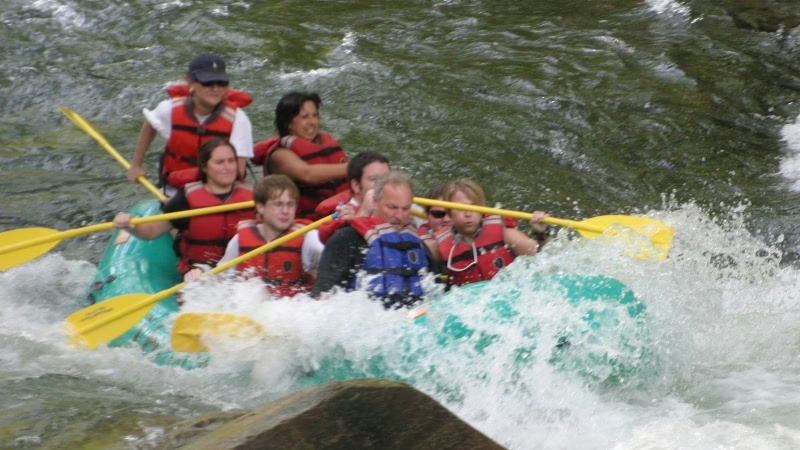
In these types of experiences, a trained facilitator takes you into the woods for an adventure. These events can be anything from a wilderness experience in ecotherapy led by a therapist or counselor to a hunting trip led by a wilderness guide. Kuo & Taylor (2004) demonstrated that therapy and other activities conducted in outdoor settings reduced symptoms of Attention-Deficit Hyperactivity Disorder. Whittington (2006) found that wilderness skills training gave adolescent girls increased self-esteem and self-confidence and helped to shatter gender stereotypes.

Animal-Assisted Therapy

Animal therapy in the form of contact with pets and/or wild or domesticated animals enhances self-actualization and can lessen symptoms of depression. Antonioli & Reveley (2005) found that simply swimming with dolphins can greatly reduce symptoms of depression. Other studies have shown that owning pets, or even just watching fish in an aquarium, can greatly reduce stress. Equine Therapy uses horses to facilitate mental and physical well-being. There are many other ways that animals can help us lead happier lives, as any pet owner can tell you!

Therapeutic Gardens

Sempik & Spurgeon (2006) demonstrated that therapeutic gardening reduces stress and lessens symptoms of depression. Blair (2009) discovered that gardening can be used as a means of helping school children to enhance self-sufficiency, social identity, meaning, and self-integration. There’s just something very healing about planting something and nurturing it as you watch it grow.

Vacations

Berto (2014) discovered that outdoor activities reduce stress and restore energy. If you’ve ever had to miss a vacation, you’re probably painfully aware of the regenerative power of taking a week or so off to spend time in nature. Cole (2012) found that you don’t need a facilitator or guide to enjoy health and well-being benefits from the use of wilderness areas. There’s a reason we’re attracted to beaches and national parks!

Architecture Incorporating Natural Spaces

Nature can be incorporated into the home environment through the use of plants, an aquarium, or even recorded nature sounds. Alvarsson et al (2010) studied the positive mental health effects of listening to nature sounds.

Outdoor Classrooms

Dennis, Wells & Bishop (2014) revealed that outdoor classrooms enhanced many critical factors of the educational experience, including: Enhanced retention, better focus, more attention to detail, less hyperactivity, more relaxation, increased confidence and self-esteem, and better cognitive functioning

Why Mindfulness-Based Ecotherapy?

Mindfulness-based ecotherapy (MBE) enhances traditional ecotherapy by combining the restorative benefits of nature with the self-regulation and awareness skills cultivated through mindfulness practices. Ecotherapy alone has been shown to reduce stress, improve mood, and increase feelings of connectedness to the natural environment (Berto, 2014).

By integrating mindfulness, participants are encouraged to attend fully to present-moment sensory experiences within natural settings, which can deepen emotional processing, reduce rumination, and amplify psychological restoration (Kabat-Zinn, 2003). This combination strengthens the therapeutic impact, particularly for individuals prone to anxiety or depression, by not only providing exposure to nature but also fostering intentional engagement with it. Mindfulness enhances attentional control, allowing participants to notice subtle natural cues, reflect without judgment, and cultivate a sense of grounded presence, thereby making ecotherapy sessions more effective and transformative (Berto, 2014; Kabat-Zinn, 2003).


References

Alvarsson JJ, Wiens S, Nilsson ME. Stress recovery during exposure to nature sound and environmental noise. Int J Environ Res Public Health. 2010 Mar;7(3):1036-46. doi: 10.3390/ijerph7031036. Epub 2010 Mar 11. PMID: 20617017; PMCID: PMC2872309.

Antonioli C, Reveley MA. Randomised controlled trial of animal facilitated therapy with dolphins in the treatment of depression. BMJ. 2005 Nov 26;331(7527):1231. doi: 10.1136/bmj.331.7527.1231. PMID: 16308382; PMCID: PMC1289317.

Berto, R. (2014). The role of nature in coping with psycho-physiological stress: A literature review on restorativeness. Behavioral Sciences, 4(4), 394–409. https://doi.org/10.3390/bs4040394

Blair, D. (2009). The child in the garden: An evaluative review of the benefits of school gardening. Journal of Environmental Education, 40(2), 15–38.

Cole, D. N. (2012). Wilderness visitor experiences: A selective review of 50 years of research. Park Science, 28(3), Winter 2011‑2012. https://www.fs.usda.gov/rm/pubs_other/rmrs_2012_cole_d001.pdf

Dennis, S. F., Wells, A., & Bishop, C. (2014). A post-occupancy study of nature-based outdoor classrooms in early childhood education. Children, Youth and Environments, 24(2). https://doi.org/10.7721/chilyoutenvi.24.2.0035

Fieldhouse J, Sempik J. ‘Gardening without Borders’: Reflections on the Results of a Survey of Practitioners of an ‘Unstructured’ Profession. British Journal of Occupational Therapy. 2007;70(10):449-453. doi:10.1177/030802260707001006

Hölzel BK, Carmody J, Vangel M, Congleton C, Yerramsetti SM, Gard T, Lazar SW. Mindfulness practice leads to increases in regional brain gray matter density. Psychiatry Res. 2011 Jan 30;191(1):36-43. doi: 10.1016/j.pscychresns.2010.08.006. Epub 2010 Nov 10. PMID: 21071182; PMCID: PMC3004979.

Kabat-Zinn, J. (2003). Mindfulness-based interventions in context: Past, present, and future. Clinical Psychology: Science and Practice, 10(2), 144–156. https://doi.org/10.1093/clipsy/bpg016

Taylor AF, Kuo FE. Children with attention deficits concentrate better after walk in the park. J Atten Disord. 2009 Mar;12(5):402-9. doi: 10.1177/1087054708323000. Epub 2008 Aug 25. PMID: 18725656.


Share Your Thoughts!

What do you think? What courses would you like the Mindful Ecotherapy Center to add in the future? Share your thoughts in the comments below! And don’t forget to subscribe to our newsletter!

Posted on

MBE Trifold Brochure

The brochure above contains additional information about the Mindfulness-Based Ecotherapy Program. If you are a certified facilitator of the Mindfulness-Based Ecotherapy program or are interested in becoming one, you may download and print the brochure below to promote your own program. It contains to blank areas for you to include information about your own local program.

Mindfulness-Based Ecotherapy Trifold Brohure

Posted on

Being Mode, Doing Mode and Two Powerful Wolves

being mode

Being Mode is where we make a change in our lives. A key aspect of mindfulness is stepping outside of doing mode and entering into being mode.

being mode

When we’re caught up in thought and feeling cycles that lead to depression and anxiety, we usually feel that we should be doing something to fix it. The problem with this is that sometimes there is nothing you can do to fix a problem. Mindfulness is a way to escape this cycle of trying to fix things by simply focusing on our moment-to-moment experience. When we are doing this, we are in being mode. In being mode, we are not trying to fix anything. We are not trying to go anywhere. We are not trying to do anything. We are not trying, period. Trying is doing, and being mode isn’t about doing.

Being Mode and the Downstairs Brain

In being mode, we are free to enjoy our experiences from moment to moment by focusing on what our senses are telling us, rather than focusing on trying to find a way out of a problem. When the downstairs brain is engaged, and the upstairs brain is temporarily disconnected, moving into being mode allows us a little breathing room.

The way to move from doing mode to being mode is to shift our mental energy from thinking mode to sensing mode. Our brains only have a finite amount of energy to spend on any given task at any given time. If we have a stressful or depressing thought cycle going on, we can shift energy from what our thoughts are telling us by engaging our internal observer to start focusing on what our senses are telling us. As you read this paragraph, can you feel your breath going in and out of your lungs? Were you even aware you were breathing before you read the previous sentence? When caught up in thinking cycles, we’re focusing on the boomerang. But by shifting our attention to our direct experiences and focusing on what our senses are telling us, we’re able to move into sensing mode.

Sensing Mode: The Way to Being Mode

When in sensing mode, we are no longer giving energy to ruminating cycles that are leading us to states that we do not want to experience. We are able to move to sensing mode by focusing first on our breathing, then on our direct experiences of the current situation. We do this by using all of our senses, in the moment, to explore the environment around us. What do we hear? What do we see? What do we smell? What do we taste? What do we feel? By asking ourselves these questions, we are able to move into sensing mode.

Two Wolves: The Being Wolf

The more energy we spend on sensing, the less energy we have to spend on thinking. Based on the tale of two wolves, we could see the two wolves as “thinking wolf” and “sensing wolf.” The more energy you give to the sensing wolf, the less energy you give to the thinking wolf. The less energy the thinking wolf receives, the weaker the thinking wolf becomes. Conversely, the more energy the sensing wolf receives, the stronger the sensing wolf becomes. By shifting from thinking to sensing, you’re not trying to ‘kill’ the thinking wolf. You’re not engaging in doing by trying to make the thinking wolf go away. You’re simply depriving it of energy so that it may eventually go away on its own. Even if it doesn’t go away on its own, you’re not focusing your attention on it. Since your attention isn’t on it, thinking wolf can’t grab you by the throat, refusing to let go.

It could be said that focusing on what your senses are telling you is a type of thinking as well, and that is partially true; however, the difference is that focusing on what your senses are telling you is a type of thinking devoid of emotional content. If you’re in a thinking cycle that is causing you anxiety or depression, then anxiety and depression are emotions. But unless you hate trees for some reason, simply sitting quietly in a forest and observing a tree as if you are an artist about to draw that tree is an exercise devoid of emotional content. By focusing on the emotionally neutral stimuli found in nature, we give ourselves the opportunity to feed the sensing wolf.

Mindfulness-Based Ecotherapy and Being Mode

Mindfulness-based ecotherapy can be a powerful tool for facilitating being mode. By combining mindful awareness with direct engagement in natural environments, this approach gently redirects attention away from the habitual “doing mode,” which is dominated by planning, problem-solving, and ruminating.

Nature’s rhythms, such as the sound of leaves rustling, water flowing, or birds singing, provide sensory anchors that draw the mind into immediate experience. Through guided practices like mindful walking, focused breathing outdoors, or reflective observation of natural phenomena, we learn to notice thoughts and emotions without automatically reacting, creating space for a deeper sense of presence. Over time, repeated experiences of this mindful immersion in the environment can quiet your sympathetic nervous system, lower stress, and cultivate an enduring capacity to remain in being mode even outside of therapeutic sessions.


References

Ilomäki M, Lindblom J, Salmela V, Flykt M, Vänskä M, Salmi J, Tolonen T, Alho K, Punamäki RL, Wikman P. Early life stress is associated with the default mode and fronto-limbic network connectivity among young adults. Front Behav Neurosci. 2022 Sep 23;16:958580. doi: 10.3389/fnbeh.2022.958580. PMID: 36212193; PMCID: PMC9537946.


Share Your Thoughts!

What do you think? Share your thoughts in the comments below! And don’t forget to subscribe to our newsletter!