Table of Contents
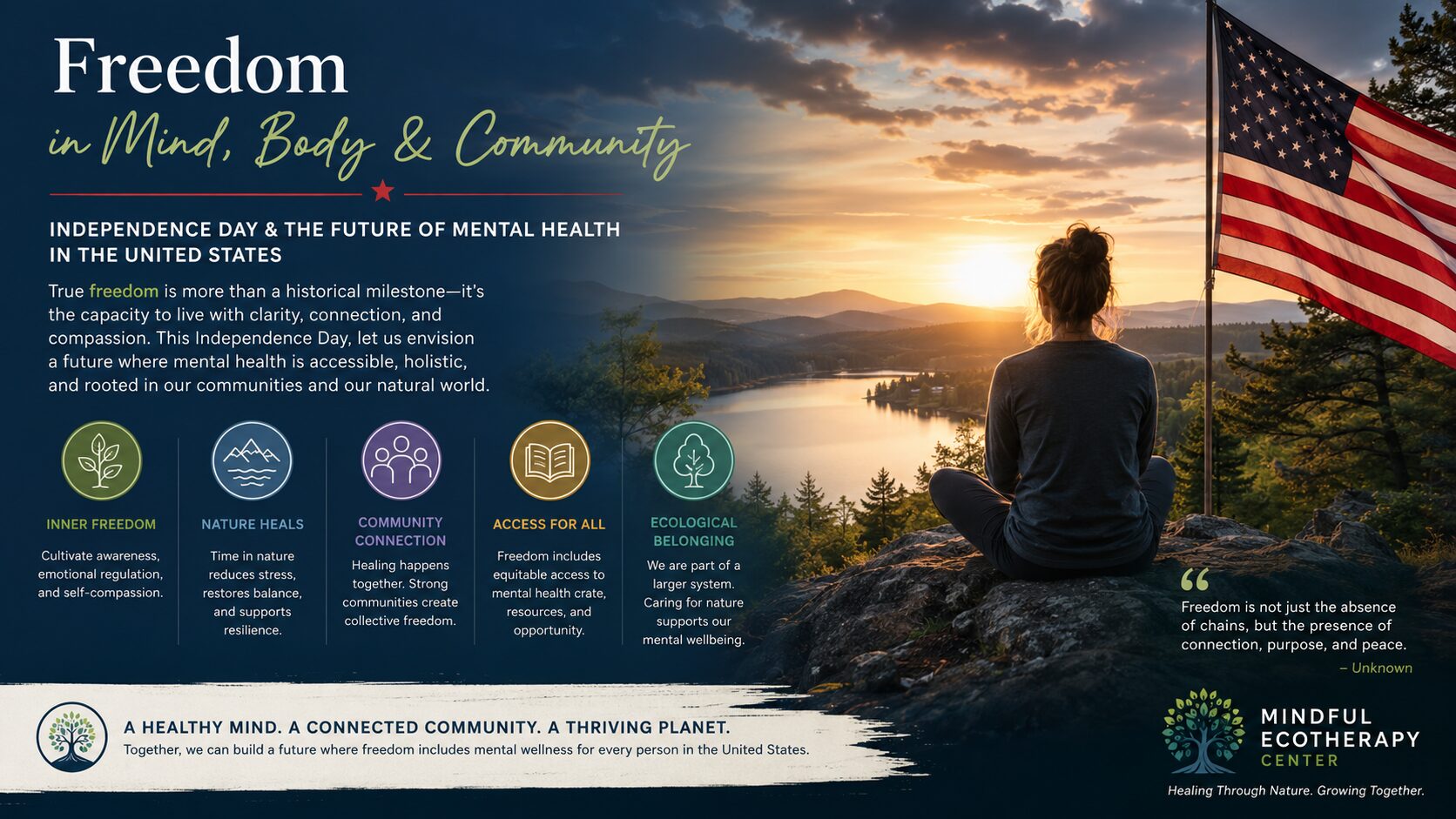
From the perspective of mindfulness-based ecotherapy, liberty is not limited to political history or civic ideals. It also includes psychological, emotional, relational, and ecological dimensions. This Independence Day, I invite you to consider whether you experience freedom only as an external condition or also as an internal state of balance, awareness, and connection.
When mental health is fragile or unsupported, the promise of liberty remains incomplete. A society can declare independence while many individuals still feel trapped in cycles of anxiety, trauma, disconnection, or chronic stress. This tension between outer liberty and inner struggle is one of the defining mental health challenges of modern life in the United States.
Mental Health in the United States: A Freedom Gap
Across the United States, mental health concerns continue to rise. Anxiety, depression, trauma-related conditions, and substance use challenges affect millions of people across all demographics. While awareness of mental health has improved significantly, access to meaningful care remains uneven.
You may notice that liberty in a mental health context is about access, stability, and support. If care is unavailable, unaffordable, or culturally disconnected, then psychological liberty becomes limited in practice.
In this sense, freedom becomes a useful lens for understanding mental health systems. It raises important questions: Are people free to receive care when they need it? Are they free from stigma when they seek help? Are they free from environments that continually reinforce stress and disconnection?
Mindfulness-Based Ecotherapy and the Experience of Freedom
Mindfulness-based ecotherapy offers a way to experience liberty directly, not just conceptually. It integrates mindfulness practices with nature-based engagement, helping you reconnect with your body, emotions, and environment in grounded, restorative ways.
When you spend time in nature with awareness, engaging in activities like feeling your breath, noticing sensory details, and allowing thoughts to come and go without judgment, you begin to regulate the nervous system more naturally. Research has shown that time in natural environments can reduce stress hormones, improve mood, and support cognitive recovery.
In this context, freedom becomes experiential. You are rediscovering it through presence. You are learning to relate to it differently, with more space and less reactivity.
Emotional Freedom and the Inner Landscape
True psychological liberty includes the ability to experience your emotions without being controlled by them. It is not the absence of distress, but the capacity to remain present with it.
You may notice that many mental health struggles are not simply about what you feel, but about how you relate to what you feel. Mindfulness-based ecotherapy encourages you to slow down enough to observe emotional patterns rather than becoming consumed by them.
In this way, freedom includes emotional literacy. It includes the ability to recognize stress responses, to pause before reacting, and to reconnect with grounding sensations in the body and in nature. This kind of internal liberty is essential for long-term mental well-being.
The Future of Mental Health: Toward Integrated Freedom
The future of mental health in the United States is likely to move toward more integrated and holistic approaches. Rather than focusing solely on diagnosis and symptom reduction, emerging models increasingly emphasize prevention, resilience, and whole-person care.
You can already see early signs of this shift in the growing interest in mindfulness, ecotherapy, trauma-informed care, and community-based mental health initiatives. These approaches recognize that mental health is shaped not only by biology but also by environment, relationships, culture, and access to nature.
In this future, freedom becomes more than a personal experience. It becomes a system-level goal. Schools may prioritize emotional regulation alongside academic learning. Workplaces may support psychological sustainability rather than burnout culture. Communities may integrate green spaces and nature-based healing as essential infrastructure, not an optional luxury.
Collective Freedom and Shared Wellbeing
Independence Day also invites reflection on collective mental health. You are not isolated from the systems around you. Your well-being is influenced by your environment, and your well-being also influences others.
When communities are under chronic stress, fragmented by polarization, or lacking access to care, collective liberty is weakened. Mental health becomes not only an individual concern but a shared responsibility.
From an ecotherapy perspective, healing is both personal and ecological. Just as you are part of a social system, you are also part of a natural one. Reconnecting with nature is not just therapeutic—it is a reminder of belonging within something larger than yourself.
Conclusion: Redefining Freedom Through Healing and Awareness
Independence Day can be more than a historical commemoration. It can be a moment of reflection on what freedom truly means in lived experience. Beyond political liberty, there is psychological freedom that encompasses the ability to feel, to heal, to connect, and to live with awareness.
Through mindfulness-based ecotherapy, you are invited to experience liberty not as an abstract ideal, but as something embodied and practiced. It lives in your breath, your nervous system, your relationships, and your connection to the natural world.
The future of mental health in the United States may depend on this broader understanding of freedom that includes not only independence, but interdependence, healing, and ecological belonging.
Share Your Thoughts About Freedom and Mental Health!
What do you think? Share your thoughts in the comments below!
And don’t forget to subscribe to our newsletter!