Posted on Leave a comment

Independence Day as a Reflection of Inner and Outer Freedom

freedom

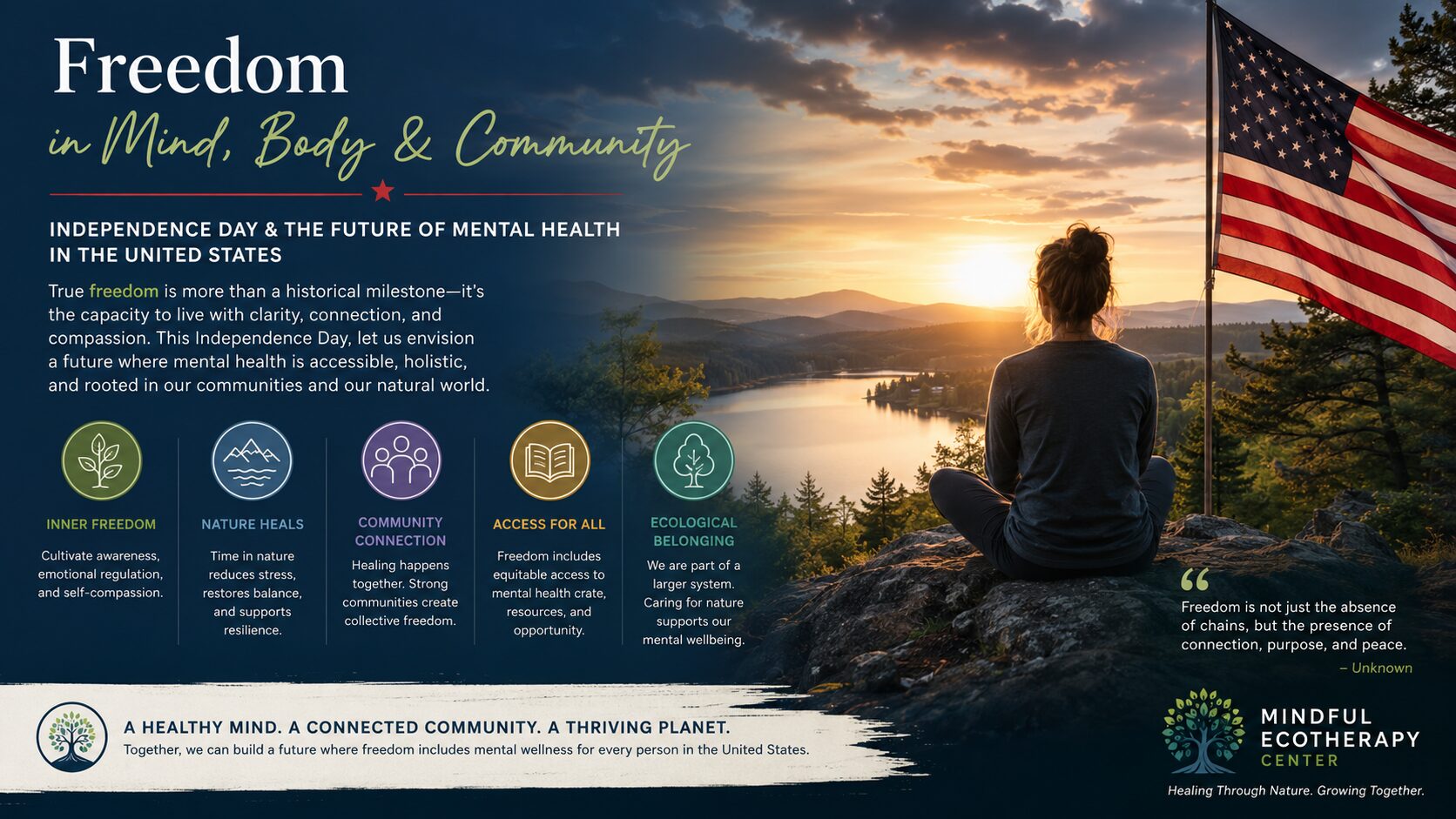
From the perspective of mindfulness-based ecotherapy, liberty is not limited to political history or civic ideals. It also includes psychological, emotional, relational, and ecological dimensions. This Independence Day, I invite you to consider whether you experience freedom only as an external condition or also as an internal state of balance, awareness, and connection.

When mental health is fragile or unsupported, the promise of liberty remains incomplete. A society can declare independence while many individuals still feel trapped in cycles of anxiety, trauma, disconnection, or chronic stress. This tension between outer liberty and inner struggle is one of the defining mental health challenges of modern life in the United States.

Mental Health in the United States: A Freedom Gap

Across the United States, mental health concerns continue to rise. Anxiety, depression, trauma-related conditions, and substance use challenges affect millions of people across all demographics. While awareness of mental health has improved significantly, access to meaningful care remains uneven.

You may notice that liberty in a mental health context is about access, stability, and support. If care is unavailable, unaffordable, or culturally disconnected, then psychological liberty becomes limited in practice.

In this sense, freedom becomes a useful lens for understanding mental health systems. It raises important questions: Are people free to receive care when they need it? Are they free from stigma when they seek help? Are they free from environments that continually reinforce stress and disconnection?

freedom

Mindfulness-Based Ecotherapy and the Experience of Freedom

Mindfulness-based ecotherapy offers a way to experience liberty directly, not just conceptually. It integrates mindfulness practices with nature-based engagement, helping you reconnect with your body, emotions, and environment in grounded, restorative ways.

When you spend time in nature with awareness, engaging in activities like feeling your breath, noticing sensory details, and allowing thoughts to come and go without judgment, you begin to regulate the nervous system more naturally. Research has shown that time in natural environments can reduce stress hormones, improve mood, and support cognitive recovery.

In this context, freedom becomes experiential. You are rediscovering it through presence. You are learning to relate to it differently, with more space and less reactivity.

Emotional Freedom and the Inner Landscape

True psychological liberty includes the ability to experience your emotions without being controlled by them. It is not the absence of distress, but the capacity to remain present with it.

You may notice that many mental health struggles are not simply about what you feel, but about how you relate to what you feel. Mindfulness-based ecotherapy encourages you to slow down enough to observe emotional patterns rather than becoming consumed by them.

In this way, freedom includes emotional literacy. It includes the ability to recognize stress responses, to pause before reacting, and to reconnect with grounding sensations in the body and in nature. This kind of internal liberty is essential for long-term mental well-being.

The Future of Mental Health: Toward Integrated Freedom

The future of mental health in the United States is likely to move toward more integrated and holistic approaches. Rather than focusing solely on diagnosis and symptom reduction, emerging models increasingly emphasize prevention, resilience, and whole-person care.

You can already see early signs of this shift in the growing interest in mindfulness, ecotherapy, trauma-informed care, and community-based mental health initiatives. These approaches recognize that mental health is shaped not only by biology but also by environment, relationships, culture, and access to nature.

In this future, freedom becomes more than a personal experience. It becomes a system-level goal. Schools may prioritize emotional regulation alongside academic learning. Workplaces may support psychological sustainability rather than burnout culture. Communities may integrate green spaces and nature-based healing as essential infrastructure, not an optional luxury.

Collective Freedom and Shared Wellbeing

Independence Day also invites reflection on collective mental health. You are not isolated from the systems around you. Your well-being is influenced by your environment, and your well-being also influences others.

When communities are under chronic stress, fragmented by polarization, or lacking access to care, collective liberty is weakened. Mental health becomes not only an individual concern but a shared responsibility.

From an ecotherapy perspective, healing is both personal and ecological. Just as you are part of a social system, you are also part of a natural one. Reconnecting with nature is not just therapeutic—it is a reminder of belonging within something larger than yourself.

Conclusion: Redefining Freedom Through Healing and Awareness

Independence Day can be more than a historical commemoration. It can be a moment of reflection on what freedom truly means in lived experience. Beyond political liberty, there is psychological freedom that encompasses the ability to feel, to heal, to connect, and to live with awareness.

Through mindfulness-based ecotherapy, you are invited to experience liberty not as an abstract ideal, but as something embodied and practiced. It lives in your breath, your nervous system, your relationships, and your connection to the natural world.

The future of mental health in the United States may depend on this broader understanding of freedom that includes not only independence, but interdependence, healing, and ecological belonging.


Share Your Thoughts About Freedom and Mental Health!

What do you think? Share your thoughts in the comments below!


  And don’t forget to subscribe to our newsletter!
Posted on

Replacing Negative Coping Mechanisms with Nature-Based Mindfulness Practices

negative coping mechanisms

Coping with stress, trauma, or overwhelming emotions can sometimes lead people to adopt harmful habits, such as substance use, overeating, or other compulsive behaviors. While these negative coping mechanisms may provide temporary relief, they often create long-term physical, emotional, and psychological harm. Recovery and behavioral change require replacement strategies that are nurturing, restorative, and sustainable. Mindfulness-based ecotherapy (MBE) offers a powerful solution by integrating mindfulness practices with direct engagement in nature. This approach not only supports emotional regulation but also fosters resilience, self-awareness, and healthy coping skills to replace negative coping mechanisms.

Understanding Negative Coping Mechanisms

Negative coping mechanisms often emerge as a response to stress, grief, trauma, or chronic anxiety. For many people, these behaviors serve as a temporary escape from discomfort, providing immediate, but fleeting relief. Substance use, for example, may numb emotional pain or alleviate anxiety, yet it does not address underlying emotional issues. Over time, reliance on negative coping mechanisms and harmful coping strategies can exacerbate emotional instability, increase dependency, and reduce overall well-being.

Replacing negative coping mechanisms requires interventions that both soothe and empower. Mindfulness-based ecotherapy offers an integrative method for doing just that: it helps people pause, reflect, and engage with their emotions in healthy, constructive ways while reconnecting with the restorative qualities of nature.

Why Nature Matters in Healing

Nature has profound physiological and psychological benefits. Spending time in natural environments reduces stress hormones, lowers heart rate, and calms the nervous system. Sensory-rich experiences can include things like feeling the texture of tree bark, hearing birdsong, and observing sunlight through leaves. These sensory experiences anchor attention in the present moment. This grounding in the here and now is essential for disrupting automatic negative coping mechanisms and retraining the brain to respond in healthier ways.

Nature also provides symbolic guidance. Observing seasonal change, growth, decay, and renewal can inspire people to reflect on their own processes of transformation. Just as a tree sheds leaves in autumn to prepare for new growth, people can release harmful coping patterns and cultivate healthier alternatives.

Mindfulness-Based Ecotherapy Practices

Integrating mindfulness with nature provides practical strategies for replacing negative coping mechanisms:

  1. Mindful Walking – Walking slowly in a park, forest, or along a river encourages attention to the present moment. Focusing on the sensation of each step, breath, and surrounding sights helps people disrupt habitual responses and cultivate intentional behavior.
  2. Nature Observation Meditation – Sitting quietly and observing natural patterns, such as flowing water, rustling leaves, or cloud formations, enhances attention and emotional regulation. People learn to notice thoughts and urges without judgment, reducing the impulse to resort to negative coping strategies.
  3. Reflective Journaling Outdoors – Writing about stressors, cravings, or emotional triggers in a natural setting helps people externalize difficult emotions and process them constructively. Journaling strengthens self-awareness and reinforces positive coping alternatives.
  4. Sensory Grounding Exercises – Engaging touch, sight, hearing, and smell in nature anchors people in the present moment. Touching soil, feeling the wind, or listening to natural sounds can replace harmful behaviors with calming, grounding sensations.
  5. Rituals and Creative Expression – Activities like planting trees, creating natural art, or tending a garden provide symbolic and tangible acts of renewal. These rituals reinforce intention, provide a sense of accomplishment, and activate reward pathways in the brain in positive ways.

Benefits of Nature-Based Mindfulness in Recovery

Replacing negative coping mechanisms with nature-based mindfulness offers numerous benefits:

  • Stress Reduction – Nature engagement reduces physiological stress responses, lowering the likelihood of reverting to harmful habits.
  • Emotional Regulation – Mindfulness helps people observe cravings and emotions without reacting impulsively, fostering self-control and resilience.
  • Cognitive Rewiring – Repeated mindfulness practice in nature strengthens neural pathways associated with healthy coping and executive functioning.
  • Self-Compassion – Nature and mindfulness together cultivate nonjudgmental awareness, allowing people to treat themselves with care and patience during recovery.
  • Connection and Meaning – Spending time in nature nurtures a sense of belonging and interconnectedness, countering isolation and enhancing well-being.

Practical Steps for Incorporating Nature-Based Mindfulness

  1. Start Small – Even ten minutes of mindful nature observation daily can create meaningful changes in coping habits.
  2. Create a Routine – Consistency reinforces new habits and strengthens brain pathways associated with healthy coping.
  3. Engage the Senses – Fully immerse in the environment, paying attention to tactile, visual, auditory, and olfactory experiences.
  4. Reflect and Journal – Record observations, emotions, and progress to track patterns and insights over time.
  5. Combine with Support Systems – Pair MBE practices with therapy, support groups, or medical guidance for comprehensive recovery support.

Conclusion

Negative coping mechanisms may offer temporary relief, but they ultimately undermine long-term well-being. Mindfulness-based ecotherapy provides a sustainable, restorative alternative by combining the grounding, calming influence of nature with mindful awareness of thoughts, emotions, and behaviors. By engaging in practices such as mindful walking, nature observation, journaling, and ritualized activities, people can replace harmful habits with positive coping strategies that support emotional regulation, resilience, and holistic health.

At the Mindful Ecotherapy Center, we encourage people seeking to break free from negative coping patterns to explore nature-based mindfulness practices as a central component of their healing journey. By connecting deeply with the natural world and cultivating present-moment awareness, people can develop healthier responses to stress, navigate cravings, and foster a more balanced, empowered, and meaningful life. Nature is not only a sanctuary for reflection—it is a partner in transformation and recovery.


The Mindful Ecotherapy Center on YouTube

Subscribe to the Mindful Ecotherapy Center’s YouTube channel to bring peace, presence, and healing into your daily life. Our videos guide you through mindfulness-based ecotherapy practices, including forest bathing, tree planting rituals, nature meditations, and reflective exercises for grief, stress, and emotional well-being. Whether you’re seeking to reconnect with the natural world, cultivate inner calm, or find restorative tools for personal growth, our content offers practical guidance, inspiration, and community support. Join us to explore the transformative power of nature and mindfulness, and start your journey toward balance, resilience, and deeper connection today!


Share Your Thoughts!

What do you think? Share your thoughts in the comments below! And don’t forget to subscribe to our newsletter!