Posted on

Meme Triads

Contrary to popular belief, a ‘meme’ is not an internet picture with words on it. A meme is just a belief that has been passed from one person to another. We get most of our core memes from our families of origin.

If your memes (inherited beliefs) are leading to consequences you want, then nothing needs to be changed. If, however, you have memes that are leading to consequences you don’t want, you have a choice. You can change them to something more conducive to positive consequences.

The first step in changing a meme is to examine the components of the meme. There are three basic components to a meme: What, Why and How. The explanation of these components is as follows:

  1. What is the problem? The ‘What’ component is usually the meme that is causing the problem.
  2. Why is this a problem? The ‘Why’ component of the meme indicates why the meme is leading to consequences you don’t want.
  3. How is the problem maintained? Sometimes the attempted solution to a problem only serves to make the problem worse.
    If I believe my spouse must be responsible for my happiness, but my spouse has grown tired of being responsible for my happiness, I might try to solve the problem by insisting even more that my spouse be responsible for my happiness. I might even resort to blaming, shaming, and guilt-tripping my spouse in an attempt to get her to resume responsibility for my happiness. But the more I try to force her into taking that responsibility, the more tired she gets of being responsible for it. My attempted solution to the problem is only serving to make the problem worse. It’s been said that, “Insanity is doing the same thing in the same way and expecting different results.” If what you’re doing to solve the problem isn’t working, then doing more of it isn’t going to work either.

The first step in changing a non-productive meme into a productive meme that generates positive consequences is to identify the components of the meme using the outline above.

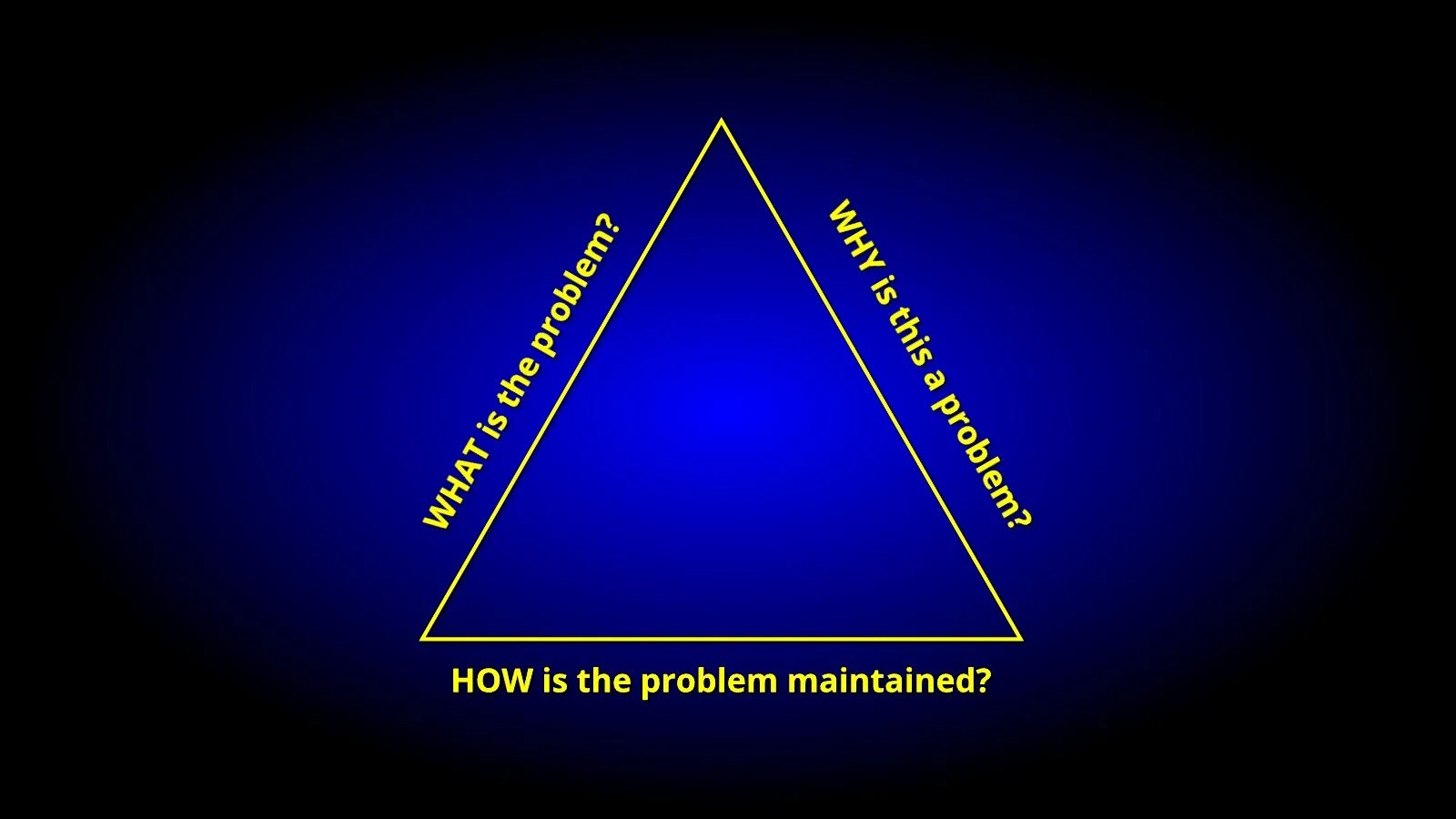
Once you’ve identified the components of the meme, picture them as legs or sides of a triangle. Triangles have three sides. All three of those sides are connected to each other. If you take away one of the sides of a triangle, it is no longer a triangle. Furthermore, since all the sides of a triangle are connected to each other, if you change one side, the other two sides must change as well.

Memes have a similar construction. Looking at the What, Why and How components of a meme, we can see that if one side is changed, all of the other sides are changed as well. Furthermore, since all three components are necessary in order for a meme to exist, if one component is taken away, the meme ceases to exist.

Since there are three sides to a triangle, and three components to a meme, a triangle can be constructed with one component of the meme on each side. One side of the triangle would be the ‘What’ component, another side would be the ‘Why’ component, and the base of the triangle would be the ‘How’ component.

Once a meme is graphed out in this fashion, then taking away one of the sides means that it is no longer a triangle. So if one of the components is altered or removed, it eliminates the meme altogether or completely changes it.
Changing one of the sides changes the two remaining sides, and therefore the meme is changed as well. So if you have a meme that is leading you to consequences you do not want, and you graph that meme out on a triangle, you have three separate chances to change the meme. You may change the ‘What’ component, or the ‘Why’ component, or the ‘How’ component. By changing any one of these components, the other components change as well, and the meme is altered. When the meme is altered, the consequences of acting on the meme are altered as well.

This may sound confusing at first, but over the coming weeks we’ll go over it in more detail. With more practice it will start to make more sense.


Posted on

Memes are A Category of Belief

Sometimes our beliefs lead us to consequences we don’t want to experience. The way to change those beliefs is to dispute the beliefs you have that are leading you to consequences you don’t want to experience. When you’ve experienced a negative consequence in your life, examine and challenge the beliefs you hold that led you to act in such a way that you got consequences you didn’t want.

Note that this act of disputing the belief is a process of trial and error. Changing a belief is no guarantee of getting a better consequence. But it is certain that if we don’t change the belief, we will continue to get the same negative consequence. Making a change isn’t an automatic recipe for success.

We can, however, make educated guesses as to how we might change our beliefs in order to get the consequences we do want. Once we’ve found a belief that might lead to a consequence we do want, we troubleshoot it before implementing it by asking what sort of things might go wrong if we change our beliefs. By making a plan to cover any potential misfires, there’s a greater chance that the changed belief will work to change the consequences to something more to our liking.

There is a special category of beliefs called memes. ‘Meme’ comes from the Greek word mīmēma, which means “imitated thing.” Memes are to ideas as genes are to physical characteristics like hair color, height, and eye color. A meme is an idea, belief or behavior that is passed from one person to another.

We get many of our earliest memes from our parents and our family. Later on we may pick up memes from our friends, our teachers, and our culture and society. Taken together, our memes make up our belief system and the way we deal with others.

If English is your native language, you probably learned it from your family. If you had been raised in a family that only spoke Spanish, then Spanish would be your native language. Your language was handed down to you from the people who raised you. You learned the language though a process of imitation by repeating the sounds you heard.

The people who raised you taught you your native spoken language. But there is also another language they taught you: Your emotional language. Your emotional language is the language you use to deal with relationships. The language you use to express emotions is made up of memes you inherited from your parents, guardians, or other loved ones in your life.

The vast majority of memes that we inherit are good and productive memes. They help us to function in our daily lives. But sometimes the memes we inherit lead to consequences we don’t want. For example, if I have a meme that says that my spouse must make me happy, and my spouse is okay with that, then there are no negative consequences.

But what happens if my spouse gets tired of bearing the burden of carrying my happiness for me? In such a case, if my belief, or meme, is that my spouse must make me happy, and my spouse has grown tired of trying to make me happy, then the consequence will be that I cannot be happy unless I learn to be responsible for my own happiness.

If that is the case, then I need to change the meme, “My spouse must be responsible for my happiness” to something more productive, along the lines of, “I must learn to be responsible for my own happiness.”

Meme Triads are a way to change beliefs. Next time we’ll talk about the components of a meme and how to use meme triads to change our less productive beliefs.

Posted on

Setting Boundaries: 7 Key Phrases to Use

boundaries connecting

You may download the worksheet using the button below.

The way to deal with conflict in positive ways is to realize that you are not responsible for anyone’s feelings but your own. If you avoid conflict out of a fear of upsetting others, first ask yourself why you think they would be upset.

boundaries - how to set healthy ones

Worrying about the emotional reactions others might have in a given situation is usually a sign of poor boundaries with the other person. Either they routinely cross your boundaries, or you routinely cross theirs, and when this happens, the result is usually conflict. Conflict is the root of most emotional aggression. The way to solve this problem is to establish good boundaries in all of your relationships. A sign of poor boundaries is the belief that another can be responsible for your emotional well-being, or that you can be responsible for another’s emotional well-being.

Do You Have Poor Boundaries?

A good rule of thumb when establishing boundaries is to ask yourself, “Am I being asked to do something that I wouldn’t ask (the other person) to do?” If the answer is ‘yes,’ then there’s probably an issue of poor boundaries in the relationship. Here are some signs that you may have poor boundaries with others:

  • Conversations on emotional topics result in anxiety and discomfort
  • You avoid conflict until things build up, then you explode
  • You feel responsible for other people’s feelings
  • You’re afraid to say ‘no’
  • You feel guilty when you do say ‘no’
  • You rarely speak up for yourself because you fear it may lead to conflict
  • You sometimes feel disrespected if you do stand up for yourself
  • You feel that you’re constantly giving and never getting back
  • Others ask you to do things for them that you would never ask them to do for you

If you answered “yes” to more than half of the items above, then you probably have poor boundaries.

Why It’s Important

Why is it important to set boundaries? If we have poor boundaries, we begin to feel responsible for the emotional well-being of others. We may also expect others to be responsible for our emotional well-being. By learning to set healthy boundaries, we minimize frustration, guilt, and anxiety for both ourselves and others. Healthy boundaries keep others from manipulating us, and help us to avoid the temptation to manipulate others.

7 Key Boundary-Setting Phrases

Here are some statements that you may use in your relationship with others to help you practice setting good and healthy boundaries. Use these statements when you feel that one of your boundaries has been crossed, or is about to be crossed:

  • “I care about you, but I cannot be responsible for your problems.”
  • “I care about you, but right now I need time to be alone.”
  • “I will not be the object of your hostility.”
  • “Just because I disagree with you, that doesn’t mean I don’t still care about you.”
  • “I enjoy spending time with you, but today I have other plans.”
  • “I don’t allow others to make me feel guilty about myself.”
  • “Even though I disagree with you, I still respect your right to feel the way you feel.”

Core Issues and Compromise Issues

In any relationship, there are core issues, and there are issues that can be compromised upon. A core issue is one in which there can be no compromise. Refusing to accept physical or verbal abuse would be an example of a core issue. It would be ridiculous for an abuser to offer a compromise of, “I’ll only physically abuse you on Tuesdays.” Physical abuse is an issue that is not open to compromise. It is therefore a core issue. Other examples of core issues might include drug abuse, marital infidelity, and verbal or emotional abuse.

A compromise issue, on the other hand, is an issue that you are willing to compromise on. An example of a compromise issue might be the question of where to have lunch with a friend or family member. You might have a lunch preference, but the choice is something that you would be willing to compromise on to some extent.

The way to distinguish a core issue from a compromise issue is that in order to compromise on a core issue, you would have to give up who you are. In other words, you would have to change your core identity. You can set a healthy boundary by refusing to compromise on your core values and your core identity. In mindfulness, we call this core identity your True Self.

Healthy Boundaries

People who lack clear limits often feel used, disrespected, and walked on. It’s easier to establish firm limits at the start of a relationship and then relax them over time than it is to strengthen weak ones. If you catch yourself saying, “I’ll do this just this one time…,” it’s a sign you need to reinforce your personal limits.

You cannot force anyone else to take responsibility for your happiness, and you cannot take responsibility for someone else’s emotional well-being. By setting and maintaining healthy limits, you make life easier for both yourself and those around you.


Share Your Thoughts!

What do you think about setting healthy boundaries? Share your thoughts in the comments below! And don’t forget to subscribe to our newsletter!

Posted on

Emotional Regulation

Emotional Regulation

Successful mood management comes from successful emotional regulation. Emotional regulation means recognizing patterns of emotional aggression and stopping the cycle of emotional aggression before it starts. This means becoming aware of and attuned to your own cycles of emotions.

Before you can become attuned to your own cycles of emotional behavior, you must first be able to identify your emotions.

Society often teaches us that there are acceptable emotions to display in public, and unacceptable emotions to display in public. Those emotions that we feel safe displaying are our secondary emotions. In situations where people tend to become emotionally aggressive, there are underlying emotions driving these secondary emotions.

These underlying emotions, called primary emotions, are emotions that we do not feel safe displaying or discussing in public. If we suppress these primary emotions for long enough, it is possible that we may eventually forget what these emotions are and what they feel like. When this happens, the first step to emotional regulation is to identify these lost emotions.

By using the mindful skills of observing and describing, you can distract yourself from drowning in unpleasant emotions by simply identifying the emotions and describing their characteristics to yourself. As you step outside of the stream of feeling by distracting yourself with the process of observing and describing, it may help to name these emotions to yourself.

For example, if you’re feeling angry, repeat to yourself, “That’s anger.” As you begin to ponder this emotional state, trace it back to its origin. Are there any primary emotions driving the anger? Could it be that you are angry because you fear losing someone or something? Are you angry because of a fear of being inadequate in some area of your life? Are you angry because you are frustrated at a personal failure? The feeling behind the secondary emotion is the primary emotion.

Ruminating Cycles and Emotional Regulation

As you use your skills of observing and describing, you will not only be distracting yourself from fully experiencing the negative aspects of the mood. You will also be exploring the primary roots of the secondary emotion being experienced. As you observe and describe your emotional states to yourself, you become more emotionally aware of their origins. The more aware you are about the origins of those emotions, the more you are able to choose which emotions to give your full attention, and which emotions to let go.

A ruminating cycle is a cycle of thought or emotion. There are positive ruminating cycles and negative ruminating cycles. Such cycles consist of the self-talk we engage in as we go about our daily business.

Let’s look at a couple of scenarios involving ruminating cycles. These cycles are from Joe and Jim. Joe’s negative ruminating cycle might look like this:

“My wife just frowned at me. I wonder what she’s upset about?”
“What have I done wrong this time?”
“Can’t I ever do anything right?”
“Why is it so hard to please her?”
“Maybe I should just divorce her and get it over with. She’s never happy.”
“I’ll show her! I’ll give her the silent treatment!”

Jim’s positive ruminating cycle might look like this:

“My wife just frowned. I wonder if she’s upset?”
“Maybe she’s just having a bad day.”
“I wonder if there’s anything I can do to help?”
“I’m happy that she trusts me enough to share her innermost feelings with me!”

Joe’s negative ruminating cycle assumes that his wife’s frown was personal in that Joe believes that his wife was frowning at him. Jim, on the other hand, simply noted that his wife had frowned, without assuming that the frown was directed at him personally. Joe also assumed that his wife’s frown was indicative of a pervasive problem: That Joe cannot ever do anything to please his wife. Jim, on the other hand, recognized that this was just one incident, and not a pervasive problem. His response to his wife’s frown was, “Maybe she’s just having a bad day.”

Finally, Joe’s ruminating cycle assumes a permanent problem: That Joe can’t “ever do anything right,” while Jim doesn’t see it as a permanent problem. He’s even willing to try to change the situation by wondering if there is anything he can do to help his wife.

Try this: The next time you find yourself in a ruminating cycle, whether it is a positive cycle or a negative cycle, begin talking out loud. Verbalize your thought and feeling patterns by observing and describing them. Look for any permanent, personal or pervasive patterns of thinking and feeling.

Be on the lookout for all-or-nothing thinking. You can usually identify such patterns of thought by looking for words like always and never. The good news about thoughts like, “Things have always been this way,” and “Things are never going to change,” is that you only need one example to disprove them. If Joe has ever done a single thing to please his wife, then he cannot say, “I can never do anything to please her.”

If Joe can find just one example of where things have gone well, then he can’t say, “I always do the wrong thing.” He might do the wrong thing 99,999 times, but if there’s even one case in which he did the right thing, then he is not justified in saying, “I always do the wrong thing.”

If Joe can think of a single time when he was able to do the right thing, then it means that it is possible to do the right thing. If it is possible to do the right thing once, it is possible to do the right thing again. All that remains is figuring out what made it possible, and repeating the conditions that made it possible.

The key point to remember about ruminating cycles is that they are self-reinforcing. Emotions like to hang around once they’ve shown up. Research has shown that once a ruminating cycle of emotional aggression gets started, we tend to act, think, and feel in ways that perpetuate the cycle. We’re conditioned to believe that when we have strong emotions, we must immediately act upon them.

Mindfulness-Based Ecotherapy teaches us that we do not have to act on those emotions, and we don’t have to dwell on them. We can simply observe and describe those emotions without feeling the need to react or respond.

It may help to remember that there is no such thing as a ‘good’ or ‘bad’ feeling. What may be considered ‘good’ or ‘bad’ is the behavior that comes after the feeling. So the problem is in the behavior, not the feeling itself. One of the behaviors that can be labeled as ‘good’ or ‘bad,’ or ‘positive’ or ‘negative,’ is the ruminating cycle itself.

It works in this way: You have a negative feeling (anger, hostility, sadness, etc.). You then activate a ruminating cycle by continuing to dwell on the feeling. As you continue to dwell on the feeling, the negative emotion feeds off of the ruminating cycle and the emotion causes you to become more and more emotionally aroused, until you act out with emotional aggression.

You can change this behavior in this way: When you note a negative emotion, simply observe it and describe it, while recognizing that you do not have to dwell on it. The feeling itself is not ‘good’ or ‘bad.’ It simply is. You can decide not to give it power over you by disengaging from the ruminating cycle. In doing so, you don’t feed the negative emotion, and it eventually subsides.

When you have mastered this, you will be well on the way to managing your moods.