Posted on Leave a comment

Masculinity, Disconnection, and the Modern Emotional Landscape

masculinity for a new age

Masculinity is a living, evolving experience shaped by culture, family systems, personal history, and the environments you move through. In this time of rapid social and ecological change, many of the older narratives about manhood no longer fit the complexity of modern life. For some people, this creates confusion, tension, or emotional strain. For others, it opens a meaningful opportunity to reconsider what manliness can become when it is grounded in awareness, embodiment, and connection to the natural world. Mindfulness-based ecotherapy offers a way to support that shift by helping you experience male identity not as a performance or role, but as something that naturally emerges through presence and relationship with life itself.

Many of the challenges associated with masculinity today are less about masculine identity itself and more about disconnection. When emotional expression is discouraged, and inner experience is pushed aside in favor of performance or self-reliance, you can gradually become separated from your own emotional signals, from others, and from the natural world. Over time, this disconnection can show up as emotional shutdown, difficulty in relationships, chronic stress, or a sense of isolation that is hard to name. From a mindfulness-based ecotherapy perspective, these patterns are adaptive responses to environments that often fail to support emotional integration and embodied awareness. What is often labeled as a “problem with masculinity” is more accurately a reflection of unmet relational and ecological needs.

Nature and Masculinity
masculinity can be nurturing
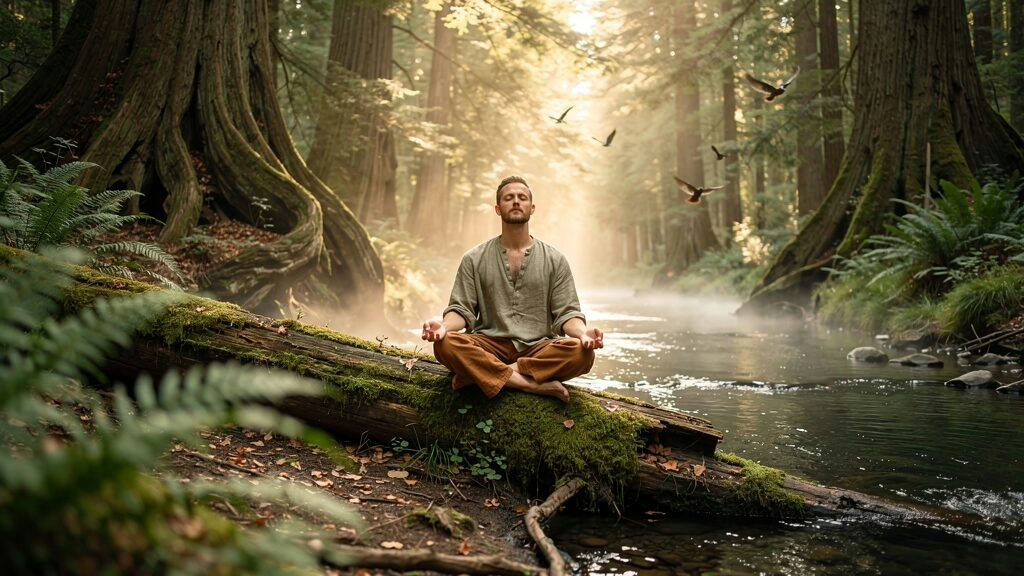
Masculinity can be nurturing

Nature provides a direct and nonjudgmental context for rethinking masculine expression in healthier ways. When you spend time in natural environments with mindful attention, you begin to notice that strength and softness are not opposites in the natural world. A river can be both powerful and yielding, a tree can be both rooted and flexible, and a mountain can be both enduring and shaped by time. These qualities are not in conflict; they coexist. Through this lived experience, masculinity begins to shift away from rigidity and toward integration. Strength becomes steadiness rather than control, emotional awareness becomes clarity rather than weakness, and vulnerability becomes a form of openness rather than threat. In this way, nature does not teach through concepts, but through direct experience of balance and interconnection.

Mindfulness-based ecotherapy also supports emotional reconnection by helping you slow down enough to notice what is actually happening within your body and mind without judgment. In natural settings, attention naturally returns to breath, sensation, and the present moment. Emotional states can be experienced as passing patterns rather than fixed identities, which allows for greater flexibility and self-understanding. This process is especially important in redefining masculine presence because it shifts identity away from performance and toward awareness. As you continue this practice, you may begin to notice that emotional regulation becomes more accessible, not through suppression, but through acceptance and grounded presence in the body.

Re-Imagining Male Identity

Over time, masculine energy can also be reimagined as something that exists in relationships rather than in isolation. Traditional cultural models of masculinity often emphasize independence and self-reliance in ways that can unintentionally limit connection. Ecotherapy expands this framework by helping you experience yourself in ongoing relationships with your body, with other people, and with the natural world. When these relationships are restored, masculinity becomes less about defending identity and more about participating fully in life with awareness and responsiveness. You are no longer separate from your environment, but an active part of a larger living system.

Masculinity and Healing

Healing in this context is not only psychological but also embodied. Many of the emotional patterns associated with masculine nature are held in the body as tension, stress, or habitual guarding. Mindfulness-based ecotherapy helps bring awareness back into the body through sensory engagement with natural environments. Walking on uneven ground, noticing wind against skin, listening to water, or simply observing light shifting through trees all help reestablish a sense of grounding. As the body relaxes and reorients to natural rhythms, emotional rigidity often softens, making space for a more flexible and integrated experience of masculinity.

In this way, masculinity can be redefined for a new ecological age as something that includes strength without suppression, awareness without detachment, and connection without dependency. It becomes less about performing a role and more about inhabiting a way of being that is responsive, grounded, and alive to the present moment. Mindfulness-based ecotherapy does not ask you to abandon masculine qualities, but to deepen them by restoring connection to yourself, to others, and to the living world around you.


Share Your Thoughts About Modern Masculinity!

What do you think? Share your thoughts in the comments below!


  And don’t forget to subscribe to our newsletter!

Posted on

After a Disaster: Flood Recovery Resource Kit

after a disaster

When flooding hits, it doesn’t ask whether you were ready. It doesn’t check your calendar. It shows up, does damage, and leaves you to sort through what’s left. The recent flooding across Washington State has been exactly that kind of natural disaster—sudden, destabilizing, and deeply disruptive to entire communities.

At the Mindful Ecotherapy Center, PLLC, we work with people every day who are carrying an invisible weight. After a disaster, that weight multiplies. News coverage tends to focus on water levels, property losses, and infrastructure damage. What gets less attention is the emotional aftermath: shock, exhaustion, grief, anxiety, irritability, numbness, and the quiet fear that things may never feel stable again.

After a Disaster – Flood Recovery Resource Kit

We created the After a Disaster – Flood Recovery Resource Kit because telling people to “take care of themselves” after a flood is not sufficient support. It’s a vague suggestion offered when people are already overwhelmed. This kit is our way of offering something tangible, practical, and grounded to the local community during a time when clarity is in short supply.

The kit is completely free. That part is intentional. During a natural disaster, access matters. People are already dealing with insurance claims, temporary housing, disrupted work schedules, and the emotional toll of uncertainty. Support should not come with barriers or price tags attached. Making this resource freely available is one way we show up for our community beyond words.

Practical, Real-Life Help

The After a Disaster – Flood Recovery Resource Kit is designed for use in real-life situations. It meets people where they are. The worksheets and practices inside are meant to be used quickly, imperfectly, and revisited as needed. There is no expectation that you complete everything or do it “right.” Partial answers count. Skipping sections that feel overwhelming is not failure; it’s self-regulation.

This kit draws directly from mindfulness-based ecotherapy principles. That means it recognizes that healing after a natural disaster happens on multiple levels at once. The nervous system needs stabilization. The mind needs tools to manage intrusive thoughts and emotional swings. The body needs grounding. And connection, to the natural world and to other people, needs to be restored after it has been disrupted.

Recovery is Not Linear

Flooding can permanently alter someone’s relationship with their environment. Nature, which once may have felt neutral or even calming, can suddenly feel threatening. Land that once felt stable may feel unreliable. The kit gently supports rebuilding a sense of safety with the environment rather than avoiding it entirely. Mindful awareness of surroundings, sensory grounding, and nature-based practices are woven throughout because the environment can also be part of recovery.

The resource kit also acknowledges something that doesn’t get said out loud often enough: emotional reactions after a natural disaster are not linear, predictable, or tidy. People may feel “fine” one moment and completely depleted the next. Anger, guilt, grief, and relief can coexist in uncomfortable ways. The kit offers structured reflection and emotional check-ins that help people name what they’re experiencing without getting stuck in it.

Reconnecting to Community After a Disaster

Community connection is another core focus. Flooding often isolates people at the exact moment they need support most. Displacement, damaged roads, and disrupted routines can quietly erode social contact. The kit includes guidance for rebuilding connection, asking for help without shame, and engaging in collective healing efforts that honor both emotional experience and environmental impact.

This is not therapy in a box, and it’s not meant to replace professional care when that’s needed. It is a bridge. A stabilizing support offered during the window when people are most vulnerable and least resourced. It reflects the Mindful Ecotherapy Center’s belief that mental health support should be responsive, compassionate, and grounded in real-world conditions, especially during a natural disaster where help may be hard to access.

Supporting Our Community

Offering the After a Disaster – Flood Recovery Resource Kit is one way we extend care beyond our office walls and into the community. It’s our way of saying: you are not expected to hold this alone, and your emotional recovery matters just as much as the physical rebuilding.

The kit is available now as a free download through the Mindful Ecotherapy Center: https://www.mindfulecotherapy.org

If the flood has left you feeling unsteady, overwhelmed, or disconnected, this resource was created with you in mind.


Share Your Thoughts on the Washington Floods!

What do you think? Have you experienced difficulties due to the recent flooding? Do you have any resources for victims of this or other natural disasters? Share your thoughts in the comments below! And don’t forget to subscribe to our newsletter!