Table of Contents
Is CBT always a good fit for trauma recovery? Cognitive Behavioral Therapy (CBT) is one of the most widely researched and commonly used therapeutic approaches in modern mental health care. It has strong empirical support for conditions such as depression, anxiety, and certain behavioral challenges. However, when it comes to trauma recovery, the question is more nuanced: Is CBT always the best option?
The short answer is “no.” While CBT can be highly effective for many, it is not universally the most appropriate or sufficient approach for every trauma survivor. Understanding its strengths and limitations can help survivors and their clinicians make more informed, compassionate choices in the healing process.
At the Mindful Ecotherapy Center, we emphasize that trauma recovery is not a one-size-fits-all process. Different people require different pathways to healing, and sometimes those pathways must extend beyond traditional cognitive models.
CBT and Trauma Recovery: Strengths and Foundations
CBT focuses on the relationship between thoughts, emotions, and behaviors. In trauma recovery, CBT-based approaches often help identify distorted thinking patterns, challenge unhelpful beliefs, and develop coping strategies for managing distress.
For many people, this structured approach provides clarity and stability. Trauma can disrupt cognitive processing, and CBT offers tools to help individuals regain a sense of control over intrusive thoughts, anxiety, and avoidance behaviors.
In trauma recovery, CBT techniques may include:
- Cognitive restructuring to address guilt or shame
- Exposure-based interventions to reduce avoidance
- Skills training for emotional regulation
- Behavioral activation to counter withdrawal and depression
These methods can be highly effective, particularly for those with PTSD or trauma-related anxiety symptoms.
Trauma Recovery and the Limits of CBT
Despite its strengths, CBT has limitations when applied to trauma recovery, especially in cases involving complex trauma (CPTSD) or developmental trauma.
One key limitation is that CBT primarily focuses on cognition. These are the thought patterns and beliefs related to trauma. However, trauma is not only a cognitive experience. It is also deeply embodied, relational, emotional, and physiological.
Many trauma survivors experience:
- Somatic symptoms (body-based distress)
- Emotional dysregulation
- Dissociation
- Attachment wounds
- Non-verbal or pre-verbal trauma memories
In these cases, focusing primarily on thoughts may not fully address the depth of the trauma response.
Some may even find that early CBT work feels overwhelming if it encourages direct engagement with traumatic memories before sufficient emotional regulation skills are developed.
Trauma Recovery Beyond Cognitive Models
In trauma recovery, healing often requires approaches that integrate the body, emotions, relationships, and environment, and not just cognition.
This is where integrative and experiential therapies become important. Approaches such as somatic therapy, internal parts work, expressive arts therapy, and mindfulness-based approaches can complement or extend beyond CBT.
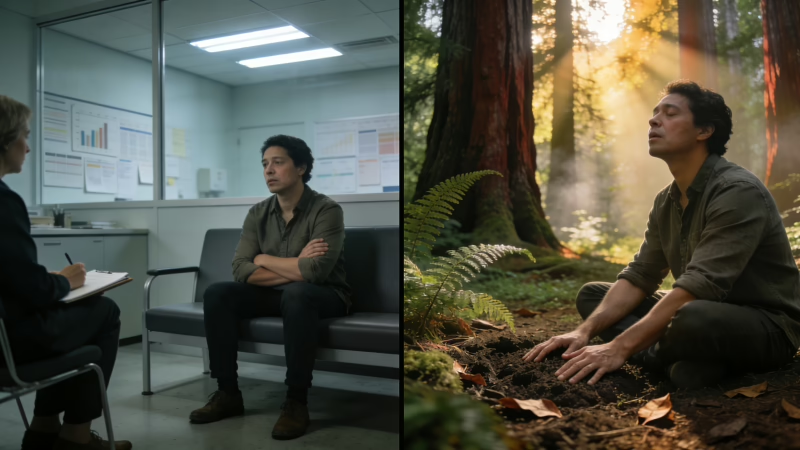
Mindfulness-Based Ecotherapy, for example, integrates nature-based practices with mindfulness to help people reconnect with their bodies and surroundings in a safe and grounding way. Nature itself can provide a non-threatening environment for emotional regulation and reflection, which is often essential in early trauma recovery.
Rather than analyzing thoughts alone, these approaches encourage awareness of present-moment experience, bodily sensations, and emotional states without judgment.
Trauma Recovery and the Nervous System
Another important consideration in trauma recovery is the role of the nervous system.
Trauma is increasingly understood as a dysregulation of the autonomic nervous system rather than solely a cognitive issue. Survivors may oscillate between hyperarousal (anxiety, panic, anger) and hypoarousal (numbness, dissociation, shutdown).
CBT can help with cognitive reframing, but it may not fully address nervous system regulation on its own. Many people benefit from interventions that directly target physiological regulation, such as:
- Breathwork and grounding techniques
- Somatic experiencing
- Mindfulness practices
- Movement and body-based awareness
- Nature immersion and ecotherapy
These approaches can help create a sense of safety in the body, which is foundational for deeper psychological healing.
Trauma Recovery as a Multi-Modal Process
Rather than asking whether CBT is “the best” option, it may be more accurate to ask: “What combination of approaches best supports my trauma recovery?”
For some people, CBT alone may be sufficient. For others, CBT may be most effective when combined with other modalities that address emotional, somatic, and relational dimensions of trauma.
A flexible, integrative model of care recognizes that trauma recovery is not linear. It unfolds in stages and often requires different tools at different times.
The Role of Mindfulness-Based Ecotherapy in Trauma Recovery
Mindfulness-Based Ecotherapy offers a complementary framework that emphasizes presence, awareness, and connection with the natural world. In trauma recovery, this approach can help individuals:
- Re-establish a sense of safety in the present moment
- Reduce hypervigilance through grounding in nature
- Develop non-judgmental awareness of thoughts and emotions
- Reconnect with sensory experience and embodiment
- Build resilience through gentle exposure to natural environments
Unlike purely cognitive approaches, ecotherapy recognizes that healing can occur through relationship not only with thoughts, but with the body, environment, and broader ecological systems.
Rethinking “Best” in Trauma Recovery
The question “Is CBT always the best option?” may ultimately reflect a broader shift in mental health care. Instead of searching for a single best treatment, trauma recovery invites us to consider complexity, individuality, and integration.
CBT remains a valuable and evidence-based tool. However, it is most effective when used as part of a broader, more holistic approach that honors the full lived experience of trauma survivors.
Healing is not just about changing thoughts. It is about restoring safety, connection, embodiment, and meaning.
At the Mindful Ecotherapy Center, we encourage a compassionate, integrative view of trauma recovery that respects both science and lived experience and one that recognizes healing as a deeply human and multidimensional process.
Learn more about integrative approaches to trauma recovery at https://www.mindfulecotherapycenter.com.
The Mindful Ecotherapy Center on YouTube
Subscribe to the Mindful Ecotherapy Center’s YouTube channel to bring peace, presence, and healing into your daily life. Our videos guide you through mindfulness-based ecotherapy practices, including forest bathing, tree planting rituals, nature meditations, and reflective exercises for grief, stress, and emotional well-being. Whether you’re seeking to reconnect with the natural world, cultivate inner calm, or find restorative tools for personal growth, our content offers practical guidance, inspiration, and community support. Join us to explore the transformative power of nature and mindfulness, and start your journey toward balance, resilience, and deeper connection today!
Share Your Thoughts!
What do you think? Share your thoughts in the comments below! And don’t forget to subscribe to our newsletter!